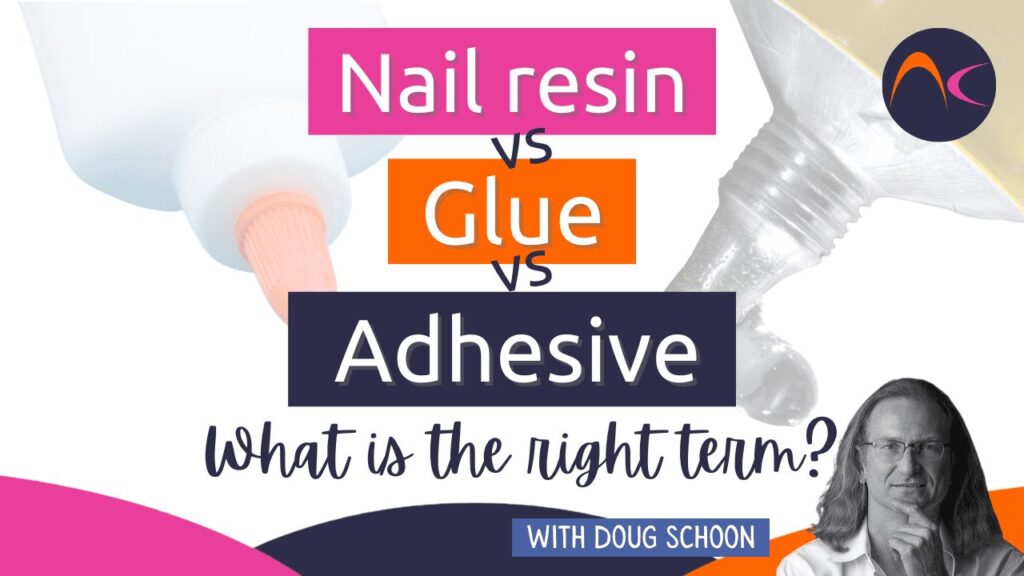
Is it “nail resin”, “glue”, or is it maybe “adhesive”? This question illustrates a big problem in the beauty industry in general and demonstrates how confusing nail industry terminology can be. Why does this continue to happen? Largely because nail product marketers too often use incorrect terms to describe their products or services, which further reinforces the use of these terms. The trade magazines sometimes do this as well. Don’t get me wrong, I’m not blaming nail marketers and the magazines, they are just responding to the words nail professionals use every day. That’s their job!
It seems to me that much of the incorrect terminology comes from nail schools, educators, and veteran nail technicians who don’t keep up with the latest educational information. That’s why I focus on providing this type of information to educators. They are our best hope for improving this situation and the industry. In practical terms, resin and glue are the same, and it is a misunderstanding to think they are different.
How did this misunderstanding occur? To understand, we have to travel back to ancient times. The word glue actually refers to animal-based adhesives. Glues were originally made from proteins extracted from animal hides, horns, and hooves. In the ’30s, that new-fangled Elmer’s Glue was developed. It was a breakthrough. This adhesive used a protein found in milk called casein. Protein-based glues have been used since ancient times to adhere things together and for thousands of years, all was well. The confusion began in the late ’40s when Elmer glue changed formulas from milk protein to a synthetic polymer called polyvinyl acetate or PVA.
This polymer belongs to a unique class of polymers that are called “resins”. Originally the term “resin” was used to describe the thick, sticky sap that oozes from certain trees, bushes, and plants. The natural resins were also used by the ancients both as glues and as protective, water-proof coatings for wood, leather, and cloth. They were even used by early artists to adhere pigments to walls to make cave paintings. Interestingly, when Elmer’s changed their formula, the term “resin” came to be used to describe synthetic substances that could mimic the thick and sticky properties of natural resins.

How does this apply to nails? Nail adhesives, wraps, resins, and no-light gels are all based on a synthetic monomer called cyanoacrylate which is not very thick or sticky. Since this monomer will eventually harden to form a sticky polymer, they are called resins; even though this is not technically correct, since they aren’t resins, they are monomers. What’s the bottom line? These products are no more glues than they are resins.
Então, em vez de usar definições imprecisas e incorretas que confundem, por que não usar um termo mais profissional? Em vez de “nail resin” or “glue”, it is better to use the word “adhesive” when you are referring to “adhering things together”, and the term “cyanoacrylate monomer” when these are used as a nail coating. Consider this as well: which of these would clients have greater respect for or be more impressed by? I think the answer is obvious.
The main value of using professional terminology is that it would end a lot of confusion and elevate the nail salon industry in the public’s eye. Getting the industry on this course has to start with nail educators. They must learn and then teach the correct terminology, as well as the importance of using the correct terms. Until this is done, this situation isn’t going to change any time soon. If you’re a nail educator, please do your part to ensure that the correct terminology is taught and used. Explain the benefits of this to your students and demonstrate a high standard. That’s what it will take to unify this industry under a common and agreed-upon set of terms.