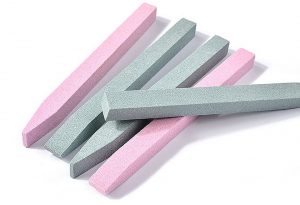
Pumice stones, or so-called Hindu stones, have been sold to nail professionals under various names for many years and are nothing new. These are made of pumice, which is finely ground lava rock. These manicure stones are very similar to the stones used in some nail salons to remove calluses. Lava stones are used mainly because they are highly aggressive and remove calluses quickly. The main difference between the different types of lava stones is the size and depth of the holes in their surfaces.
For use on feet – the holes are very large and deep, and for manicuring – they are very small and shallow. Pumice stones have been prohibited in many places mainly because they can be very difficult to clean, especially the stones used for pedicures. The large holes quickly and easily trap dead tissue. The holes make these stones very difficult to properly clean since skin is hard to remove from the deep crevices. If they can’t be properly cleaned, then they can’t be properly disinfected. I personally don’t recommend these be used on feet. These stones are too aggressive and often used to completely remove calluses. As explained in other questions, calluses should only be smoothed and should never be completely removed. Complete removal of a callus makes the foot more susceptible to injury, blisters, and infection. Calluses are designed to protect the feet.
Pumice stones used for manicuring have very small surface holes that are not deep, so these are much less likely to trap debris and therefore are much easier to clean. I have not tested them to determine if they can be properly disinfected, but I suspect that they can be disinfected if they are carefully cleaned. This means the removal of all visible signs of debris before completely immersing them in a disinfectant.
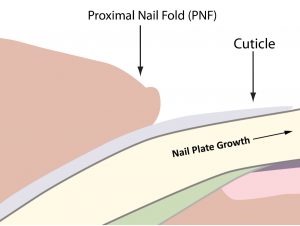
The biggest problem in my view is that for manicuring, these stones are very hard, highly abrasive, and not flexible. This causes them to be overly aggressive and damaging to the natural nail plate. To make matters worse, they are sometimes used to remove the very thin cuticle tissue adhering to the thinnest and softest part of the nail plate. What? Or I should ask why? Isn’t this like using a chain saw to mow the grass? You can do that, but why would you want to? This is extreme overkill and these pumice stones are not the best way to safely and carefully remove cuticle tissue.
If excessive downward pressure is used with these stones, the nail plate may be seriously damaged and overly thinned. Instead, I recommend using a disposable wooden pusher stick, which is much safer. Metal curettes are also very useful for this purpose, but metal pushers can be too sharp and may injure the living tissue. Regardless of the implement used, I recommend using a soft touch whenever working on the nail plate and especially near lưỡi liềm (moon) where the nail plate is softest and not yet fully hardened. Nail damage to this area occurs easily so take appropriate care.