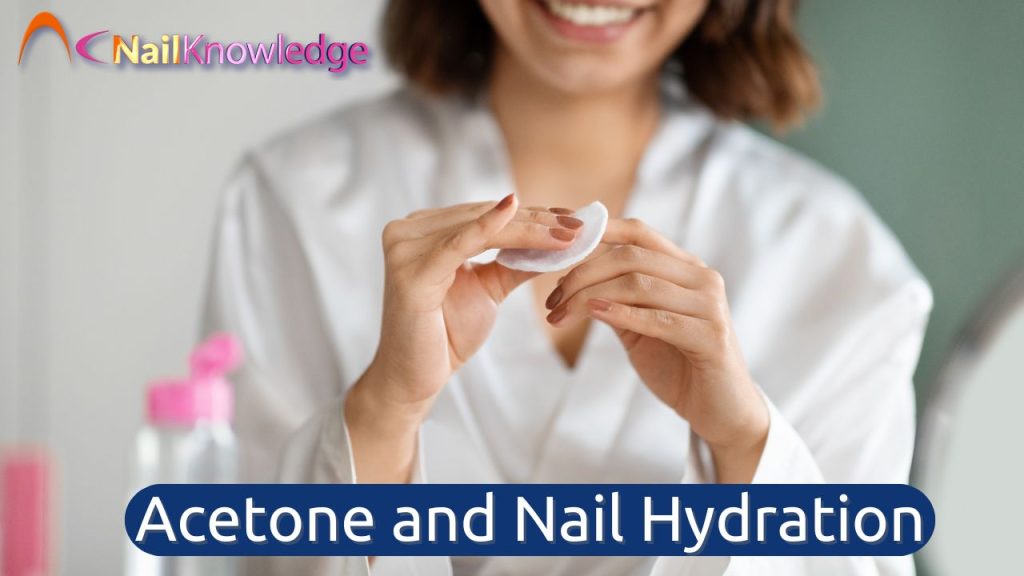
La acetona no daña la placa ungueal ni elimina su humedad estructural, y la comprensión de la acetona y la hidratación de las uñas es clave para saber por qué sus efectos son temporarios y cosméticos, no dañinos.
- Agua ligada: esta proviene del lecho ungueal y la matriz mientras la uña se está formando. Forma parte de la estructura de la uña y no se puede eliminar fácilmente con acetona.
- Agua libre: proviene del medio ambiente y se encuentra temporalmente dentro y sobre la superficie de la uña. Se puede ganar y perder fácilmente.
Comprender la acetona y la hidratación de las uñas es esencial porque la acetona solo afecta la humedad superficial y los lípidos, no el agua unida que le da a la uña su integridad estructural.
La acetona solo elimina los aceites superficiales y el agua libre. No elimina el agua ligada de las estructuras internas de la uña y, por lo tanto, no deshidrata la uña en un sentido estructural o biológico. Es por eso que la apariencia seca después del uso de acetona es temporal y reversible.
La placa ungueal recupera naturalmente su equilibrio normal de humedad al restablecer el equilibrio con el entorno circundante. Este es un proceso físico. Este equilibrio también se restablece desde el lecho ungueal, parte del agua simplemente asciende a la superficie de la uña.
En condiciones prácticas de salón, es extremadamente difícil deshidratar verdaderamente una uña con acetona. Esto requeriría horas de contacto continuo. Los tiempos normales de remojo o retirada son demasiado cortos para causar deshidratación estructural.
Lo que el acetona puede hacer:
- Hace que las uñas y la piel parezcan secas temporalmente
- Elimine los lípidos superficiales que contribuyen a la flexibilidad y la comodidad
- Piel circundante seca por exposición repetida
Lo que la acetona no hace:
- Eliminar el agua ligada de las estructuras profundas de la uña
- Causar deshidratación permanente
- Daño en la estructura de la uña
- Crear uñas quebradizas por sí mismo
Sobre la “sobreexposición”:
La sobreexposición no significa uso profesional normal.
Sobreexposición significa:
- Contacto repetido con acetona varias veces por semana
- Extremadamente frecuente retirada y reaplicación sin tiempo de recuperación
- No re-aceitado ni acondicionamiento de la piel
- Contacto prolongado con la piel sin protección
En estos casos, el riesgo es cosmético y superficial:
- Las uñas pueden parecer persistentemente secas
- La piel circundante puede irritarse
- Las uñas pueden sentirse menos flexibles porque los aceites superficiales son eliminados constantemente
- El clavo nunca tiene tiempo de volver a su equilibrio normal.
Aun así, esto no es un daño real en las uñas. Es un problema de condición de la superficie.

Orientación práctica:
El uso profesional normal, como la eliminación de gel cada 2 o 3 semanas, es seguro.
La remoción semanal no se considera exposición frecuente.
Si las uñas aparecen quebradizas, la causa es mucho más probable que sea:
- Lijado excesivo
- Traumatismo mecánico
- Raspado agresivo
- Mala técnica de extracción
- Falta de seguimiento
Acetona e hidratación de las uñas: la realidad científica
“La acetona elimina los aceites superficiales y el agua superficial temporal, no la humedad estructural de la uña. Su efecto secante es temporal y reversible. El verdadero daño en las uñas proviene de traumas mecánicos, no de la acetona. La sobreexposición significa un uso muy frecuente sin tiempo de recuperación o cuidado posterior, lo que afecta la apariencia y la comodidad, no la estructura de la uña.”