Cuando se trata de trabajar con geles, el curado UV es uno de los pasos más importantes para crear servicios de uñas seguros y duraderos. Pero, ¿cuánto sabes realmente sobre cómo funciona la luz UV dentro de tus productos?
La verdad es que la luz ultravioleta no viaja muy lejos. Eso significa que la forma en que aplicas y curas tus geles marca toda la diferencia entre uñas fuertes y hermosas y capas blandas y poco curadas que pueden causar problemas más adelante.

¿Qué es el curado con luz UV y por qué es importante para las técnicas de uñas?
Piensa en la luz UV como una herramienta que endurece tus geles. Pero como cualquier herramienta, tiene límites. La luz UV solo puede penetrar hasta cierto punto antes de ser bloqueada, absorbida o reflejada. Incluso tu uña natural tiene protección UV integrada, aproximadamente la misma que usar un protector solar SPF 40.
Es por eso que nunca se ve una quemadura solar en el lecho ungueal. La placa de la uña detiene la mayor parte de la luz. Y sucede lo mismo con los geles: cuanto más grueso o oscuro sea el producto, más difícil será que la luz ultravioleta llegue al fondo.
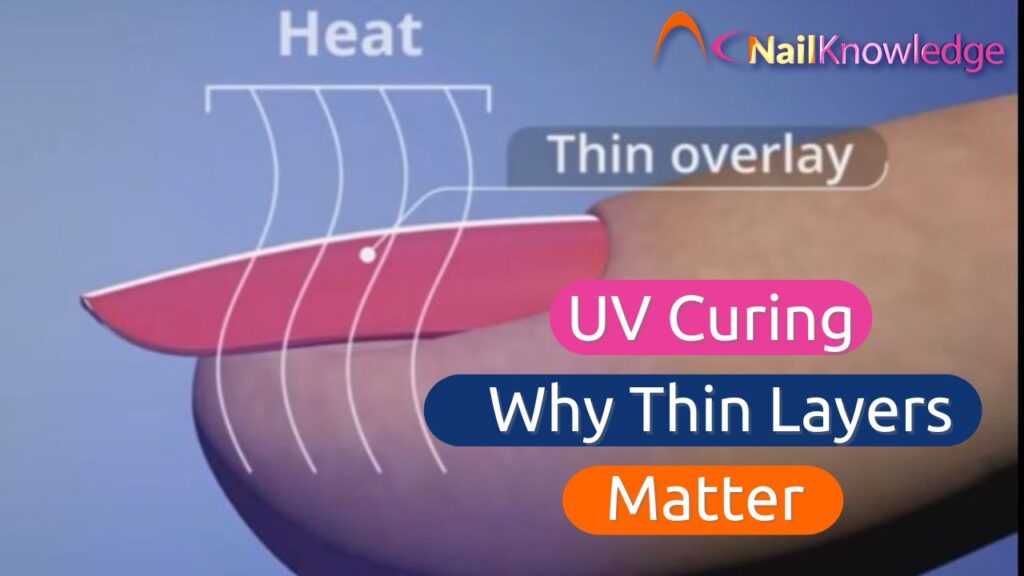
Comprensión de la profundidad de curado en productos en gel
Si aplicas una capa de gel demasiado gruesa, la parte superior puede verse brillante y curada, pero por debajo puede seguir blanda o pegajosa. Eso es una curación insuficiente y es un problema común.
Regla simple:
- Aplica capas finas y uniformes.
- Cura cada capa completamente antes de aplicar la siguiente.
- Evite grumos o aplicaciones demasiado gruesas.
Imagina tu capa de gel como dos hojas de papel apiladas, ese es aproximadamente el grosor adecuado para una buena curación UV.
El “Efecto Paraguas” en Tonos Oscuros y Brillantes
Los tonos claros o límpidos permiten que la luz ultravioleta pase fácilmente, por lo que son más sencillos de curar. Pero los geles oscuros como el negro, el rojo intenso o el marrón chocolate, y los geles llenos de purpurina se comportan de manera diferente.
Los científicos lo llaman el “efecto paraguas”. Los pigmentos y las piezas de purpurina actúan como pequeños paraguas, proyectando sombras que impiden que la luz ultravioleta llegue a las capas inferiores. Por esta razón, los geles oscuros o con purpurina son más difíciles de curar y están especialmente formulados por los fabricantes.
Mejores prácticas para técnicos de uñas:
- Aplica colores oscuros o con brillo en capas extrafinas.
- Cura cada capa durante un minuto completo.
Por qué la sobrecuración no funciona
Muchas técnicos de uñas piensan que dejar la mano en la lámpara por más tiempo “arreglará” el curado insuficiente. Lamentablemente, ese no es el caso:
- Los fotoiniciadores tienen límitesEstos son los ingredientes que reaccionan a la luz ultravioleta para curar el gel. Una vez que se han consumido todos, la reacción está completa. Más tiempo no hará ninguna diferencia.
- La luz bloqueada no se puede solucionarSi el gel es demasiado espeso o pigmentado, las capas inferiores nunca reciben suficiente cantidad de luz UV. Minutos extra no ayudarán porque la luz simplemente no llega a ellas.
- Picos de calor explicadosSe producen picos de calor durante la etapa temprana del curado cuando una gran cantidad de gel se endurece rápidamente y libera calor. Esto es más pronunciado si la capa es demasiado gruesa o si la lámpara tiene una intensidad UV muy alta. Una vez que la reacción se completa, el curado adicional no creará más calor, pero tampoco mejorará el curado.
👉 Por eso, capas finas y uniformes con la lámpara correcta son mucho más efectivas que intentar curar por más tiempo.
Riesgos de seguridad del curado inadecuado
Cuando el gel no está completamente curado, no es solo un problema del servicio. El producto sin curar puede permanecer blando en el interior de la capa e incluso filtrarse en las paredes laterales, el área de la cutícula o alrededor de los sellos de la uña. Una vez que entra en contacto con la piel viva, la exposición repetida puede desencadenar reacciones alérgicas que pueden durar toda la vida.
Es por eso que el curado UV adecuado es esencial tanto para la seguridad como para el rendimiento:
- Usa la lámpara recomendada por la marca del gel.
- Aplica capas finas y uniformes para que la luz penetre completamente.
- Mantenga el producto alejado de la piel en todo momento.
- Asegúrate de que cada capa esté completamente curada antes de añadir la siguiente.
Mejores prácticas para un curado UV exitoso siempre.
La curación UV es más efectiva en capas finas y uniformes. Al aplicar el producto correctamente y curar con la lámpara adecuada, lograrás uñas hermosas y duraderas, al mismo tiempo que mantendrás segura la piel de tus clientas.
✅ Qué hacer y qué no hacer en el curado UV para técnicos de uñas
✅ Visite
- Aplicar capas finas y uniformes para una mejor curación.
- Curar cada capa completamente antes de aplicar el siguiente.
- para lámpara recomendada por tu marca de gel.
- Mantener geles fuera de la piel para evitar alergias.
- Aplicar Geles oscuros y brillantes extra finos y curar durante al menos un minuto.
❌ No
- Aplicar masas o abrigos gruesos (no curarán correctamente).
- Asumir que curar por más de 2 minutos solucionará la subcuración.
- Mezcla y combina lámparas con diferentes marcas de gel.
- Ignora las capas pegajosas, blandas o gomosas; eso es señal de curado insuficiente.
- Dejar gel sin curar toca tu piel o la de tu cliente.