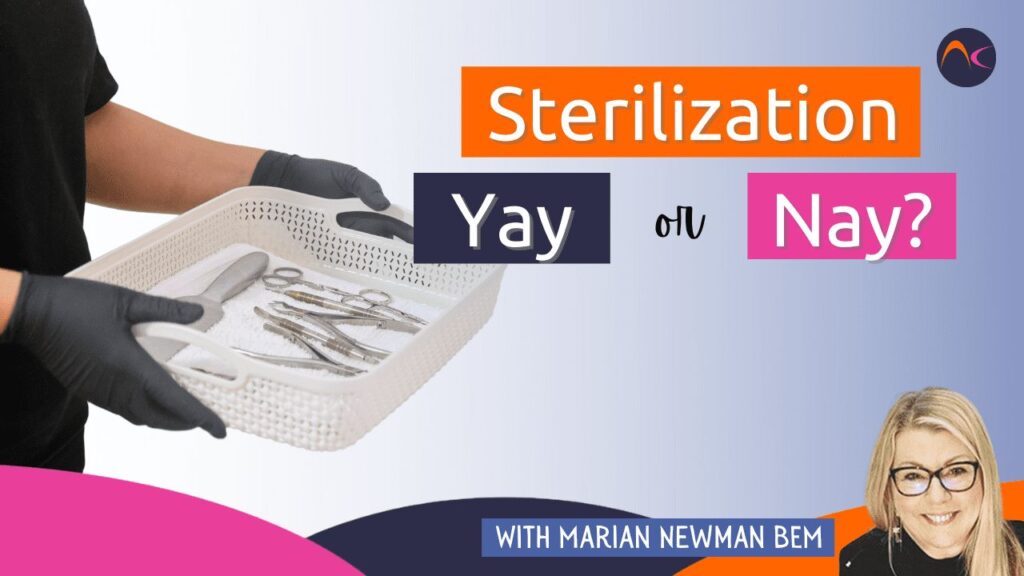
For the last two years, there have been endless discussions on Health & Safety measures and hygiene due to the pandemic. But, for decades, every country has had training courses that are clearly ‘not fit for purpose’. They do not teach their students about the decontamination levels that will guarantee to keep their clients (and themselves and employees) as safe as possible. We are talking about cleaning/sanitizing, disinfection, and sterilization.
Even with some lack of education, the pandemic should have brought some focus onto hygiene and understanding what is required for us, nail professionals. From some ‘digging’, it seems that there are several levels within the sector:
- aqueles que levam a higiene e a descontaminação muito a sério e entendem os níveis
- aqueles que têm um entendimento razoável e fazem o melhor que podem
- aqueles que gostam que seus clientes pensem que seus níveis de higiene são altos, mas possivelmente não entendem completamente
- aqueles que não se concentram na higiene real.
Qual deles é você?
The debate on whether nail services need an autoclave continues with plenty of arguments on both sides. In reality, an autoclave is essential for tools that may come into contact with any bodily fluids. This would suggest that nail services do not require this level of hygiene. But do they?
It is very easy to nick the skin with a file or cuticle nippers. It is also easy to cause a minor abrasion on the skin with a buffer, and it is definitely easy to cause an abrasion when using an e-file at the base of the nail and on the Proximal Nail Fold.
A cut on the skin is usually obvious as it will bleed. If it is a file that has caused the wound, we can discard it. If it is a metal tool, then it will likely have blood on it however minuscule. However, with a minor abrasion, the likelihood is that it will not be noticed immediately. But as soon as it happens it will become slightly wet. This is plasma from the blood that is clear and may have some white blood cells in it; it could be lymphatic fluid. Both are there to help protect the wound from infection. (Red blood cells and other blood bourn cells will arrive to heal the wound, and this is when the redness/inflammation can be seen some time after). As the PNF is living skin there can also be leakage of the contents of the skin cells.
Portanto, essa descrição mostra como as ferramentas podem entrar em contato com fluidos corporais sem que você perceba! Há um argumento a favor de uma autoclave, especialmente se você usar um arquivo eletrônico na pele.
Há também o argumento de que um profissional de unhas prefere tomar todas as precauções possíveis com relação à saúde e à segurança e quer que seus clientes saibam disso, para que se sintam seguros.
The autoclave is the highest level of decontamination but one level down from that is using a hospital-grade disinfection system. This is very specific and it should say in the brand specifications and marketing what level of pathogens it will destroy. It will have clear instructions on how to use it, and it will be strong enough to be harmful to the skin. For nail services with no autoclave, this level is non-negotiable. It must be part of any hygiene routine for metal tools. If the instructions are followed to the letter, it will be good enough for any minor contact with bodily fluids.
Um simples desinfetante não fará esse trabalho com eficácia.
Descendo um nível, temos um desinfetante para superfícies duras. Ele ainda não é adequado para contato com a pele, mas pode ser usado para limpar mesas, pisos, interruptores de luz, maçanetas, etc. Esse produto não limpará adequadamente as ferramentas de metal.
The lowest level is ‘cleaning’ and this falls into two categories:
- O método preferível é um sabão líquido, água corrente (quente ou fria) e tempo suficiente em contato com o sabão e a água.
- Um limpador à base de álcool, geralmente na forma de gel. A forma de gel é a ideal, pois o álcool precisa ficar em contato com a superfície por um curto período de tempo, e o gel evapora mais lentamente do que um líquido fino.
Esse nível é essencial para a limpeza das mãos tanto do profissional de unhas quanto de todos os clientes. O primeiro método deve sempre vir em primeiro lugar e depois ser apoiado na mesa pelo segundo método. O segundo método nunca deve tomar o lugar da água e do sabão nos serviços de manicure.
O primeiro método, usando água e sabão, também é uma etapa ESSENCIAL antes que os dois níveis superiores (autoclave e desinfetante de grau hospitalar) possam ser executados com eficiência! Cada ferramenta deve ser lavada com água e sabão líquido usando uma escova para remover todos os resíduos e óleos que dificultarão o processo de descontaminação.
Your safety, your client’s safety, and the safety of others around you are paramount. Do not cut corners. It is far better and far more professional to go over and above where hygiene is concerned.
Leia mais em Higiene adequada do salão de beleza.