I often get my ‘blog inspiration’ from social media and the questions that are being asked.
How many posts do we see where someone asked “Why is this happening? It’s chipping, but it doesn’t happen to any of my other clients” Really?
Not every system or service suits all clients! It really is a case of understanding the condition of each client’s nails.
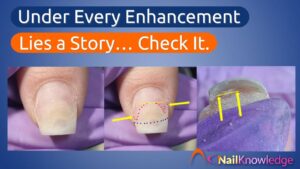
For example, a weak and bendy nail is unlikely to hold onto any basic UV gel polish. The client may have nails like that to start with BUT if the nail plate is buffed on every reapplication, then it will keep getting thinner and thinner! What could have worked at the start will now no longer work.
Modern UV gel products have superior adhesion and do not require buffing/etching! Why would you continue to compromise the quality of your clients’ nails?
Maybe the quality of your clients’ nails need some extra help with strength by using a ‘builder’ first. Again, modern builders do not need the nail to be buffed/etched!
I had a question just the other day: “I’ve been advised to buff the natural nail with a 100grit buffer and use an acid-based primer for my UV gel polish.” NO!! This is so wrong!
Thick and strong nail plates may also not be successful with a UV gel polish. This is because the UV coating is more flexible than the nail plate, so they are not working together when they flex, which they both do all the time.
There is no ‘one size fits all’! But so many good quality brands are providing a range of products to make sure ‘one size DOES fit all’! But every nail professional need to assess the condition and quality of every client’s nails. They are ALL different.
Como sempre, tudo se resume a educação e compreensão. O mesmo protocolo de aplicação não será adequado a todos os clientes.
Há várias maneiras de educar os clientes:
- Não prometa o que não tem controle
- Informe aos clientes que qualquer revestimento depende de como eles tratam suas unhas
- Talvez você precise de algumas consultas para entender o que é certo para eles
- If coatings don’t work how you expect, don’t naturally blame the client! It may be your fault by not assessing the nail condition correctly or not doing a thorough prep
- Explicar aos clientes o que pode acontecer e o que eles precisam fazer para apoiar seu serviço de unhas
- Se as clientes não usarem um bom óleo para unhas várias vezes ao dia, é improvável que qualquer serviço de unhas resista ao teste do tempo
- Do not be scared of your clients! You are the professional and educating them from the first appointment will mean you won’t be apologising and offering free re-applications
- Se você estiver realmente confiante em seus serviços, produtos e protocolos de preparação, explique o que pode ter acontecido
- Não aceite que os serviços possam passar de 3 semanas sem problemas (outra explicação que precisa ser entendida desde o início)
- A situation that doesn’t happen ‘to any other client’ just demonstrates that every client is different
Muitas das perguntas que vejo sendo feitas geralmente se resumem à falta de confiança por parte do profissional de unhas. Mais uma vez, educação e compreensão são fundamentais! Além disso, a qualidade dos produtos que estão sendo usados. Se você souber o que está fazendo, todas as situações, problemas e desafios poderão ser respondidos para a satisfação de cada cliente.