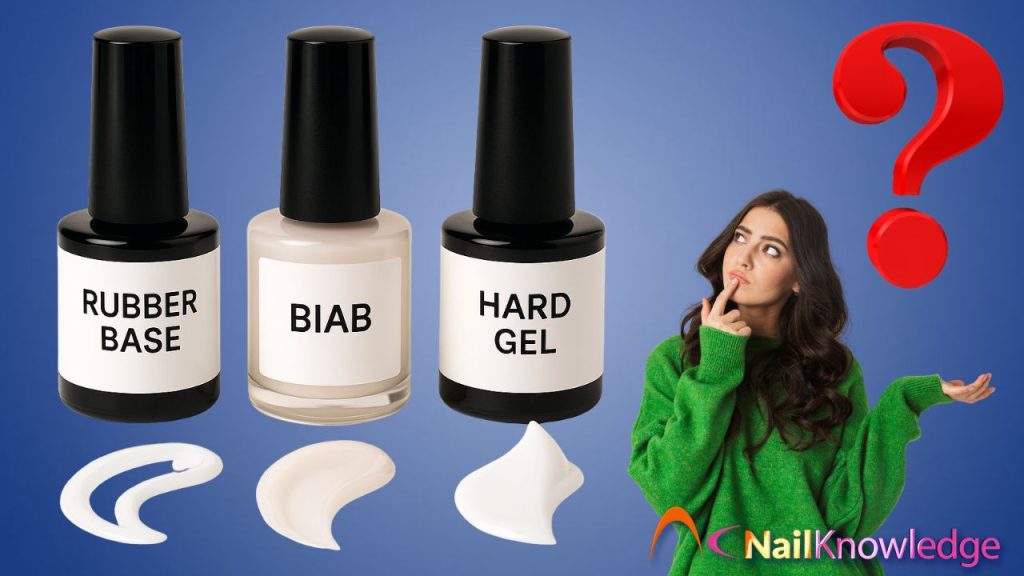
Entendendo a real diferença entre a base de borracha, o Builder in a Bottle e o Hard Gel
Por que isso é importante
Students and new professionals often get confused by marketing terms and social-media tutorials that treat every gel as the same. In reality, these products have different chemistry, flexibility, and curing behaviour, which directly affects how safely and effectively they can be used.
Rubber Base – Flexible Support for Natural Nails
Rubber Base is designed for natural nails that need a little strength but still want flexibility.
It contains softer oligomers and fewer cross-links, so it cures into a bendy, resilient coating.
Used correctly, it:
- Improves adhesion and reduces breakage on thin or weak nails
- Should only be applied in thin layers
- Must não be used for building structure or long overlays
If applied too thick, the surface may cure while the lower layers stay soft and under-cured — increasing the risk of lifting, cracking, or allergic reactions.
Builder in a Bottle (BIAB) – Semi-Hard Strength for Short Nails
Builder in a Bottle is chemically between a soft and hard gel.
It has more cross-linking than Rubber Base, giving extra strength and a semi-rigid feel while remaining soak-off.
Ideal uses include:
- Strengthening natural nails
- Creating very short extensions (1–2 mm)
- Leveling the surface for a smooth apex on short nails
Like Rubber Base, BIAB should be applied in thin to moderate layers to ensure full curing.
Think of it as a “reinforced rubber base” — stronger, but still flexible.

Hard Gel – The Strong, Fully Cross-Linked System
Hard Gel has the highest cross-link density, forming a rigid, durable structure after curing.
It cannot be soaked off and must be filed away.
This strength makes it perfect for:
- Structured overlays
- Building an apex
- Creating long extensions or sculpted shapes
It can be applied in slightly thicker layers than Rubber Base or BIAB, but still requires careful control to avoid under-curing (“the cheese-soufflé effect”).
Understanding Flexibility and Curing
| Product Type | Flexibility | Curing Depth | Suitable For | Not Suitable For |
|---|---|---|---|---|
| Rubber Base | Very flexible | Shallow | Adhesion, natural overlays | Building structure or apex |
| Builder in a Bottle | Semi-flexible | Moderate | Strengthening, 1–2 mm short extensions | Long extensions |
| Hard Gel | Rígido | Deep | Structured overlays, apex, long extensions | Soak-off systems |
Key Teaching Points
✅ Apply in thin, even layers for consistent polymerisation.
✅ Match the product to the client’s nail type and lifestyle (flexible vs rigid).
✅ Do not layer incompatible systems (e.g., hard gel over a rubber base).
✅ Emphasise that social media shows looks, not science.
✅ Proper curing and layer control are essential for strength and safety.
Takeaway
Rubber Base, BIAB, and Hard Gel each have a role — but they are not interchangeable.
The difference lies in the química: how tightly their molecules bond and how they cure under light.
Once you understand that, the application rules make perfect sense — and your results become more consistent, professional, and safe.