How is the consistency of a UV gel related to the flexibility of the cured UV gel?
Độ đặc của gel UV được xác định bởi độ đặc của các thành phần được sử dụng.
To explain better, I’ll need to discuss how these products cure.
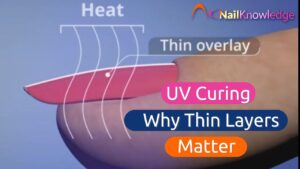
Only low-power UV energy sources are used to cure UV gels, which means nail lamps emit very low amounts of UV energy, so curing is not very efficient. This helps explain why it is not possible to properly cure the monomer liquids used to create two-part systems- they will not cure in a reasonable amount of time using a nail lamp. To overcome this problem, UV gels aren’t based on monomers, but instead they are made from pre-made short chains of monomers called “oligomers”.
Monome so với Oligome và tác động của chúng lên tính nhất quán
“Mono” is latin for “one” and “mer” means “units”, so monomers are individual “molecules”. “Oligo” means “few”, so an oligomer is a short chain of monomers, typically up to 3,000 monomers long.
Since monomers are small molecules, they move around more quickly and easily inside their container, which is why they are flowable liquids. Oligomers are longer and more bulky, so they get in each other’s way and can become temporarily tangled up. Their bulky size slows them down so they can’t move nearly as quickly or easily as monomers. The result is that the oligomers have a tendency to be thicker and stringier, which is why they have a gel-like consistency.
Depending on which oligomer is used, the UV gel can be a bit thicker or thinner. The thickness is also called “viscosity”. The viscosity of the product may increase or decrease by the addition of other additives. For instance, titanium dioxide is a white pigment made of solid particles. Adding a sufficient amount of this white pigment can significantly increase the viscosity of the uncured UV gel.
Vì vậy, có thể dễ dàng nhận thấy rằng độ dày của gel UV được quyết định bởi các thành phần.

Độ đàn hồi của gel UV: Các yếu tố vượt ra ngoài độ dày và tầm quan trọng của việc bảo dưỡng đúng cách
Độ mềm dẻo của gel UV đã đóng rắn KHÔNG được xác định bởi độ dày của gel UV chưa đóng rắn.
Tính linh hoạt phụ thuộc vào hai điều:
- The chemical structure of the oligomers and other ingredients used
- The percentage of cure. Unfortunately, under curing a UV gel will make it seem more flexible.
This causes some nail technicians to be fooled into thinking their UV gels are properly cured, when they are not. It is important to note that under curing makes UV gel nail coatings appear to be more flexible.
Under curing also causes nail filings and dust to contain larger amounts of unreacted ingredients, which increases the potential for adverse skin reactions such as irritations or allergies. And when these nails are soaked off, these ingredients are released into the solvent and can lead to allergic skin reactions.
Do đó, độ đặc của gel UV không liên quan đến độ mềm dẻo của lớp phủ móng. Rõ ràng là còn nhiều điều cần biết về gel UV và cách bảo dưỡng đúng cách.