The Role of HEMA in Elevating Nail Coating Adhesion
Most nail pros now understand the function of HEMA.
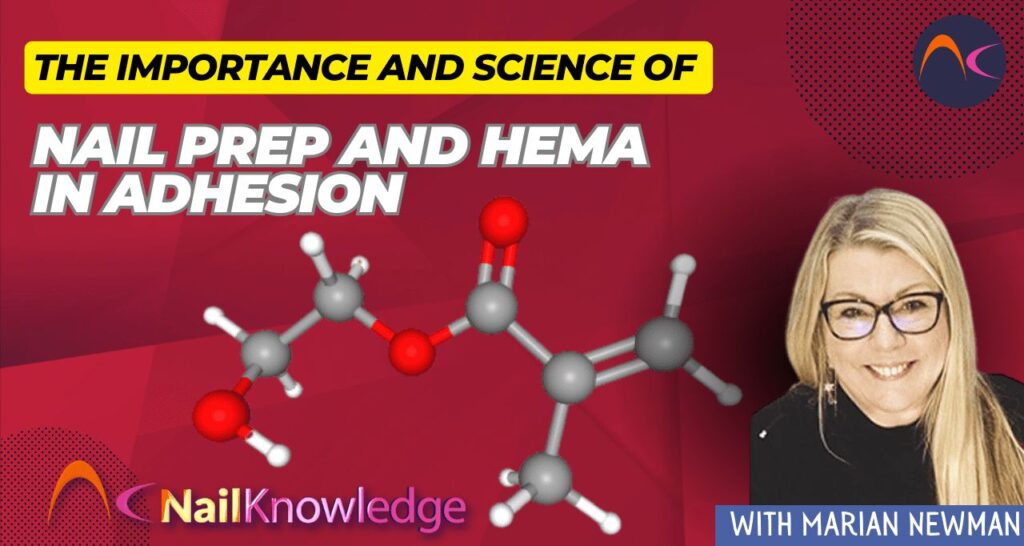
It is a monomer that enhances the adhesion of a coating on the nail plate. Higher percentages of HEMA allow for maximum adhesion with little nail prep. When HEMA is at a lower level then a better level of nail prep is needed.
Those who are rebranding from a high HEMA level to a lower level are often surprised that they have incidences of lifting. This is almost always due to the lack of accurate nail prep.
HEMA adheres very well to the keratin in the nail plate cells. Nail prep can be minimal for a high HEMA product. It will adhere well and stay put for several weeks.
However, higher percentages of HEMA can trigger allergic reactions, as a significant portion of the monomer might not undergo complete curing. This partial curing could result in the leaching of HEMA, potentially leading to various issues.
Enhancing Nail Prep During Transition to Lower HEMA Percentage
When rebranding to a lower HEMA % it is essential to give more attention to nail prep.
Tại sao lại như vậy?
The cells of the nail plate are non-living and are mostly keratin and a small amount of other cell contents. Non-living skin cells, that is the cuticle on the nail plate have less keratin content and more of the additional cell contents. It is more like the dry skin that we see on legs, for example. It will easily slough off, but the keratin of the nail plate cells is connected to other nail plate cells and is designed to stay put!

Comprehensive Nail Plate Preparation
Correct nail plate prep is a series of steps. These steps should take up around a third to a half of the whole service. It does take this long to carry out an accurate nail prep.
Firstly, the manufacturers instructions should be followed.
The process
- some suggest using a cuticle remover. This is usually a sodium hydroxide based product that softens the non-living skin cells of the cuticle
- others suggest a totally dry removal of the cuticle
- leaving any trace of cuticle on the nail plate will result in lifting as the coating will not adhere to it
- cuticle on the nail can be much further up the nail than many realise. It can be over ½ way up the nail
- using a good cuticle tool will allow you to feel the cuticle. It is softer than the nail plate
- every last trace must be removed by using gentle movements with a cuticle tool. If the cuticle ends up as a ‘frill’ at the base of the nail this is what must be cut off! NOT the living proximal nail fold
- there is also a lot of cuticle found along the sides of the nail plate
- after this many brands require the removal of the shine. This should only be the shine and a white block should be enough. Anything hasher will thin the nail plate and cause problems in the future
- once you are absolutely confident that every trace of cuticle has been removed, the cleansing of the nail plate should follow
- the nail plate always has a level of oils and moisture on its surface. This will create a barrier to the coating so should be carefully removed
- usually a combination of acetone (a solvent) and IPA (an alcohol) will make sure this is done efficiently
- care must be taken to include the side of the nail plate and right up to the proximal nail fold so every part of the nail plate is clean and oil-free
- those then the manufacturers that have a problem holding onto coatings, this should be done a nail at a time and then apply the coating. Natural oils will very soon be replaced
- then following manufacturers should be followed. Some recommend extra help with adhesion and the use of a primer to make sure the keratin is ready to accept the coating
- if all these steps are done efficiently, it will be almost ½ of the whole service and it is worth it as there will be little chance of a service breakdown
- many suggest that medications can affect adhesion. This is not necessarily true as the surface of the nail is what creates the adhesion and if this is good nothing will affect it
Many brands need this thorough and efficient nail prep and anything less will result in service breakdown.
Kết luận
If you are used to high HEMA content and change to lower HEMA content, you absolutely need to spend more time on your nail prep. Nothing less will do.
Be sure to watch our mini lesson on HEMA in the Nail Industry