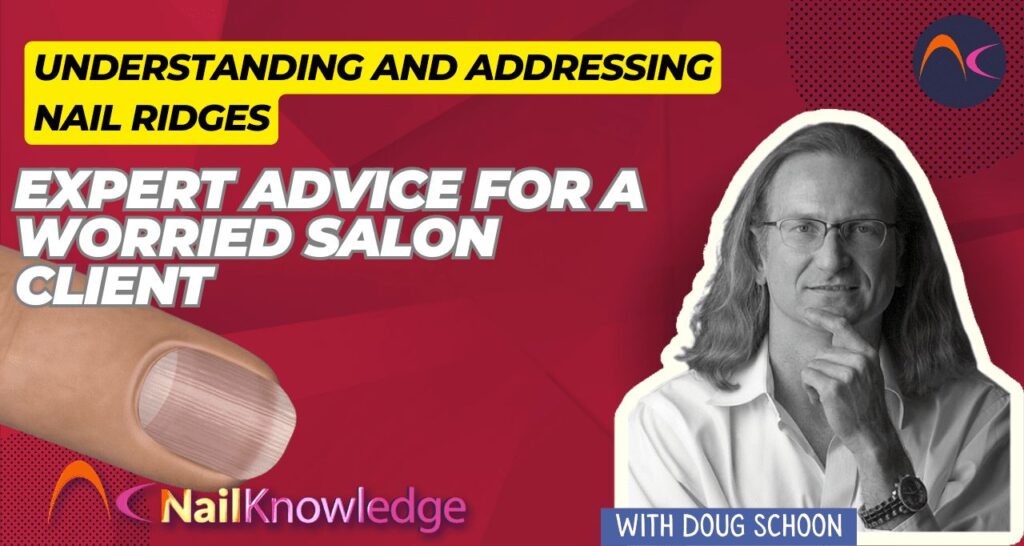
Addressing a Client’s Apprehensions about Buffing Nail Ridges
We have a difficult salon client that has ridges in her nail plates. She doesn’t allow me or any of the other nail techs to buff them because she says that the buffing will cause them to crack and bleed. I explained to her that light buffing will not make them bleed. What is a good way to explain to her that buffing is ok?
Navigating the Misconception of ‘Ridges
In nail anatomy, a ridge refers to a raised line on the nail plate, while a groove refers to a shallow depression. They often appear together, which is why both terms are sometimes used interchangeably in conversation. Scientifically, however, they describe different surface features.
I agree with your client. It is common for nail technicians to buff the nail plate smooth to remove so-called “ridges”, but surprisingly, there are no ridges on the nail plate to be removed. The nail plate can’t suddenly start growing ridges. That’s not possible due to the way the nail matrix produces nail cells. Instead, the nail plate develops shallow grooves where the ageing or damaged nail matrix isn’t working as efficiently and is now making fewer new nail cells in certain areas.
Bảo quản độ dày của móng
It is normal to see shallow grooves on nail plates of people older than thirty and is considered a normal sign of healthy ageing.
While nail surface changes can occasionally be linked to health conditions, the vast majority of ridging and grooving seen in salon clients is related to natural ageing, genetics, or mechanical influences such as filing, product wear, and product removal. They are not automatically signs of illness or deficiency.
I don’t recommend filing to remove these high points. Why? That just reduces the thickness of the entire nail plate and the nail plate can be sustainably weakened. Buffing away these so-called “ridges” will just thin the nail plate down to be as thick as the bottom of the deepest groove on the plate. The file just strips away the top layer. Yikes! That’s a lot of nail plate being removed. It is far better to keep the client’s nail plates thick! Nail coatings, including nail polish, don’t adhere well to overly thin nail plates.

Duy trì độ bám dính của lớp phủ móng tay
The reduction in plate thickness often leads to poor adhesion of any applied nail coating. Excessive plate thinning can also cause the nail’s surface to peel excessively and/or crack at the free edge. When the nail plate develops these grooves, rather than filing the surface smooth, it is far better to use an opaque base coat to fill and cover the grooves. This will maintain the thickness and integrity of the nail plate.
Nghệ thuật ngụy trang: Tăng cường và che giấu rãnh móng tay
Overlaying the nail plate with a thin layer of any type of artificial nail coating can also camouflage the groove and reinforce/strengthen the nail plate, while improving its appearance without over thinning. In the long run, this is a far superior method for improving the appearance of the client’s nail plates. There is no need to make the nail plate thinner, when it’s relatively easy and better to cover and hide normal grooves that run the length of the plate.
Áp dụng các giải pháp thay thế lành mạnh hơn để có vẻ ngoài hoàn hảo
Tóm lại, điều quan trọng là phải giải quyết những lo ngại của khách hàng tiệm về việc đánh bóng gờ móng tay. Mặc dù việc làm phẳng phiến móng là một cách làm phổ biến để cố gắng loại bỏ các đường gờ này, nhưng điều quan trọng là phải hiểu rằng bản thân các đường gờ không tồn tại trên phiến móng. Thay vào đó, các rãnh nông có thể phát triển do ma trận móng bị lão hóa hoặc hư hỏng, ảnh hưởng đến việc sản xuất các tế bào móng mới ở một số vùng nhất định.
Filing or excessively buffing the nail plate to remove these grooves can lead to undesirable consequences. It not only reduces the overall thickness of the nail plate but also weakens its integrity, making it prone to cracking and peeling. Furthermore, overly thin nail plates do not provide a suitable surface for nail coatings, such as polish, to adhere to effectively.
Thay vì dùng dũa, một cách tiếp cận được khuyến nghị là sử dụng lớp sơn lót mờ để lấp đầy và che các rãnh. Phương pháp này giúp duy trì độ dày và độ bền của móng đồng thời cải thiện vẻ ngoài của móng. Ngoài ra, phủ một lớp mỏng bất kỳ loại sơn móng tay nhân tạo nào lên móng có thể ngụy trang các rãnh và gia cố móng mà không làm móng quá mỏng.
By understanding these alternatives, it becomes clear that there is no need to make the nail plate thinner. It is far more beneficial to employ techniques that cover and conceal the normal grooves that naturally occur along the length of the plate. Ultimately, embracing these approaches will not only enhance the appearance of the client’s nail plates but also promote their long-term health and integrity.