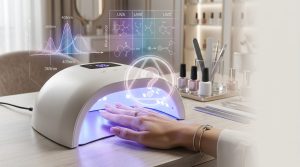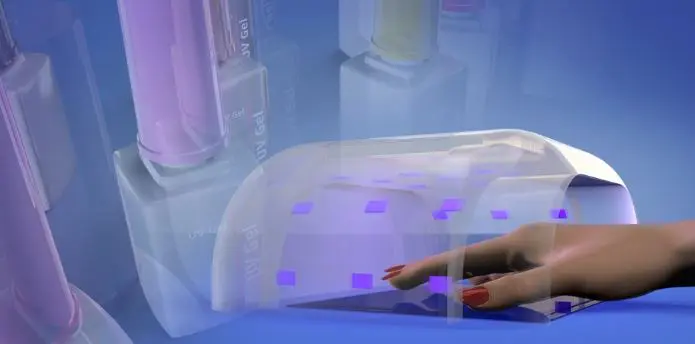
Toda la evidencia científica y la educación correcta señalan la importancia de usar sistemas compatibles. Cualquier gama de productos de gel UV, ya sea un esmalte en gel, un gel UV duro o blando, o un híbrido, tiene su propia formulación. Esto significa que los fotoiniciadores en la formulación son muy específicos y necesitan la lámpara UV correcta con respecto a la longitud de onda, intensidad y tiempo. Sin todo esto, NO hay garantía de que el recubrimiento logre un curado adecuado y esto puede llevar a un curado insuficiente (y la posibilidad de desarrollar alergias) o a un curado excesivo (quemadura del lecho ungueal y problemas asociados).
¡Las marcas que no tienen su propia lámpara UV o no pueden recomendar una versión genérica que hayan probado científicamente para obtener un ‘curado adecuado’ deben evitarse. También las marcas que recomiendan una lámpara UV basándose en la potencia. Claramente no comprenden lo que venden.
Tantos profesionales de uñas llegan a un punto en el que quieren cambiar de marca por muchas razones diferentes. Atrás quedaron los días en que se necesitaba un ‘curso de conversión’ para comprar, por lo que cualquiera puede, prácticamente, comprar cualquier cosa. Entonces, la pregunta sigue surgiendo sobre cómo probar una nueva marca sin tener que comprar la lámpara específica.


¿Cuál es la solución?
Cambiar de marca por un motivo concreto es una cosa. Añadir otra marca a varias ya utilizadas es otra.
Cada situación se reduce a ‘elecciones juiciosas’!
Está claro que ‘una talla no sirve para todos’. Quizás un arte de uñas un poco más creativo sea lo adecuado para la clientela de un profesional de uñas individual. PERO 2 marcas diferentes, quizás incluso 3, si se eligen sabiamente desde el principio, deberían ‘servir para todos’. Si se necesita más que esto, ¿quizás las elecciones no fueron las correctas al principio?
Tantas marcas excelentes y de alta calidad tienen una amplia gama de alternativas para adaptarse a la mayoría de las eventualidades. Incluso una insistencia en tener una gama masiva de 100 colores para elegir ’te encanta‘ (pero aquí, tengo que preguntar, ¿es esta la elección del profesional de uñas o de sus clientes? ¿Cuántos ’productos que no se venden‘ hay? Si entiendes el ’color‘, casi cualquier cosa se puede lograr con una colección relativamente pequeña que no lleva más tiempo de lograr que decidir a un cliente y ciertamente ahorra el desembolso que nunca se recuperará).
Esto es algo que hay que tener en cuenta cuando se desean varias marcas. Elija las marcas adecuadas para empezar. ¿Quién tiene presupuesto para seguir comprando más y más? ¿Recuperará los costes? ¿Realiza un cálculo de pérdidas y ganancias para asegurarse de que no está pagando más de lo que sus ingresos pueden soportar?
Pasando probablemente al problema mayor: ¿cómo se prueba una marca nueva? Es casi imposible realizar una prueba adecuada sin utilizar la lámpara UV correcta y adecuada. Quiere probar 3-4 marcas, pero no puede comprar una lámpara UV para cada una. ¿Qué hay que hacer?
Las ferias comerciales son un excelente lugar para tener ‘uñas de prueba’ donde un buen demostrador explicará todos los beneficios. Puedes probar un revestimiento. Pero eso es solo una uña en una persona (tú) y aplicada por un experto. Un muy buen comienzo. ¡Pero necesitas descubrirlo por ti mismo y en más uñas que solo las tuyas!
Cómo hacerlo sin la lámpara UV correcta. ¡¡¡El uso de cualquier lámpara no será un buen juicio!!!
1. Decide qué características estás buscando. Por ejemplo: gama de colores, geles UV duros y/o blandos, altos niveles de pigmentación, adherencia/durabilidad, facilidad de eliminación y muchas otras.
2. Investiga la marca que estás considerando. ¿Tienen su propia lámpara UV (o una que puedan recomendar que hayan probado)? ¿Tienen material educativo disponible (sabrán lo que venden)? ¿Qué reseñas y comentarios hay sobre ellos en redes sociales? ¿Tienen buen servicio al cliente? ¿Mantienen buenos niveles de stock o a menudo están agotados? ¿Proporcionan fichas de datos de seguridad (SDS) antes de comprar?
3. Si hay un comentario en SM que diga ‘fabuloso’, ¡pregunta por qué! Ese comentario no es suficiente.
4. ¿Pruebas? ¿Cómo? Primero, compra la base y el top correspondientes. Si es UV GP, compra algunos colores: nude, oscuro, con brillo/purpurina. Prueba cómo pinta cada uno, es decir, 1, 2 o 3 capas para obtener el efecto deseado (recuerda que las capas finas curan mejor). Si es un gel UV duro o blando: ¿cómo lo manipulas? ¿Se queda en su sitio o se ‘escapa"? Pruébalos todos en varias personas diferentes. ¡Uno no es suficiente! Todas las uñas son diferentes.
5. ¿No hay lámpara adecuada? (por supuesto que no). Siempre y cuando no haya un pico de calor, entonces doble curado. No se puede curar en exceso con el tiempo y duplicar el tiempo asegurará un curado completo. Si hay un pico de calor (curado en exceso), coloque las uñas en el ‘brillo’ de los rayos UV primero para ralentizarlo. Luego, vaya dentro de la lámpara para un curado completo.
6. Toma tu decisión sobre si te gusta la aplicación. Si confías en la adherencia y la longevidad (recordando que UV GP NO está diseñado para durar más de 3 semanas, ya que pueden ocurrir cambios en la placa y el lecho ungueales dentro de este tiempo)
7. Si tú, como profesional de uñas, has tenido una reacción alérgica, necesitas descubrir a qué eres alérgico exactamente y esto solo se puede hacer con una prueba de alergia y ¡NO adivinando! Si eliges una marca a la que reaccionas, ¡necesitarás tomar precauciones extremas para evitar el contacto! Si un cliente tuyo ha tenido una reacción, ¡debe evitar el ingrediente de por vida!
¡Escuchar comentarios como “He usado la lámpara xxx durante x años y no he tenido problemas”; “He mezclado x con x y no he tenido problemas” NO es la respuesta! Si esto es cierto, tuvieron suerte. Por otro lado, no seguir las ‘instrucciones del fabricante’ anulará tu seguro (¡pero ese es un tema completamente diferente!).
Seguir estos consejos le permitirá elegir bien, cambiar de marca si es necesario y evitar problemas tanto a usted como a sus clientes.