I was discussing with a nail professional recently, and she mentioned that the UV gel polish she uses “pulls back” when cured.
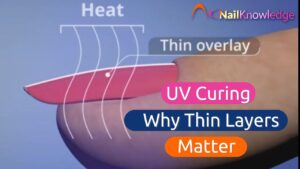
What some nail pros are calling “pull back” may be the effects of UV gel polish shrinkage. All nail coatings shrink when they cure, some more than others. In general, the more thoroughly a nail coating cures, the more it will shrink. Here’s why shrinkage is related to curing: the molecules in the coating are linking together and therefore becoming much closer to each other, which leads to shrinkage. That’s what happens when millions of molecules that make up a nail coating suddenly come closer together. So a small amount of shrinkage is completely normal and unavoidable. Whenever any type of nail coating shrinks, its edges pull back and will recede toward the center. The more it shrinks, the more it will pull back.
UV gel polish shrinks as it cures, but so can any type of UV-cured nail coating. Shrinkage is also determined by “how” these UV coats are cured. Overcuring can cause more shrinkage which may be seen as increased pull back from the edges. As I said, shrinkage of nail coatings always occurs to some degree for all types of nail coatings, that’s normal, however excessive shrinkage can cause service breakdown.
Overcuring of UV nail coatings and excessive shrinkage can be caused by using an incorrect nail lamp. Undercuring often leads to much less shrinkage and therefore less pull back. However, undercured nail coatings can pick up stains more easily, are less durable, and their filings are more likely to cause adverse skin reactions. Undercuring should be avoided. UV gel colors created a special challenge because certain shades or colors can block UV penetration.
To achieve various shades or colors, certain colorants and pigments must be used, and these may be prone to absorbing or blocking UV energy. Also, these colorants or pigments may be needed in higher concentrations to ensure full coverage or opacity. The increased concentration of these can affect the ease of application, making it more difficult to apply these particular shades or colors. In other words, some shades or colors must be formulated differently from others, in order to account for these effects. Various special additives may then be needed to make application easier. Also, more photoinitiators (PI) may be required to ensure a proper cure. Different shades of UV gel polish often have different formulations and this can affect the ease of application, and may increase “shrinkage”.

In general, UV-cured nail coatings tend to shrink more than any other type of nail coating. Cyanoacrylate monomer-based coatings such as fiberglass wraps, the so-called “no-light” gels, or nail tip adhesives tend to shrink the least. Mostly, this is because cyanoacrylate monomers do not form “cross-linked” structures when they cure, as do UV systems and the “two-part” systems often referred to as “liquid and powder”. Cross-linking improves strength and durability, but excessive cross-linking increases shrinkage and reduces overall durability. Liquid and powder systems are right in the middle, shrinking less than UV systems, but more than cyanoacrylate-based products.
The amount of “pull back” from the edges can be made worse when the nail plate is not properly prepared in order to remove surface oils. Surface oils can block adhesion to the surface of the nail plate and can contribute to pulling back as well. If the nail coating doesn’t adhere well to the surface of the nail plate, it can pull back more easily when the coating shrinks. The opposite is true, as well. Coatings that adhere very well may not pull back as much, even though they have a considerable amount of shrinkage.
Shrinkage happens “during” the curing process, not “before” curing and that’s important to understand. Some mistakenly believe the amount of pullback is related to working too quickly or too slowly. Pull back isn’t affected by how fast or slow you work, so it doesn’t help to “allow time” for shrinkage to occur before you cure. That’s not going to help.
The amount of shrinkage is directly related to the type of ingredients in the formula and their concentrations, as well as the wavelength and intensity of UV exposure. It’s easier to formulate a UV curing product that shrinks excessively and a whole lot harder to formulate one that doesn’t shrink excessively. You can’t control how the product is formulated, but you can ensure that you are properly curing and cleaning the nail plate.