• Pular para navegação primária
  • Pular para o conteúdo principal
  • Pular Rodapé
NailKnowledge

NailKnowledge

  • Cursos
  • MyNailEra
  • Livros eletrônicos gratuitos
  • Base de conhecimento
    • Base de conhecimento
    • Pergunte aos especialistas
    • Glossário
  • Notícias
  • Blog
  • Login

Informações gerais

O que observar ao refazer ou reequilibrar os aprimoramentos de unhas artificiais

There’s something incredibly satisfying about removing old gel polish or giving artificial nails a good rebalance. It’s like hitting the refresh button on your client’s hands. But here’s a question we should all ask ourselves: Are we really checking everything we need to when redoing or rebalancing artificial nail enhancements? Because if not, we might be missing warning signs that can turn into serious nail health problems.

When you’ve soaked off that old product or filed back for a rebalance, it’s more than just prepping for a new design. It’s also your window of opportunity, your only real chance to check the client’s natural nails for any signs of trouble. And yes, there’s a lot more to see than just a bit of lifting or growth.

Inspecting the Nail Plate When Redoing Artificial Nail Enhancements

We tend to focus on the surface, rightly so. After all, that’s where we apply product, create shape, and show off our work. But when redoing artificial nail enhancements, we must look closely at the natural nail underneath.

Yellowing on the nail plate? That could be a red flag for onycholysis or inner nail plate damage.
Greenish discolouration? Classic sign of the beginning of a bacterial infection, Pseudomonas aeruginosa is the usual suspect here.
Chalky white patches? That’s potentially white superficial onychomycosis, a type of fungal infection that can easily be mistaken for nothing more than product damage.

Each of these conditions has one thing in common. They are contraindicações. That means you should não continue the service without further assessment or referral. But here’s the kicker: they all need to be treated differently, so identifying the right issue matters.

Why You Must Check Under the Free Edge During Nail Rebalancing

Here’s where things get even trickier. While most techs are trained to inspect the surface of the nail plate, far fewer routinely check underneath the free edge.

Now, I get it. It’s easy to skip. Clients are often in a hurry, we’re watching the clock, and if you’re working with a dark gel colour or builder gel, any issues underneath are effectively masked. But skipping this check is like only cleaning your kitchen counters and ignoring the mould in your fridge. Just because you can’t see it doesn’t mean it’s not there.

Let me show you why this matters.

Onycholysis and What It Means for Redoing Artificial Nail Enhancements

A colleague of mine once discovered significant onicólise when removing her own artificial nails. Now, she knew her stuff, she just hadn’t realised the lateral nail walls were part of what we call the “guardian seals” of the nail unit. Once removed, it revealed widespread nail plate detachment.

What’s shocking is that the onycholysis had eaten up two-thirds of her nail, something you’d never spot from above. The yellow arrows she marked on the photo showed the detachment spreading right into the lateral nail fold. The nail looked completely normal from the top but was hiding a whole world of trouble beneath.

And guess what? That “world of trouble” becomes a five-star resort for bacteria if left untreated.

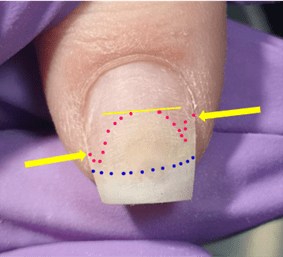
I want to show you something: Onycholysis

This is what one of my colleagues saw when she removed her artificial nail product – I forgive her for the missing lateral side walls at the time she didn’t realize they were one of the 4 guardian seals of the nail unit.

  • A linha amarela mostra onde a placa ungueal está presa ao leito ungueal, como deveria estar.
  • As setas amarelas mostram onde termina a onicólise e também a quantidade de placa ungueal descolada na dobra ungueal lateral.
  • A cor rosa pontua a extremidade proximal da onicólise.
  • Os pontos azuis onde o faixa onicodérmica e o hiponíquio deve ser.
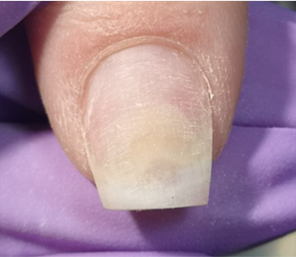
Onicólise
Onicólise – A detailed Look

Have a look at this picture of the nail unit from under the free edge. The yellow arrows and line show the detachment of the hyponychium and onychodermal band.
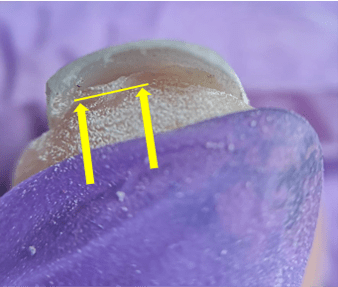
Onycholysis behind the free edge.

Now imagine if this colleague, was just doing an infill maybe from a dark blue or black hard gel or builder gel polish, no way she would see just how bad the onycholysis is a menos que ela olhasse para trás da borda livre. A onicólise consome quase 2/3rd da unha! Isso é espaço suficiente para uma família de bactérias e outros agentes patogênicos maléficos tirarem férias por 6 meses!

Missing the Signs? Here’s What Can Happen…

Infections don’t wait for your next appointment. If an area of onycholysis is left unchecked, it can create the perfect moist, dark, and protected environment for bacteria like Pseudomonas aeruginosa to move in and wreak havoc.
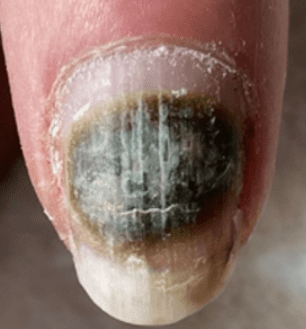
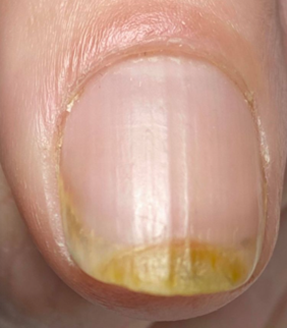
Infecção bacteriana por Pseudomonas aeruginosa
Pseudomonas Aeruginosa bacterial infection – almost resolved

One salon client here in the Netherlands dealt with such an infection for six months, despite following protocols and seeking proper treatment. That’s how long it can take to correct something that may have started out as a tiny patch of lifting or a crack in the product. And no, removing the nail plate wasn’t an option. Those kinds of extreme measures are for medical professionals, not nail techs.

And it’s not just bacteria. Fungal infections like onicomicose superficial branca can also take hold if water gets trapped under damaged enhancements. These often show up as powdery white patches, sometimes brushed off as “just dryness” or over-buffing damage, when in fact, they require completely different care.
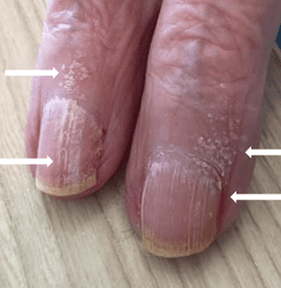
Onicomicose superficial branca

When to Pause During Rebalancing Artificial Nail Enhancements

We all want to give clients beautiful nails, but beauty can’t come at the cost of health. If you see signs of infection or nail trauma, stop. Explain your concerns professionally, show them what you see (photos help a ton here), and refer them to a GP or podiatrist if needed.

Sometimes, infections or reactions aren’t your fault. Maybe the client whacked their hand, cracked the product, and let water seep in. Maybe they’ve developed an allergy to an ingredient. That’s not on you. But missing it? Ignoring it? That’s where things go wrong.

Education Is Power – Keep Learning

We don’t live in a static industry. Nail technology, medical knowledge, and hygiene protocols evolve all the time. What you learned five years ago might already be outdated. That’s why ongoing education is not a luxury, it’s a necessity.

When redoing or rebalancing artificial nail enhancements, you’re not just applying a pretty surface. You’re making health checks. You’re being a professional. You’re being a guardian of your client’s natural nail health.

So next time you prep for a refill or remove that last layer of gel, take a breath. Look under the free edge. Take your time. Ask yourself: “Am I seeing everything I need to see?”

Because prevention isn’t just better than cure, it’s the difference between flawless nails and six months of painful, stubborn recovery.

Let’s keep eyes open, keep learning, and above all, keep those nail beds happy and healthy.
Arquivado em: Unhas DIY que deram errado, Informações gerais

Sintomas de psoríase nas unhas em clientes

Como identificar os sintomas de psoríase nas unhas em clientes com confiança e cuidado

As nail professionals, we often spend more time examining our clients’ nails than they do themselves. Whether you’re prepping for a manicure, applying gel, or giving a hand massage, you’re in a unique position to notice early warning signs of certain conditions, like nail psoriasis. It’s not uncommon for clients to be completely unaware of what’s happening under the polish. Spotting potential nail psoriasis symptoms in clients isn’t about diagnosing but about being observant and informed so you can offer the best advice and ensure their wellbeing.

So how do you recognise the signs of nail psoriasis without alarming your client, and when should you recommend they speak to a healthcare provider? Let’s explore the clues, what they mean, and how to navigate the conversation professionally.

Reconhecendo os sinais visuais da psoríase das unhas no salão de beleza

Nail psoriasis can be tricky to spot because it shares symptoms with other nail conditions. Most commonly, it appears in individuals who already have psoriasis on their skin, but it’s not limited to them. Interestingly, only about 5 percent of people with psoriasis experience symptoms limited to the nail plate. However, those with psoriatic arthritis, especially in fingers and toes, often show signs in their nails as well.

This condition isn’t contagious. It doesn’t come from bacteria, fungi, or any outside source. Instead, it’s rooted in the immune system and often runs in families. That means it’s not a hygiene issue, which is an important distinction to make when explaining it to a client.

You’re not expected to identify medical issues. But spotting changes in the nails helps you offer guidance and shows your professionalism.

Mudanças na cor e na textura da superfície a serem observadas

When scanning your client’s nails during a service, there are a few tell-tale signs that may point to nail psoriasis symptoms in clients. One of the most recognisable is the “salmon patch.” These look like tiny drops of oil or blood trapped under the nail plate and tend to appear pinkish or reddish in tone.

Other discolouration might include patches of green, yellow, or brown. These could be mistaken for fungal infections or bruising, but if seen in combination with other symptoms, they may be signs of psoriasis.

Surface texture is another clue. The nail plate might develop small pits or indentations, like pinpricks scattered across the surface. These pits can be random or neatly aligned, giving the nails an unusual, rough appearance even though they haven’t been filed.

In more advanced cases, the nail may become thicker, appear chalky underneath, or start crumbling at the free edge. This brittleness is a result of weakened nail structure, not neglect.

Separação das unhas, sangramento e sensibilidade

If you notice the nail lifting from the nail bed, beginning at the free edge and pulling back toward the cuticle, this condition is known as onycholysis. It’s a common issue for those with nail psoriasis and can open the door to secondary infections.

Você também pode ver hemorragias por estilhaçosAs manchas são pequenas linhas pretas que correm na direção do crescimento da unha. Elas são causadas por capilares rompidos no leito ungueal e geralmente são inofensivas, mas sua presença, juntamente com outros sinais, reforça a necessidade de encaminhar o cliente a um profissional médico.

Vermelhidão em a lúnula (the half-moon at the base of the nail) and inflammation around the nail folds (known as paronychia) can also be part of the picture. These symptoms may make the nails feel sore or tender, which the client might casually mention in conversation without realising it’s a sign of something more.

Comunicar suas preocupações sem alarmes

When you’re faced with several of these symptoms at once, it’s wise to gently suggest your client consult a dermatologist or podiatrist. The key here is tone. Avoid sounding alarmed or overly clinical. Instead, speak in calm, neutral language that keeps the focus on their health.

For example, you could say: “I’ve noticed a few changes in your nails that I think are worth showing to a dermatologist. It’s nothing to panic about, but it could be something like nail psoriasis, and they’ll be able to give you a clear answer.”

This approach respects the client, keeps their dignity intact, and shows that you’re looking out for their overall wellbeing, not just their manicure.

Práticas seguras para psoríase das unhas no ambiente do salão de beleza

Despite its appearance, nail psoriasis is not caused by an infection, and it cannot be passed from one person to another. That means it’s completely safe to carry out nail services, as long as the client is comfortable and the nail bed is not open or actively inflamed.

In fact, well-applied artificial nail coatings can help protect the nail from further trauma. UV gel manicures, acrylic overlays, and other professional coatings are not harmful to the condition. Just be sure the nail isn’t lifting or damaged to the point of exposing the nail bed, as that could invite irritation or infection.

Conselhos sobre cuidados diários com as unhas para clientes com sintomas de psoríase nas unhas

Although there is no cure, many clients benefit from practical, everyday care tips to manage nail psoriasis. Encourage them to keep nails short and the free edge smoothly filed. Suggest wearing gloves while doing housework or gardening, especially during colder months. A high-quality skin conditioner can help prevent cracking and dryness, which often aggravate symptoms.

Sapatos confortáveis e bem ajustados também são importantes, principalmente para aqueles que se exercitam regularmente. Para clientes abertos a tratamento médico, informe-os de que há terapias disponíveis, desde cremes tópicos até injeções e tratamentos leves. Isso pode oferecer um alívio significativo, mesmo que os resultados demorem a aparecer.

Quando encaminhar seu cliente

Consulte um podólogo se seu cliente tiver:

  • Dor, inchaço, sangramento ou sensibilidade ao redor da unha
  • Unhas com mau cheiro ou que parecem infectadas
  • Symptoms that aren’t improving after self-treatment
  • Alterações em várias unhas, especialmente se elas parecerem simétricas
  • Histórico pessoal ou familiar de psoríase ou problemas de pele
  • Any unusual or concerning changes you’re unsure about

Acha que seu cliente tem uma infecção fúngica nas unhas? Na verdade, pode ser psoríase ungueal. Saiba como identificar a diferença, evitar diagnósticos incorretos e proteger a higiene do salão.

Considerações finais sobre a identificação de sintomas de psoríase nas unhas em clientes

As a beauty professional, you’re not there to diagnose condições médicas, but your role can still be powerful. By being informed about nail psoriasis symptoms in clients, you’re better equipped to support them with empathy, professionalism and the right advice.

Clients trust you not just for beautiful nails, but for your expertise. When you notice changes in nail texture, colour, or structure, you have the opportunity to guide them toward the care they might need, without judgment or alarm. That’s a mark of true professionalism.

Fungal Infection or Nail Psoriasis? Here’s How to Tell the Difference

Você acha que seu cliente tem uma infecção fúngica nas unhas? Na verdade, pode ser psoríase ungueal. Saiba como identificar a diferença, evitar diagnósticos incorretos e proteger a higiene do salão.

Arquivado em: Informações gerais, Condições das unhas, Serviços para unhas

O tratamento de unhas com suco de limão vale a pena?

Um olhar mais atento à tendência do tratamento de unhas com suco de limão

Todos nós já ouvimos essa frase: quando a vida lhe der limões, use-os em suas unhas. Ok, talvez não seja bem essa frase, mas a ideia de um tratamento de unhas com suco de limão tem circulado por blogs de beleza e painéis do Pinterest há anos. É um daqueles remédios caseiros que prometem unhas mais brilhantes, mais fortes e mais saudáveis com ingredientes de sua cozinha. Parece perfeito, certo?

Mas não tão rápido. Embora o fascínio dos cuidados naturais com as unhas seja tentador, há um outro lado desse truque cítrico sobre o qual nem todo mundo fala. Portanto, antes de começar a mergulhar os dedos no suco de limão, vamos dar um mergulho mais profundo no que esse tratamento realmente faz e se realmente vale a pena espremê-lo.

Do que se trata o tratamento de unhas com suco de limão?

Apresentado como uma solução multifuncional para unhas manchadas, quebradiças ou propensas a fungos, o tratamento de unhas com suco de limão é exatamente o que parece: aplicar suco de limão fresco nas unhas e cutículas, seja diretamente, misturado com azeite de oliva ou como molho.

O apelo está na simplicidade. Vitamina C? Sim. Antisséptico natural? Sim. Um item básico da cozinha que tem um cheiro ótimo? Com certeza. E, de acordo com os adeptos do faça-você-mesmo, é assim que deve ser:

  • Remover manchas amarelas ou descoloração das unhas
  • Ilumina a aparência geral da lâmina ungueal
  • Fortaleça as unhas fracas com vitamina C
  • Combate pequenas infecções fúngicas graças ao ácido cítrico

É fácil ver por que as pessoas o experimentam. Além disso, em comparação com os caros séruns e tratamentos para unhas, ele é incrivelmente econômico.

Ele realmente funciona?

Mais ou menos isso. O suco de limão pode ajudar a remover manchas superficiais, como as de esmalte tradicional. ou fumo, graças ao seu leve efeito clareador. Pense nisso como um creme dental branqueador, mas para as unhas. Usado com moderação, especialmente quando misturado com azeite de oliva, ele pode até oferecer um pouco de hidratação e brilho.

Também há algo satisfatório em esfregar uma fatia de limão na ponta dos dedos. A sensação é de limpeza, saborosa e refrescante. E, com certeza, a vitamina C é um nutriente essencial que contribui para a produção de colágeno, que desempenha um papel importante na resistência das unhas.

Mas aqui está o ponto crucial. O fato de a vitamina C estar no suco de limão não significa que suas unhas a absorverão e começarão a crescer como flores silvestres. A quantidade real absorvida pela placa ungueal é provavelmente mínima, e o benefício é mais anedótico do que cientificamente comprovado.

Os perigos ocultos do tratamento de unhas com frutas cítricas

É aqui que as coisas ficam interessantes. Embora o tratamento de unhas com suco de limão possa parecer inofensivo, há um perigo surpreendente associado a ele, especialmente se você for um amante do sol.

Você já ouviu falar de fitofotodermatite? Parece um feitiço de Harry Potter, mas na verdade é uma reação cutânea muito real e desagradável. Veja como ela funciona. Sucos de frutas cítricas, como limão ou lima, podem permanecer na sua pele. Se você sair ao sol, certos compostos do suco reagem quimicamente com a luz UV, causando vermelhidão, estrias, erupções cutâneas ou até mesmo bolhas dolorosas.

Essas reações podem demorar um ou dois dias para aparecer, geralmente parecendo queimaduras solares, eczema ou até mesmo queimaduras de segundo grau. E veja só. Elas podem durar semanas. Não é exatamente o visual de beleza brilhante que você estava procurando.

Profissionais da área de unhas e dermatologistas alertam que mesmo pequenas quantidades de suco de limão aplicado na pele, especialmente ao redor das unhas e cutículas, podem ser absorvidas e desencadear esse efeito. Portanto, embora você esteja deixando as unhas de molho para ficar bonita, pode estar se preparando para uma experiência seriamente desconfortável se sair ao ar livre logo em seguida.

O remédio natural para unhas com limão realmente vale a pena?

Depende de seu objetivo e de sua exposição ao sol. Se você estiver em um ambiente fechado, tentar remover suavemente manchas nas unhas antes de uma nova camada de esmalte, Se você não tiver um cabelo muito duro, uma única aplicação de suco de limão pode ser suficiente. Especialmente se você enxaguar bem e hidratar em seguida.

Mas se você estiver procurando algo para fortalecer suas unhas ou tratar problemas contínuos como fungos ou fragilidade, Se você não tiver uma pele saudável, provavelmente será melhor usar tratamentos projetados especificamente para essa finalidade. Aqueles que não correm o risco de transformar sua pele em um experimento científico irritante.

E definitivamente, definitivamente não se sente perto de uma janela ensolarada ou saia de casa logo após tomar suco de limão. Confie em nós, essas erupções cutâneas com manchas não valem a pena.

Alternativas mais seguras para o clareamento e fortalecimento das unhas

Se o tratamento de unhas com suco de limão não se sente mais seguro, não se preocupe. Existem maneiras mais seguras e eficazes de dar às suas unhas o carinho que elas merecem:

  • Use um lápis de clareamento de unhas para dar brilho cosmético
  • Hidratar com óleos para cutículas que contenham jojoba ou vitamina E
  • Esfolie suavemente com um polidor de unhas para remover manchas superficiais

A melhor parte? Esses métodos não farão com que você evite nervosamente a luz do sol como um vampiro em julho.

Nosso veredicto sobre o uso do suco de limão para a saúde das unhas

Os remédios caseiros podem ser reconfortantes. Há algo de fortalecedor em usar ingredientes naturais e familiares para cuidar de nós mesmos. Mas é importante lembrar que “natural” nem sempre significa seguro ou eficaz.

O tratamento de unhas com suco de limão pode parecer um truque de beleza inofensivo, mas entre o risco de fitofotodermatite e a falta de respaldo científico sólido, provavelmente é melhor mantê-lo como um experimento ocasional, não como uma rotina de unhas.

Às vezes, é realmente melhor deixar os limões para o chá.

Arquivado em: Informações gerais, Desmistificação de mitos

Unha encravada após a remoção do gel?

If you’ve ever looked down at your nails and noticed one of them narrowing oddly at the tip, sometimes even feeling a little tight or uncomfortable, you’re not alone. A question that comes up frequently in salons and online forums is: “What is this strange shape happening to my nail?” More often than not, it’s something called a pinched nail, and it’s especially common after gel removal.

This seemingly small change can feel alarming, particularly if it’s a new development. The good news? It’s usually reversible once you understand the underlying causes — and that’s exactly what we’re unpacking today. Whether it appeared suddenly or was masked by a product like builder gel ou BIAB, a pinched nail after gel removal is your nail’s way of telling you it needs a little extra care.

O que exatamente é uma unha encravada?

Uma unha encravada se refere a um placa ungueal that appears to taper unnaturally at the free edge, creating a tight, sometimes concave shape that hugs the fingertip more than usual. It can look like the nail is being squeezed from the sides, hence the term pinched. Some people describe it as a claw-like or “sucked in” appearance at the tip, while others notice discomfort or even slight pressure under the nail.

It’s not always a cause for panic, but it is a sign that your nails are trying to tell you something.

Por que é comum ver uma unha encravada após a remoção do gel

This might sound familiar: you soak off your gel, buff lightly, and suddenly notice your nail looks… different. Tighter. Narrower at the tip. That’s the pinched nail showing up, and it’s incredibly common right after removing gel polish or gel overlays.

Why? Because gel products, especially those with a rigid structure like builder gels or hard gels, bond closely with the nail.

A remoção envolve uma combinação de acetona and physical filing, two things that, when paired, can wreak havoc on the nail’s natural moisture and structure. Acetone shrinks and dehydrates the nail plate, while filing thins it, especially around the edges. This combo weakens the sidewalls, and without that support, the nail can start to collapse inward, mimicking the look of a pinched nail. Even if you’ve been super careful, small bits of overfiling across several appointments can add up. And the thinner the free edge becomes, the more prone it is to curling or “pinching” once the gel is gone and the nail is left unsupported.

This is why many people notice a pinched nail only after gel is removed — not because it appeared suddenly, but because the gel had been masking the shape change all along.

Como o encolhimento do gel e a resposta do hiponíquio podem alterar o formato das unhas

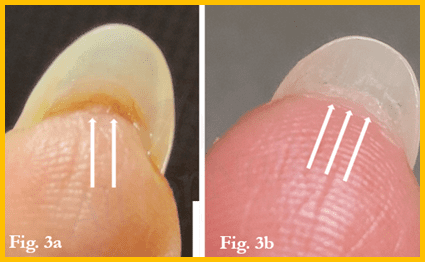
Behind the free edge of the nail plate lies the hyponychium, one of the important guardian seals, what you may not be aware of is a lot of BIAB’s or Builder Gels shrink when they cure, how much they shrink depends on the ingredients, but know that they all do to some extent and if you have filed into the lateral nail folds and weakened the nail plate the structure of the nail is compromised and the nail plate will change shape. The other part of the problem is due to the pressure on the free edge the hyponychium will be irritated and part of its defense when its irritated is to call in the troops and thicken a little, causing more pressure on the underside of the free edge. How do we know this? During the Covid-19 pandemic a lot of our consumers removed their own nail product as this couldn’t be infilled, so 2 things happened:

  1. Eles enchiam demais em um esforço para remover o produto
  2. They couldn’t get their nails redone and o hiponíquio teve tempo para se recuperar.

Fig. 3a: Hiponíquio levemente elevado

Fig 3b: Three months into lockdown – the hyponychium is relaxed the nail plate is not damaged by filing into the lateral nail folds or roughing up the nail plate before reapplying the Gel.

Causas comuns de unha encravada

Now that we’ve tackled the gel connection, let’s look at other factors that can trigger or worsen a pinched nail:

1. Preenchimento excessivo das paredes laterais

Possibly the biggest offender. Over time, repeated filing — even gentle — can thin the sidewalls, especially when removing enhancements like Plexigel. Once those side areas lose structure, the nail’s free edge is left vulnerable and can start curling inwards as it grows.

2. Desidratação por imersão em acetona

Acetone, while great for product removal, pulls moisture from both the nail plate and surrounding skin. If you’ve ever felt that chalky, tight sensation post-soak, you know the feeling. Prolonged exposure, especially if followed by buffing, can temporarily (or permanently) warp the nail shape.

3. Anatomia natural ou trauma repetitivo

Algumas pessoas são naturalmente mais propensas a ter uma unha encravada devido à sua leito ungueal shape. But if it’s something you’ve only recently noticed, look at lifestyle habits. Typing, picking, tapping, or even frequent exposure to pressure under the free edge can distort growth over time.

4. Alterações no hiponíquio

The hyponychium, the sensitive skin under the free edge, can shift or recede if irritated. This may happen due to overfiling, chemical exposure, gel shrinkage during curing or friction. When this skin detaches or becomes inflamed, the nail may grow in tighter, adding to that pinched look.

Como cuidar e prevenir uma unha encravada

If you suspect you’re dealing with a pinched nail, don’t panic. It’s often reversible with a little care and patience.

1. Faça uma pausa

Afaste-se dos aprimoramentos e dê às suas unhas a chance de se recuperar. Um mês sem géis ou remoções permitirá que a placa ungueal cresça normalmente e recupere sua forma natural.

2. Reidratar, reidratar, reidratar

Nails need moisture just like skin. Apply a good quality nail & skin oil  behind the free edge at least 4 times a day. Rinse your hands a few times a day with an Allantoïne & Ureum rinse, this will help recondition the nail and surrounding tissue, and finish with a little of your favorite lotion, if it contains Allantoïne and Ureum that’s an added bonus and your nails and nail area will love you for it.

3. Minimizar o trauma adicional

During this recovery period, Keep nails trimmed short to prevent catching or bending. Be gentle when typing, opening containers, or using your nails as tools (just don’t!).

4. Evite arquivar áreas finas

Skip the sidewalls entirely when buffing or shaping for now. Focus only on gentle surface smoothing if needed — and avoid pressure.

5. Monitoramento de padrões

If it’s spreading to other nails or worsening, it could signal an underlying health or nutritional issue. Keep an eye out and consider speaking to a pro if you’re concerned.

Considerações finais

A pinched nail might start as a subtle cosmetic change, but it’s often a message from your body or your habits, that something needs adjusting. Whether it’s overfiling, dehydration, trauma, product shrinkage or just the aftermath of gel removal, paying attention early can help you course-correct and avoid long-term damage.

O lado positivo?

As unhas são resistentes. Com um bom plano de recuperação, cuidados e alguns pequenos ajustes em sua rotina, a maioria das unhas comprimidas pode voltar a ter força total e beleza.

Arquivado em: Informações gerais, Condições das unhas

Problemas de enrugamento e cura nas unhas do polegar

When it comes to achieving flawless nail finishes, the thumbs can often present unique challenges. This article explores the common issues of wrinkling and incomplete curing that many encounter with their thumb nails, particularly focusing on the application process and the role of nail curing equipment.

The Role of Uneven Application for Wrinkling Nails

One of the primary reasons for wrinkling and incomplete curing on the thumbs is the uneven application of the base coat. Thumbs are more prone to this issue due to their wider and flatter surface area compared to other fingers, which can lead to a thicker or uneven layer of product. When the base coat is applied too thickly, especially on the sides of the thumbs, it can prevent the curing light from effectively polymerising the entire layer. This incomplete curing results in a wrinkled appearance and can affect the durability of the nail finish.

Best Practices for Base Coat Application on Thumbs

To combat these issues, it is crucial to adopt a targeted approach when applying the base coat to the thumbs. Here are a few tips:

  • Apply Thinly: Ensure a thin and even application across the entire nail, paying particular attention to the sides where the product tends to accumulate.
  • Separate Application: Consider applying the base coat separately to the thumbs, which allows for more focused attention and control over the thickness.
  • Curing Techniques: Properly position your thumbs under the curing light, ensuring that all parts of the nail are adequately exposed.

The Benefits of a Mirrored Base in Nail Curing

A mirrored base in a nail curing lamp is designed to enhance the effectiveness of the curing process. Here’s how it works:

  • Reflective Surface: The mirrored base helps reflect UV or LED light back onto the nail, particularly targeting hard-to-reach areas like the sides and tips.
  • Even Curing: This reflection ensures more uniform exposure to the curing light, potentially reducing issues like wrinkling and incomplete curing.

Is a Mirrored Base Necessary?

Adjusting your base coat application technique should be your first step, and a mirrored base can serve as an additional aid. Its effectiveness, however, largely depends on the type of curing lamp you use and the specific challenges you face with your nail treatments. If you continue to experience issues despite optimising your application technique, incorporating a mirrored base might be worth considering.

Final Recommendations for Wrinkling on Nails

For those struggling with wrinkling and incomplete curing on their thumbs, focus initially on perfecting your base coat application. This involves applying thin, even layers and ensuring proper exposure to curing light. If problems persist, then exploring advanced equipment options like a curing lamp with a mirrored base could provide the solution you need to achieve perfect, long-lasting nail finishes.

By understanding these key aspects and making a few strategic adjustments, you can greatly improve the appearance and durability of your nail enhancements, especially on challenging areas like the thumbs.

Arquivado em: Informações gerais, Serviços para unhas

Unhas de gel DIY que deram errado

Evite danos e reações alérgicas com dicas de especialistas

Os aprimoramentos das unhas podem ser lindos, mas o que acontece quando sua rotina de unhas causa mais danos do que benefícios?

O setor de unhas está em expansão, com inúmeros entusiastas recorrendo a kits de unhas DIY em casa. No entanto, uma publicação recente na mídia social de Amy Brown Meyer destaca os possíveis riscos de cuidados inadequados com as unhas. Amy compartilhou suas preocupações sobre a irritação após uma manicure caseira com gel, o que provocou uma resposta detalhada e reveladora de Tracy Anne Shelverton, nossa especialista em unhas.

Tracy’s response is a masterclass in understanding nail and skin health, emphasizing how improper techniques like overfiling or trimming (too much) skin can compromise the protective skin layers around your nails. This not only leads to irritation and swelling but opens the door to potential allergic reactions and or irritation caused by the chemicals in artificial nail products.

Como as unhas de gel feitas por você mesmo podem prejudicar a saúde de suas unhas

De acordo com Tracy, a pele ao redor de suas unhas faz parte do selos de proteção that protect your nails and nail units from pathogens and allergens. However, improper techniques like preenchimento excessivo, corte agressivo ou uso incorreto de ferramentas pode enfraquecer essa barreira.

Quando isso acontece:

  • A pele fica irritada, levando a vermelhidão, inchaço e respostas imunológicas.
  • Os alérgenos de produtos em gel não curados podem penetrar nas camadas danificadas da pele, podendo desencadear reações alérgicas permanentes.

Sem a barreira protetora da pele, os compostos dos produtos para unhas artificiais, especialmente os que contêm acrilatos, podem entrar facilmente no corpo, causando irritação de curto prazo e sensibilidade de longo prazo.

Reações alérgicas a unhas de gel: Riscos e impactos em longo prazo

Um fato alarmante é que as reações alérgicas aos produtos para unhas podem ter implicações que vão além da sua manicure. Tracy adverte que os mesmos compostos encontrados em todos os produtos para unhas artificiais que precisam endurecer também são usados em adesivos médicos e cimento odontológico.

O que isso significa para você:

  • O desenvolvimento de uma alergia agora pode tornar mais complicados os tratamentos médicos futuros, como cirurgia ortopédica ou trabalho odontológico.
  • As reações alérgicas podem levar a inchaço, coceira, vermelhidão e até mesmo sensibilidade crônica a produtos químicos relacionados.

Etapas para proteger suas unhas e pele

Se você gosta de fazer as unhas em casa, há maneiras de se manter segura e proteger a saúde das unhas:

  • Respeite a barreira de sua pele: Evite fazer o preenchimento excessivo ou aparar as dobras das unhas (a pele ao redor das unhas).
  • Evite o contato com a pele: Certifique-se de que os produtos para unhas artificiais, especialmente os géis não curados, não toquem sua pele durante a aplicação.
  • Dê à pele tempo para se recuperar: Se você notar irritação ou vermelhidão, interrompa o uso dos produtos e deixe-os agir. pelo menos três meses para que sua pele se recupere.
  • Considere a possibilidade de fazer testes para alergias: If you suspect an allergic reaction, consult a dermatologist for patch testing to identify allergens.
  • Eduque-se: Invista em treinamento adequado para aprender técnicas seguras de aplicação de unhas. Cursos e livros eletrônicos como os oferecidos por NailKnowledge pode ajudá-lo a dominar a arte de aprimorar as unhas sem comprometer sua saúde.

Uma lição para entusiastas e profissionais de unhas

The story of Amy’s irritated nails is a powerful reminder that beauty should never come at the cost of health. Whether you’re a DIY enthusiast or a professional nail technician, understanding the science behind nails, artificial nail products and skin is crucial for safe and beautiful results.

Perguntas frequentes sobre unhas de gel e reações alérgicas

Q: Can gel nails cause allergic reactions?
Sim, as unhas de gel contêm acrilatos, que são alergênicos. Se eles entrarem em contato com a pele, especialmente se a barreira cutânea estiver comprometida, podem desencadear reações alérgicas como vermelhidão, inchaço ou coceira.

P: Como posso evitar a irritação das unhas de gel DIY?
Evite fazer o preenchimento excessivo das unhas ou aparar a pele. Certifique-se de que os produtos em gel não curados não toquem sua pele durante a aplicação.

P: O que devo fazer se sentir irritação após uma manicure de gel?
Interrompa imediatamente o uso de todos os produtos para unhas e permita que a pele se recupere. Consulte um profissional se os sintomas persistirem e considere a possibilidade de fazer um teste de alergia, se necessário.

Quer saber mais?

Libere todo o seu potencial com o Pacote completo NailKnowledgeO site da empresa, o recurso definitivo para entusiastas e profissionais de unhas.

With lifetime access to everything NailKnowledge has to offer, you’ll gain expert guidance and tools to achieve salon-quality nails while keeping your hands healthy and beautiful.

What’s Included in the NailKnowledge Complete Bundle?

  • 3 cursos abrangentes
  • 18 Aulas
  • 35 pontos de conhecimento
  • 6 eBooks líderes do setor
  • Seu próprio Perfil do artista/salão para mostrar sua experiência

Whether you’re just starting out or looking to deepen your expertise, this one-time purchase equips you with all the tools, insights, and resources to elevate your nail skills.

Sem taxas contínuas, apenas uma vida inteira de conhecimento.

Pacote completo do Nailknowledge

Proteja suas unhas, proteja sua saúde e mantenha suas mãos com a melhor aparência possível, da maneira certa.

Arquivado em: Unhas DIY que deram errado, Informações gerais, Saúde e segurança, Condições das unhas

  • Página 1
  • Página 2
  • Página 3
  • Páginas intermediárias omitidas ...
  • Página 30
  • Ir para Próxima página »

Aumente o nível de suas percepções sobre as unhas

Participe de nosso boletim informativo!
ASSINAR...

Direitos autorais © NailKnowledge

NailKnowledge

  • MyNailEra
  • Livros eletrônicos
  • Sobre nós
  • Cursos
  • Notícias
  • Blog
  • Boletim informativo
  • Glossário

Políticas

  • Página de privacidade
  • Termos e condições
  • Política de cookies

Suporte

  • Entre em contato conosco
  • Conheça os especialistas
  • Pergunte aos especialistas
  • Suporte ao sistema
  • Perguntas frequentes
Portuguese
Portuguese
English Spanish Vietnamese