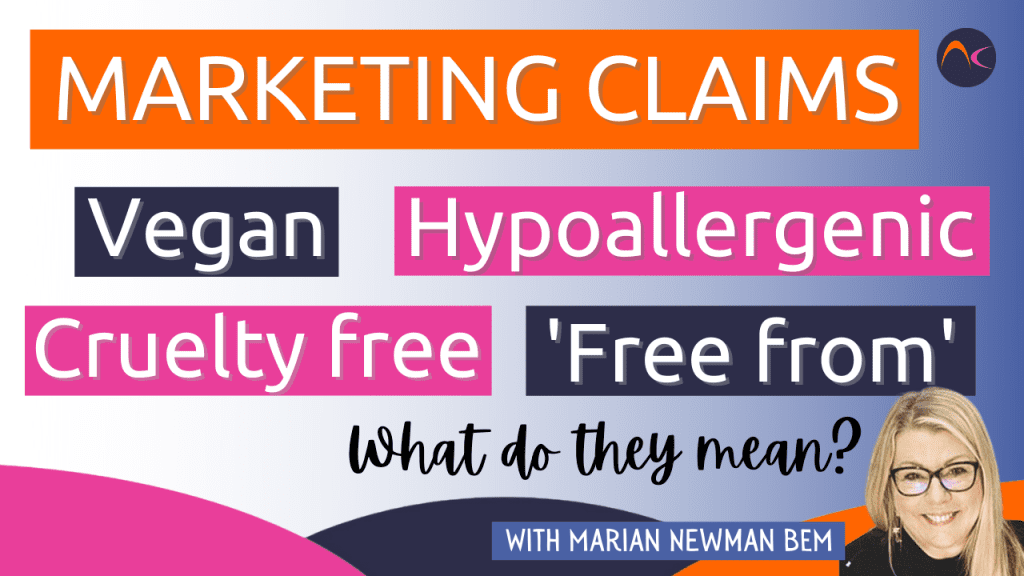
This is a brief description on what all these mean (or should mean!). You may see that many claims are just marketing stories and have no basis in legal requirements nor accuracy!
Claims should follow certain criteria as best practice:
- Legal Compliance. All cosmetics fall under the Cosmetic Regulations for each country. These are very detailed, and claims should not be made if they fall under the legal requirements anyway.
- Truthfulness. Claims should not be based on false or irrelevant information
- Evidence support. Each allowable claim must be supported by evidence to prove it
- Honesty. Claims must not go beyond the evidence
- Fairness. Claims should be objective and not criticise ingredients that are legal to be used in cosmetics nor cause confusion with products of a competitor
- Informed decision making. They should allow a professional or consumer to make informed decisions. They should be relevant and understandable to the average end user.
- Hypoallergenic. This is an allowable claim if it has supporting evidence. But do not be misled by the claim. It does not mean that allergic reactions are impossible. It means that the potential is ‘below average’ so is less likely to trigger a response than those products that cannot make this claim. Nail coating products, by their nature, contain known allergens, some higher than others. But also, skin contact of uncured product should be avoided at all times (and this includes improperly cured coatings that appear cured) However, many feel more confident using this type of product and, for nails, they are unlikely to contain the more well-known allergens.
- ‘Free from’. This started as referring to traditional nail polish, but it is such a misleading claim! Some on the list that is often published are banned anyway. Some are ingredients that haven’t been used for years. Some that have been claimed to be harmful have had the claims proven to be wrong or are in such minute quantities so are negligible. One on most lists: formaldehyde, which is a gas, is not added as an ingredient but there are many cosmetic ingredients that, when chemically reacting together, release an tiny, negligible amount that is around 0.0003%
A new claim that keeps popping up is that some UV gel polishes claim to be ‘x free’. Well, the understanding of ‘free from’ relates to the list for nail polishes. Traditional nail polishes and UV gel polishes are totally different product types so the accepted ‘free from’ doesn’t apply. Now if they said ‘free from HEMA or isobornyl acrylate’ for example, it would be relevant!

- Vegan. This relates to any animal derived product and any animal cruelty. Virtually ALL nail coatings have no animal products included so they are all vegan. The only very rare exception is if the pigment carmine is used but this has been long replaced by alternatives. For strict vegans there are a few ingredients that may be objected to. Examples of these could be lanolin (derived from sheep wool) and bees wax (harvested from hives). The animals are not harmed in the collection of these but there is obviously a strong connection
- Cruelty free. There is no animal testing on finished cosmetic products anywhere in the world. The brand can use the ‘cruelty free’ logo but only under certain circumstances which are, briefly, that the manufacturer and their suppliers have not commissioned any animal testing on any product or any of its ingredients. All cosmetic products are inherently cruelty free so, in many ways, it is not needed as a claim nor the logo.
Interestingly, in the Cosmetic Products Enforcement Regulations 2013 (that also apply to the UK from 1st Jan 2021) Article 21 states that certain information must be made easily available to the public!
You will see how some claims do not fall in line with ‘best practices’! Notice #5!!!
In conclusion, understanding is essential! Don’t get taken in by claims that stretch a point! Some (and by no means all) can be misleading, inaccurate or even wrong! It’s an over saturated market and brands need to make their mark. Buy from trusted and authorised sources and you should be fine.