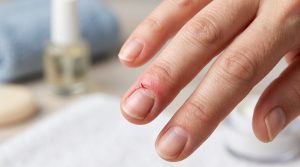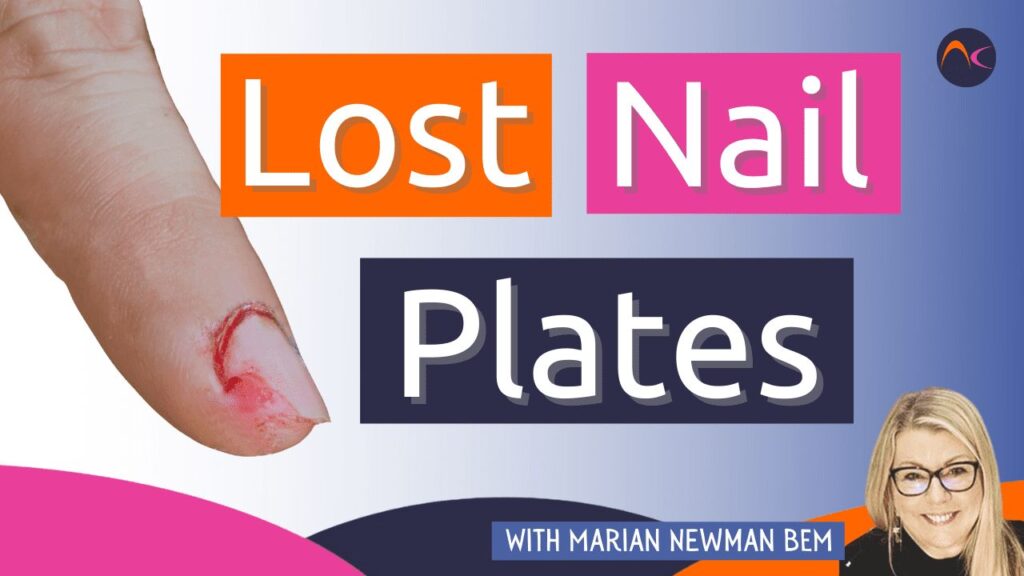
There have been a lot of gruesome images of nail plates being ripped off the nail bed due to accidents while wearing coatings or enhancements.
This used to be a fairly frequent event many years ago when MMA was the main monomer used in an L&P system, but it shouldn’t be the case now! So, what is happening? How can it be prevented?
MMA (methyl methacrylate) is not any more hazardous than the far more common EMA (ethyl methacrylate) but it is inappropriate for nail overlays and enhancements. One of the reasons for this is it is too hard and inflexible. Its adhesion to the nail plate is also very strong as it mostly uses a physical bond to the nail plate which, basically, needs to be shredded for the bond to work.
This meant that if there was accidental damage to the nail the overlay wouldn’t break but the nail plate would be ripped off!! OUCH!!! Very painful, open to infection and months to heal and grow back.
EMA as a monomer, is much more flexible and the nail plate does not need to be shredded and therefore severely weakened. With the correct application, i.e., correct ratio and structure, the overlay or enhancement will break before the nail plate is ripped off.
The same is true for any type of coating, overlay or enhancement. Adhesion and strength needs to be good for longevity but not put the whole nail plate at risk of this dreadful result, that can occur with minimal pressure.
Accidental damage can still be painful as the break can be over the hyponychium and can draw blood but, it is where a natural nail can break with enough force. When this happens, all the bodies protection systems come into play. The blood will clot and help seal the area; antibodies will help protect against infection. The pain will be short lived, and all will heal very quickly. A break lower down on the nail bed or a nail plate ripping off is far more serious!
The natural nail flexes all the time. Using your hands or just walking for toe nails, means that the nails move along with the fingers or toes. If the flexibility of the overlay is much less than the nail plate, then the ‘best’ scenario is that the overlay will be pulled apart from the nail plate causing lifting anywhere on the nail. The worst scenario is the loss of a nail plate.

So what is causing these breakages? Well, many things:
- Overlay too thick. If the coating, overlay or enhancement is too thick, i.e. the thickness is stronger than the nail plate, the nail plate will rip off first
- Using a product that is not formulated to be flexible
- The wrong ratio of a L&P system
- Too much buffing of the nail plate so it becomes weakened and can easily ‘pop off’ the nail bed
- Allowing clients to go too long between services so the structure of the enhancement or coating moves to a place that compromises the nail plate
- This can happen with a UV gel polish especially if a ‘builder’ has been used and the service time is too long
How can this be avoided?
- Use good quality products that are flexible
- Use the correct ratio for an L&P system
- Structure the coating or enhancement correctly
- Do not apply ANY system too thick for the nail plate under it
- Do not continually buff the nail plate to weaken it
- Make sure appointments are appropriate i.e. no more than 3-4 weeks max!
If a nail plate is ripped off while wearing a coating, overlay or enhancement this is the fault of the nail professional!!! An overlay or enhancement should ALWAYS break before the nail plate is ripped off.
What to do if this happens:
- An exposed nail bed cannot have a new nail attached
- An exposed nail bed needs to heal and grow a new nail
- There are some products that are formulated for this service BUT there is always the chance that a client can develop an allergic reaction to these being applied to the open nail bed. This is where careful consultation and advanced education is needed.