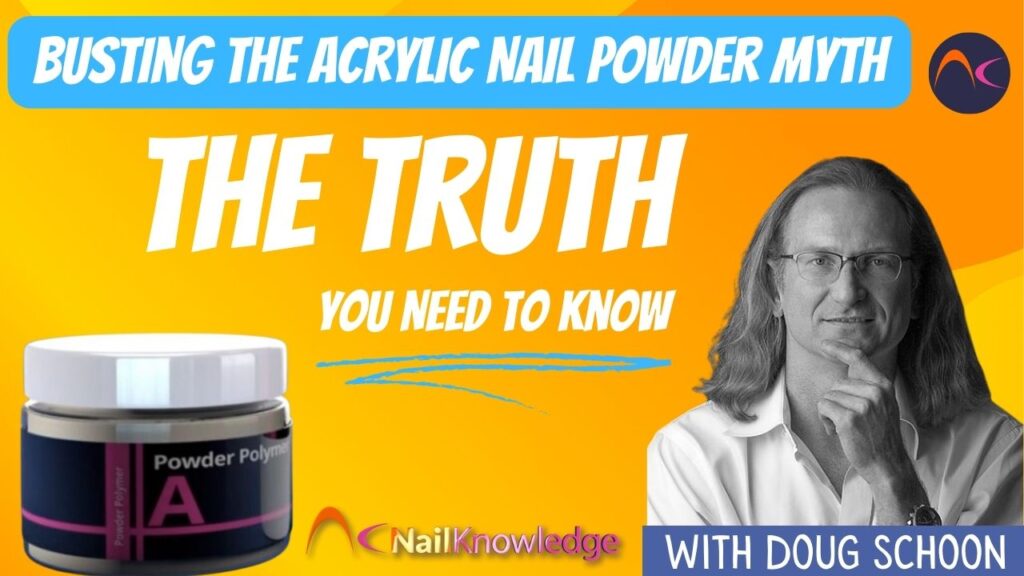
Aren’t all acrylic nail powders just a blend of ethyl and methyl methacrylate? Aren’t they basically all the same?
No, acrylic nail powder varies greatly and it is a myth that they are all the same. Wonder who started this myth? No surprise, it was started by those who sell low quality nail powders. Of course, they want to fool nail professionals into using inferior and/or incorrect nail powders. They can’t make money if nail technicians use the powder that was specifically designed for use with the monomer of their choice. So, they fooled them into believing a “powder is a powder”, which is false.
Thành phần bột làm móng và cách sử dụng MMA an toàn
Here are the facts – nail powders are polymer blends and their compositions vary widely. For instance, a nail powder could be a blend of 10% poly ethyl methacrylate, which is the polymerized form of ethyl methacrylate and 90% poly methyl methacrylate. Or it could contain the reverse, 90% poly ethyl methacrylate and 10% poly methyl methacrylate, and every combination in-between.
When methyl methacrylate or MMA is polymerized to make bột làm móng tay giả, this is considered a safe and appropriate use for this monomer. This is NOT the same as using MMA monomer as the liquid component in a system. I don’t recommend using MMA monomer nail products because they are likely to lead to damage of the nail plate.
Mở khóa sức mạnh của bột làm móng Co-polymer tùy chỉnh
It is important to understand that nail powders are often customized “co-polymers”. A co-polymer is a polymer containing two types of monomers in their structure and not just blended together. Co-polymers are completely different from those created by physically blending two different types of polymers. Co-polymers are one polymer, made from two different monomers. This means that knowledgeable scientists can create hundreds of powders that all have ethyl and methyl methacrylate and each powder will be different in strength, durability and ease of use.
There is an even more important difference, as I discussed in Volume l of my Face-to-Face series, it is VERY important to understand that various nail powders contain varying amounts of benzoyl peroxide or BPO. The amount of BPO used depends on the formulation of the monomer liquid component of the system. Some monomer liquids require more BPO, while others need less. The BPO concentration is usually between 1-2%, however there is a VERY big difference between a nail powder containing 1% verses a nail powder containing 2% BPO. A nail powder with 2% BPO contains twice as much BPO as a powder with only 1%.

Vai trò quan trọng của BPO trong bột làm móng Acrylic
The amount of BPO in the powder determines how “completely” the liquid monomer will cure. Too little BPO, the enhancement will under-cure. Too much BPO, the enhancement will over-cure. Over-curing can lead to discoloration, brittleness, cracking, breaking, chipping and loss of adhesion or lifting.
Những nguy hiểm của lớp sơn móng tay chưa khô
Under cured nail coatings may have a lower resistance to staining or they can be overly flexible and have increased cracking at the stress zones near the free-edge.
However, there is a much more important problem to consider, under-cured nail coatings are much more likely to cause adverse skin reactions for clients and nail professionals. Under-curing leaves excessive amounts of monomer trapped in the coating. Therefore, fresh dust and filings may be rich in monomer. Prolonged or repeated contact to monomer-rich dust and filings may lead to skin overexposure, which is a leading cause of allergy to nail enhancements.
Mức độ BPO phù hợp: Điều cần thiết để làm móng đẹp hơn
If you use the incorrect powder, it may not contain the correct amount of benzoyl peroxide. In other words, don’t use a 1% BPO containing nail powder with systems designed for use with a 1.5% BPO powder, and the opposite is true. Even a half percent difference in BPO can lead to an under-cured enhancement and higher risk of skin irritation or allergies.
This is especially true during the first hour after creating the enhancement. This is when the coating contains the highest concentration of uncured monomer and the potential for over exposing the skin is at its highest.