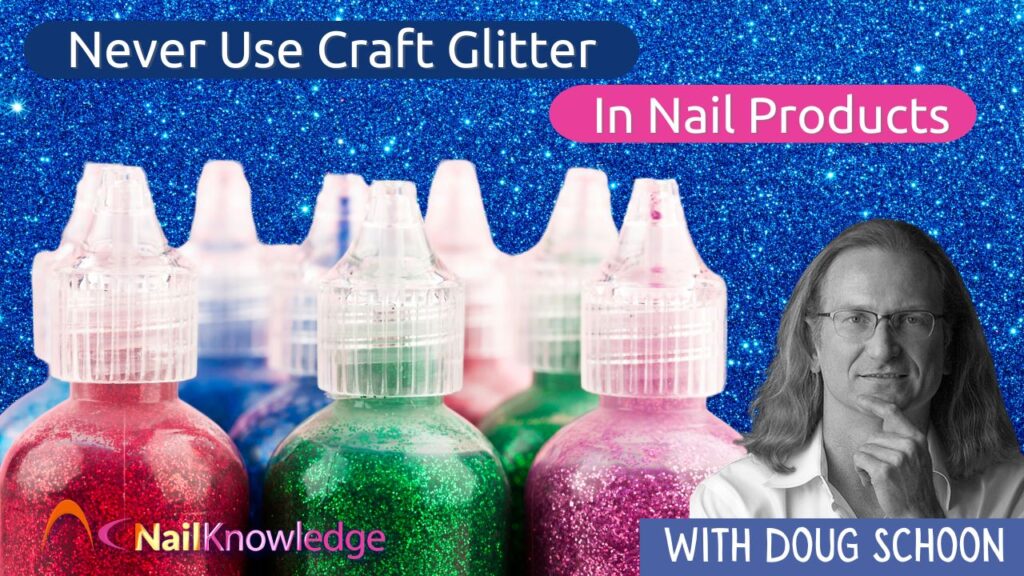
We get asked this question a lot: “Can I use craft glitter with nail products instead of glitters made specifically for nails? Aren’t they basically the same thing?” While it might seem like a harmless swap, there are some important reasons why craft glitters should never be used in nail applications. Let’s dive into the details to clear up any confusion and explain the potential risks.
Tại sao chỉ có nhũ dùng trong mỹ phẩm mới an toàn cho móng tay
In my opinion, craft glitters sold for arts and crafts should not be used for nail art application and should never be mixed with nail products. I recommend using only glitters and other colorants that are cosmetic-grade. Not just any cosmetic-grade colorant, you should only use those that are specifically sold for use in nail coating cosmetics. Why? There are several good reasons for why I believe this to be true. Many countries, including the US, Canada, Australia and those of the European Union and others have specific regulations concerning which types of colorants can be used in cosmetics. This is done to ensure safety. Those used for crafts or other non-cosmetic uses are not designed for the type of contact that can occur with cosmetics and may cause adverse skin reactions.
Cảnh báo thực tế: Phản ứng dị ứng từ kim tuyến thủ công
An example of what can happen when improper colorants are used. This was reported in a highly respected medical journal in 2012. Several physicians reported a case-study involving a patient that had come to them with an allergic reaction after wearing UV gel nail coatings for about a year. This 37-year-old housewife had never before experienced any type of phản ứng dị ứng da. Trong ba tháng, cô đã nhận được dịch vụ làm móng giả from a nail professional and then decided that she could “do it herself”. That was the first mistake she made. After about seven months, she developed multiple, intensely itchy sores on the skin surrounding her nail plates and on the palms of both hands.
Để xác định lý do tại sao cô ấy gặp phải phản ứng bất lợi này trên da, bác sĩ đã tiến hành một xét nghiệm miếng dán da tiêu chuẩn. Xét nghiệm này cho da cô tiếp xúc với một lượng nhỏ các chất gây dị ứng phổ biến, cũng như sản phẩm làm móng mà cô đang sử dụng.
The test results were surprising. The skin testing showed she was NOT reacting to the nail coating product at all, as the doctors may have first suspected. Instead she was having a surprisingly strong allergic reaction to another common allergy producing substance included in the patch testing. She reacted strongly to a substance called “cobalt chloride”, which seemed rather odd, until the patient was questioned further.
The doctor learned she had purchased some “craft glitters” from the Internet and had been mixing up her own color blends which she applied to her own nails. That was her second mistake. Upon further investigation, it was learned that “cobalt” was listed as an ingredient in the glitters. The cobalt ingredient in the craft glitters was entirely responsible for her allergic skin reaction. Once she stopped using the craft glitters, these skin problems disappeared.

Những nguy hiểm của chất tạo màu không phải mỹ phẩm trong sản phẩm làm móng
Cosmetic colorants don’t contain cobalt, nickel, chromium, or other such metals, because these are known to cause allergic skin reactions. Not all metals cause skin allergies. Titanium is an example of one that does not. These allergy causing metals and their derivatives should never be used in any cosmetic products. Even inhaling the dusts of these allergy causing metal colorants can be unsafe. It also is important to understand that not all cosmetic colorants are useful for nail application.
Some contain special additives that can contribute to nail coating service breakdown. For example, some cosmetic colorants have a silicone surface-coated which can block adhesion and contribute to lifting problems. While others contain additives that allow them to be dispersed in water, making them incompatible with nail coating products. Using these can weaken the nail coating and make them more likely to crack or break.
Tại sao các thương hiệu đáng tin cậy và các đại lý được ủy quyền lại quan trọng
Responsible manufacturers select and test glitters and color pigments before selling them; they choose those that are safe for use and those which are compatible with nail coating products. This takes out the guess work and helps protect the safety of nail professionals and their clients. Now you can see why I recommend that nail professionals only use glitters and colorants specifically designed for nail products. But there’s more, I recommend purchasing only from the manufacturer or their authorized dealers. The Internet is filled with counterfeit products that can be unsafe and may contain potentially hazardous substances that should NOT be used in cosmetic products.
Tránh hàng giả: Chọn nhà phân phối được ủy quyền và thương hiệu đáng tin cậy
I wrote an Education Update that warns salon professionals about this issue. In that Update I recommend avoiding purchasing any professional salon products from the Internet unless the product is sold by an “authorized” distributor. Counterfeits are often sold by unauthorized dealers, so beware! These can be found all over the Internet. I also recommend sticking to respected, brand name products. Otherwise, you never know what you’re getting or what’s being used in your services. They may seem cheaper, but they are cheaper for a reason. Most of the time, the safe ingredients have been substituted for cheaper ingredients that may be unsafe.