Thumb sucking, a common habit among children, can have surprising effects on nail growth and shape. In this article, we’ll explore the intriguing relationship between thumb sucking and nail plate distortion, shedding light on why some nails grow in distorted shapes while others seem to defy growth altogether.

Why Does Thumb Sucking Distort Nail Growth?
The phenomenon of nail plate distortion due to thumb sucking is a fascinating yet concerning aspect of childhood habits. To understand why this occurs, we need to delve into the properties of the nail plate itself.
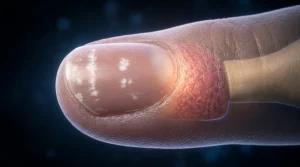
Imagine the nail plate as a solid structure, similar to ice in a glacier. While seemingly rigid, the nail plate possesses a degree of malleability, allowing it to change shape under prolonged pressure. This concept is crucial in comprehending why thumb sucking can lead to distorted nail growth.
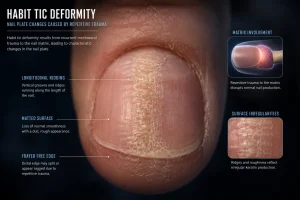
Prolonged or repeated pressure, such as that exerted during thumb sucking, gradually causes the nail plate to deform. While the changes may not be immediate, over time, the constant pressure alters the shape of the nail plate permanently. This phenomenon is particularly evident in conditions like “Habit Tic,” where individuals habitually flick their nail plates with another finger, resulting in deformation over weeks or months.
Understanding the Case of Non-Growing Nails
The case of a child whose nail on the sucking thumb refuses to grow presents an intriguing puzzle. While it’s tempting to attribute this phenomenon to moisture loss from the nail, the reality is far more complex.
Contrary to popular belief, sucking the thumb does not deplete moisture from the nail plate. In fact, the mouth provides ample moisture, which is transferred to the nail plate and absorbed. However, the growth of the nail is not governed by moisture levels; instead, it is regulated by the nail matrix.
The nail matrix, a specialized tissue beneath the cuticle, controls the rate of nail growth. Regardless of external factors like thumb sucking or moisture levels, the nail matrix dictates the pace at which nails grow. This explains why cutting the nail does not influence its growth rate; the matrix remains the ultimate arbiter of nail length.
Thumb Sucking’s Influence on Nail Growth: Parental Solutions
Thumb sucking can exert significant influence on nail growth and shape, leading to distortions over time. However, it’s essential to recognize that nail growth is primarily governed by the nail matrix, not external factors like moisture or pressure. By understanding these dynamics, parents can take proactive steps to address thumb sucking habits and promote healthy nail development in children.
FAQs
1. Can thumb sucking permanently damage nail growth?
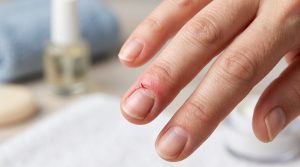
Thumb sucking can indeed lead to permanent nail distortion if the habit persists over an extended period, exerting consistent pressure on the nail plate.
2. How can parents help children overcome thumb sucking habits?
Encouraging positive reinforcement, providing distractions, and seeking professional guidance from pediatricians or dentists are effective strategies for helping children break the habit of thumb sucking.
3. Are there any preventive measures to protect nails from distortion?
Implementing techniques such as applying bitter-tasting nail polishes or using thumb guards can deter thumb sucking behavior and mitigate the risk of nail distortion.
4. At what age should parents be concerned about persistent thumb sucking?
While thumb sucking is common among infants and toddlers, persistent thumb sucking beyond the age of 4 or 5 may warrant intervention, as it could potentially impact dental and oral development.
5. Are there any long-term consequences of untreated thumb sucking habits?
Untreated thumb sucking habits can lead to not only nail distortions but also dental malocclusions, speech impediments, and social challenges, emphasizing the importance of timely intervention.