The Onychodermal Band
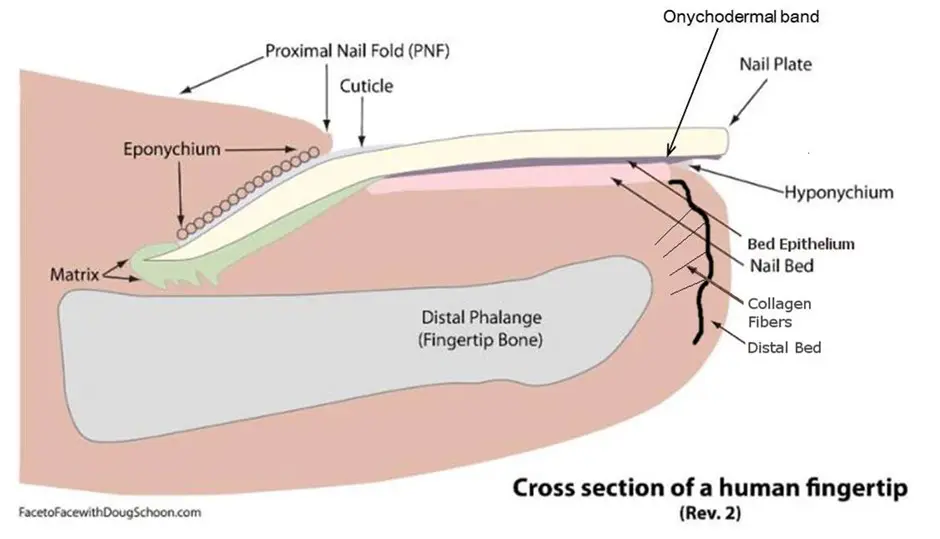
We see it every day while we’re at work, but do we really know what it is? Let’s take a closer look at Doug Schoon’s illustration to get a better understanding.
If we attempt to view it from behind the free edge, it appears like this:
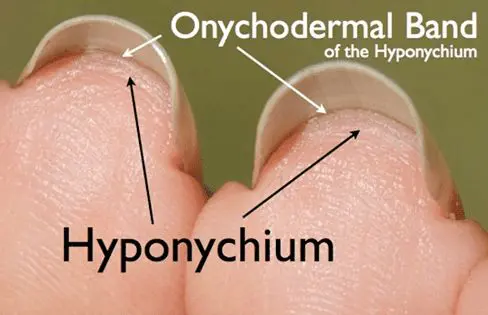
• The Onychodermal Band is non-living tissue. It’s an extension of the bed epithelium.
• It has a gray-brownish color.

The Onychodermal Band: A Hidden Protective Barrier
Between the nail plate and the nail bed lies the bed epithelium. When the bed epithelium reaches the end of the nail bed and folds in on itself, it becomes the Onychodermal Band. This narrow, compacted tissue acts as an extra pathogenic barrier beneath the free edge of the nail plate. It forms a partnership with the hyponychium and together they become a super seal – it often goes unnoticed and is nearly invisible. You have to look closely to perceive it.
The Onychodermal Band is somewhat translucent, a thin layer beneath the distal edge (free edge) of the nail plate, spanning the entire width of the nail plate and bordering the visible white of the free edge.
The Onychodermal Band serves to prevent the smallest infectious organisms and contaminants from infiltrating the nail bed. If this protective tissue (pathogenic barrier) is breached, the nail plate separates from the nail bed causing onycholysis and dramatically increasing the risk of infection.
Its partner in the nail unit is the Hyponychium and that hyponychium is one of the four guardian seals of the nail unit, designed to protect the nail bed from germs and other infections, such as fungus or yeast. While the hyponychium is composed of living epidermal tissue. It’s important to note that the Onychodermal Band is non-living tissue and needs to remain elastic to perform its job effectively.
Enhancing Elasticity: Applying Oil Behind the Free Edge for Nail Health
Applying oil behind the free edge, rather than on top of the nail plate, can help maintain the elasticity that is needed, even if the Onychodermal Band has already detached.
Cautionary Measures and Autoimmune Considerations for Nail Care
Beware when using an Efile to shorten the nail coming out of a nail enhancement behind the free edge or if you use a sharp instrument to clean under the free edge, might accidentally damage it, and you’ll immediately see the consequences as onycholysis.
Some auto immune diseases can also have an impact:
• Psoriasis
• Lichen Planus
• Eczema
These are all diseases that can affect the Onychodermal Band, the nail matrix, the nail plate or the nail bed which then causes the seal to break. Applying oil behind the free edge is crucial because oil repels water keeps the guardian seal elastic and does not provide a source of nourishment for germs, offering excellent protection.
In this image, you can clearly see how psoriasis can affect it. When the ‘oil slick’ blister forms, the bed epithelium is directly affected by the upwards pressure of the blister dislodging it from the nail bed. As the nail plate moves (perpetual motion) and the damaged bed epithelium gets closer to the free edge onycholysis is a fact and the nail bed is exposed to any and all pathogens.
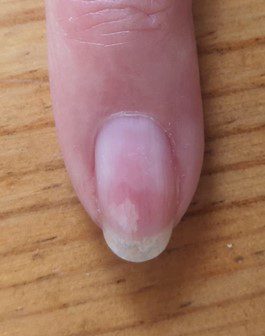
Sometimes, you may also notice that the hyponychium is pulled along with the Onychodermal Band. Something simple (but not always noticed) like product shrinkage can easily cause this to happen. If you recognize this happening, stop with your nail product until the hyponychium is recovered or find a more flexible product. Here, too, a good quality oil is your friend. If you work with a cuticle pusher or an e-file in this area, you’re likely to cause more irritation.
The Onychodermal Band is of utmost importance for the overall health of the nail unit and must be treated with care. Being cautious during cleaning under the free edge is necessary. It’s better to clean with a soft brush and oil, always avoiding sharp objects under the free edge to keep the nail unit healthy.
In Conclusion
The Onychodermal Band may go unnoticed in our daily lives, but it plays a crucial role in protecting our nails from infections and maintaining their overall health. Understanding its function and how to care for it is essential for nail health and hygiene. So, next time you’re working on your nails, remember the significance of the Onychodermal Band and treat it with the care it deserves to keep your nails looking and feeling their best.