El curado del esmalte en gel es un proceso químico, no simplemente una cuestión de tiempo bajo una lámpara. Muchos problemas comunes como arrugas, capas pegajosas, burbujas o encogimiento a menudo se malinterpretan como fallos de aplicación, cuando en realidad se explican mejor por la forma en que la química del gel interactúa con la energía lumínica durante el curado.
Entender el curado del esmalte en gel ayuda a explicar por qué diferentes productos se comportan de manera distinta, incluso cuando se aplican correctamente.


El curado del esmalte en gel es una reacción química
El esmalte en gel se cura a través de un proceso llamado polimerización. Esta reacción comienza cuando ingredientes específicos del gel, conocidos como fotoiniciadores, absorben la luz ultravioleta dentro de su rango de curado diseñado. Una vez activadas, estas moléculas desencadenan que el gel se enlace y endurezca.
Si el gel no recibe el tipo o la cantidad correcta de energía lumínica, la reacción de curado puede ser incompleta, desigual o inestable.
Por qué el comportamiento de curado difiere entre los productos en gel
No todos los geles se formulan de la misma manera. Las diferencias en la carga de pigmento, la viscosidad y el tipo de fotoiniciador influyen en cómo la luz penetra en el producto y cómo progresa la reacción de curado.
Es por eso que algunos geles curativos con una superficie pegajosa mientras que otros curan en seco. En muchos sistemas, una capa pegajosa de inhibición es intencional y favorece la adhesión entre capas, mientras que otros productos están diseñados para curar completamente sin dejar residuo.
El comportamiento de curado es, por lo tanto, un resultado de la formulación y el diseño, no simplemente del tiempo de curado.
Arrugas y encogimiento durante el curado
El arrugamiento durante el curado suele ocurrir cuando la superficie del gel cura más rápido que la capa que se encuentra debajo. A medida que el curado continúa, el movimiento en la capa no curada puede hacer que la superficie superior se distorsione.
La contracción también es una parte normal del curado del esmalte en gel. A medida que el gel polimeriza, se tensa ligeramente. La contracción excesiva, particularmente lejos de las paredes laterales, a menudo está relacionada con un desequilibrio en el curado en lugar de una aplicación única. Cuando aplicamos demasiado producto, esa contracción también puede hacer que nuestro producto se arrugue.
Ambos efectos están influenciados por la formulación, el grosor de la capa y la rapidez con la que ocurre la reacción de curado.
Microburbujas e irregularidades en el curado
Las microburbujas que aparecen después del curado suelen ser el resultado de aire atrapado o de un comportamiento de curado desigual. A medida que el gel se solidifica, se puede liberar gas si el curado progresa de manera inconsistente en todo el producto.
Este comportamiento se ve afectado por el grosor del gel, la cantidad de pigmento que contiene y cómo la luz de curado penetra en el producto.
Longitud de onda de la lámpara y curado del esmalte en gel
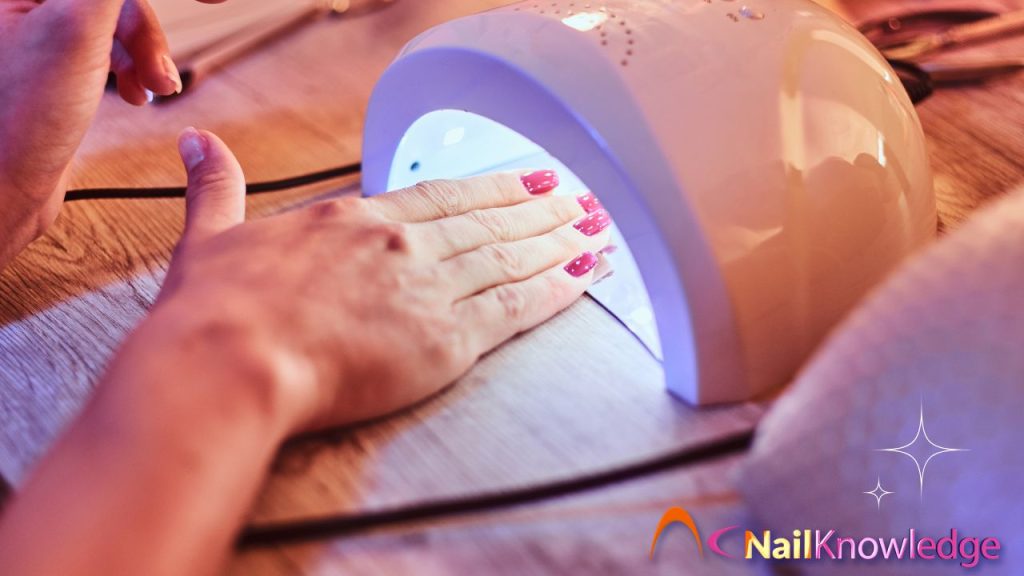
El curado del esmalte en gel depende de si la lámpara de curado emite luz dentro del rango de longitud de onda requerido por los fotoiniciadores del gel. Si la salida de la lámpara no coincide con la formulación del gel, el curado puede ser incompleto o irregular, incluso si se aumenta el tiempo en la lámpara.
Es por eso que el rendimiento del curado no se determina solo por el tiempo. La compatibilidad de la lámpara (usar una lámpara correspondiente) juega un papel fundamental para lograr un curado estable y completo.
La idea errónea de la sobrecuración
El curado excesivo a menudo se malinterpreta. Dejar un gel bajo una lámpara por más tiempo no suele dañar el producto. Los problemas surgen cuando la reacción de curado ocurre demasiado rápido, a menudo debido a una potencia de lámpara demasiado intensa o que no coincide con la formulación del gel.
En estos casos, el problema radica en la compatibilidad del curado en lugar del tiempo de exposición excesivo.
Por qué es importante entender el curado del esmalte en gel
Muchos problemas visibles de curado comparten la misma causa subyacente: desequilibrio entre la formulación del gel y las condiciones de curado. Sin comprender esta relación, la solución de problemas se convierte en una conjetura y es imposible de lograr.
NailKnowledge educación se enfoca en explicar el comportamiento del curado para que los problemas se comprendan a nivel químico en lugar de tratarse como fallos aislados.