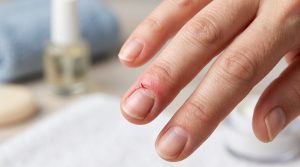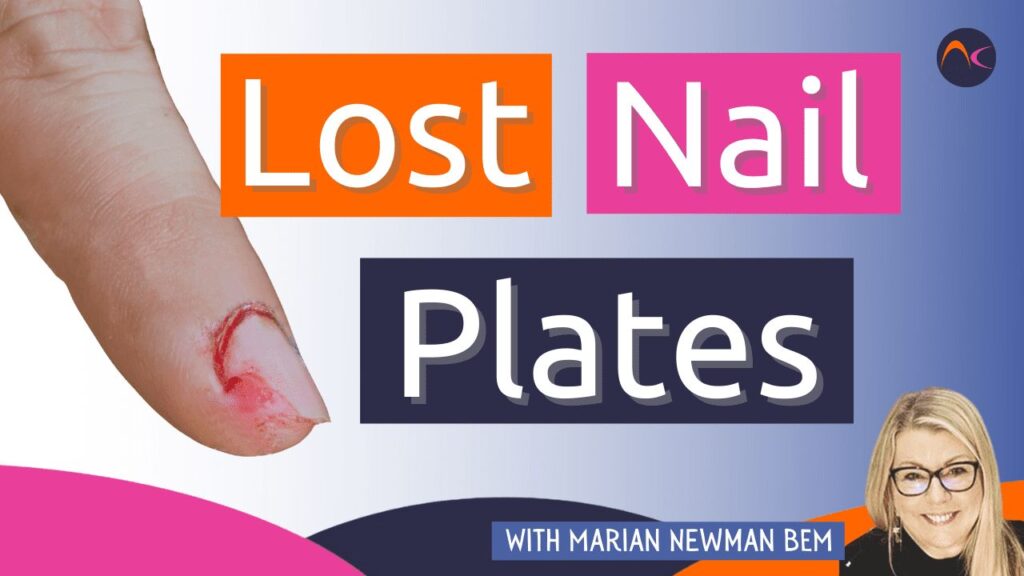
Ha habido muchas imágenes espantosas de placas de uñas arrancadas del lecho ungueal debido a accidentes mientras se llevaban recubrimientos o mejoras.
Este era un evento bastante frecuente hace muchos años cuando el MMA era el monómero principal utilizado en un sistema de L&P, ¡pero no debería ser el caso ahora! Entonces, ¿qué está pasando? ¿Cómo se puede prevenir?
El MMA (metacrilato de metilo) no es más peligroso que el EMA (metacrilato de etilo), mucho más común, pero es inapropiado para capas y extensiones de uñas. Una de las razones es que es demasiado duro e inflexible. Su adhesión a la placa de la uña también es muy fuerte, ya que utiliza principalmente una unión física a la placa de la uña que, básicamente, necesita ser triturada para que la unión funcione.
Esto significaba que si había un daño accidental en la uña, el recubrimiento no se rompería, ¡sino que la placa ungueal se arrancaría! ¡¡AY!! Muy doloroso, expuesto a infecciones y meses para sanar y crecer de nuevo.
El EMA como monómero es mucho más flexible y la placa ungueal no necesita ser lijada y, por lo tanto, debilitada severamente. Con la aplicación correcta, es decir, la proporción y estructura correctas, el recubrimiento o la extensión se romperá antes de que la placa ungueal sea arrancada.
Lo mismo ocurre con cualquier tipo de recubrimiento, superposición o mejora. La adhesión y la resistencia deben ser buenas para la longevidad, pero no deben poner en riesgo toda la placa ungueal de este terrible resultado, que puede ocurrir con una presión mínima.


El daño accidental aún puede ser doloroso, ya que la rotura puede ocurrir sobre el hiponiquio y sangrar, pero es donde una uña natural puede romperse con suficiente fuerza. Cuando esto sucede, entran en juego todos los sistemas de protección del cuerpo. La sangre se coagulará y ayudará a sellar el área; los anticuerpos ayudarán a proteger contra infecciones. El dolor será de corta duración y todo sanará muy rápidamente. ¡Una rotura más abajo en el lecho ungueal o el desprendimiento de la lámina ungueal es mucho más grave!
La uña natural se flexiona todo el tiempo. Usar las manos o simplemente caminar para las uñas de los pies significa que las uñas se mueven junto con los dedos de las manos o los pies. Si la flexibilidad de la cobertura es mucho menor que la de la placa ungueal, el ‘mejor’ escenario es que la cobertura se desprenderá de la placa ungueal, causando desprendimiento en cualquier parte de la uña. El peor escenario es la pérdida de la placa ungueal.
¿Cuál es la causa de estas roturas? Pues muchas cosas:
- Recubrimiento demasiado grueso. Si el revestimiento, recubrimiento o mejora es demasiado grueso, es decir, el espesor es más fuerte que la placa de clavos, la placa de clavos se arrancará primero.
- Utilizar un producto que no está formulado para ser flexible
- La proporción errónea de un sistema L&P
- Demasiado limado de la placa de la uña, de modo que se debilita y puede desprenderse fácilmente del lecho ungueal.
- Permitir que los clientes pasen demasiado tiempo entre servicios para que la estructura de la mejora o recubrimiento se mueva a un lugar que comprometa la placa de la uña.
- Esto puede suceder con un esmalte en gel UV, especialmente si se ha utilizado un ‘constructor’ y el tiempo de servicio es demasiado largo.
¿Cómo puede evitarse?
- Utilice productos de buena calidad que sean flexibles
- Utilizar la proporción correcta para un sistema L&P
- Estructurar correctamente el revestimiento o la mejora
- No aplique NINGÚN sistema demasiado grueso para la placa de la uña que hay debajo
- No pulir continuamente la placa de la uña para debilitarla
- Asegúrese de que las citas son apropiadas, es decir, no más de 3-4 semanas como máximo.
Si una placa de uña se arranca mientras se lleva puesto un recubrimiento, superposición o mejora, ¡¡¡es culpa del profesional de las uñas!!! Una superposición o mejora SIEMPRE debería romperse antes de que la placa de la uña se arranque.
Qué hacer si esto ocurre:
- No se puede adherir una uña nueva a un lecho ungueal expuesto
- Un lecho ungueal expuesto necesita cicatrizar y crecer una nueva uña
- Existen algunos productos que están formulados para este servicio, PERO siempre existe la posibilidad de que un cliente pueda desarrollar una reacción alérgica a su aplicación en el lecho ungueal expuesto. Aquí es donde se necesita una consulta cuidadosa y educación avanzada.