¿Cómo se relaciona la consistencia de un gel UV con la flexibilidad del gel UV curado?
La consistencia de un gel UV viene determinada por la consistencia de los ingredientes utilizados.
Para explicar mejor, necesitaré hablar sobre cómo se curan estos productos.
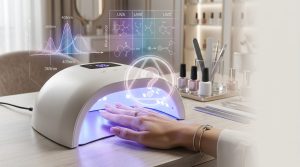
Solo se utilizan fuentes de energía UV de baja potencia para curar los geles UV, lo que significa que las lámparas para uñas emiten cantidades muy bajas de energía UV, por lo que el curado no es muy eficiente. Esto ayuda a explicar por qué no es posible curar adecuadamente los monómeros líquidos que se utilizan para crear sistemas de dos partes: no se curarán en un tiempo razonable usando una lámpara para uñas. Para superar este problema, los geles UV no se basan en monómeros, sino que están hechos de cadenas cortas de monómeros prefabricadas llamadas “oligómeros”.


Monómeros frente a oligómeros y sus efectos en la consistencia
“Mono” es latín para “uno” y “mer” significa “unidades”, por lo que los monómeros son “moléculas” individuales. “Oligo” significa “pocos”, por lo que un oligómero es una cadena corta de monómeros, típicamente hasta 3.000 monómeros de largo.
Dado que los monómeros son moléculas pequeñas, se mueven más rápida y fácilmente dentro de su recipiente, por lo que son líquidos fluidos. Los oligómeros son más largos y voluminosos, por lo que se estorban entre sí y pueden enredarse temporalmente. Su voluminoso tamaño los ralentiza, por lo que no pueden moverse tan rápida o fácilmente como los monómeros. El resultado es que los oligómeros tienden a ser más espesos y fibrosos, por lo que tienen una consistencia similar a la del gel.
Dependiendo del oligómero utilizado, el gel UV puede ser un poco más espeso o más diluido. El espesor también se denomina “viscosidad”. La viscosidad del producto puede aumentar o disminuir con la adición de otros aditivos. Por ejemplo, el dióxido de titanio es un pigmento blanco compuesto por partículas sólidas. La adición de una cantidad suficiente de este pigmento blanco puede aumentar significativamente la viscosidad del gel UV no curado.
Así pues, es fácil ver que el grosor del gel UV viene determinado por los ingredientes.
Flexibilidad del gel UV: Factores más allá del grosor y la importancia de un curado adecuado
La flexibilidad de un gel UV curado NO viene determinada por el grosor del gel UV no curado.
La flexibilidad depende de dos cosas
- La estructura química de los oligómeros y otros ingredientes utilizados
- El porcentaje de curado. Desafortunadamente, una curación insuficiente de un gel UV lo hará parecer más flexible.
Esto hace que algunas manicuristas se equivoquen al pensar que sus geles UV se curan correctamente, cuando en realidad no es así. Es importante destacar que un curado insuficiente hace que los recubrimientos de uñas de gel UV parezcan más flexibles.
El curado insuficiente también provoca que las limaduras y el polvo de las uñas contengan mayores cantidades de ingredientes sin reaccionar, lo que aumenta el potencial de reacciones cutáneas adversas como irritaciones o alergias. Y cuando estas uñas se retiran con disolvente, estos ingredientes se liberan en el disolvente y pueden provocar reacciones alérgicas en la piel.
Por lo tanto, la consistencia de un gel UV no está relacionada con la flexibilidad del recubrimiento de la uña. Está claro que hay mucho más que saber sobre los geles UV y el curado adecuado.