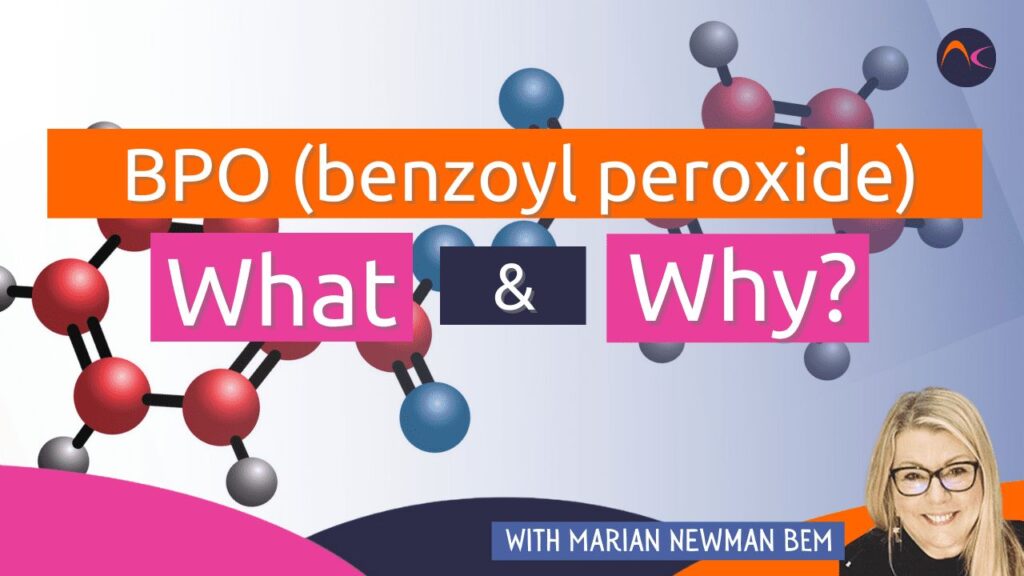
In the liquid monomer and powder polymer system, Benzoyl Peroxide is the initiator. An initiator is what provides the start of a chemical reaction. In the L&P system, the room temperature and the heat from the finger are the energy that gives the initiator (BPO) the ‘starting gun’ to react with the catalyst in the liquid monomer, which is the ingredient that controls the speed of the reaction.
Polymer powder is not actually a powder. It is manufactured beads of a copolymer that are coated with several ingredients. One of these is BPO, and the other main one is pigment. There are others but we are focussing on BPO.
When the monomer liquid and the polymer powder meet the BPO, coating the polymer beads, splits to create the equivalent of free radicals that search out and encourage the monomers to form into long polymer chains. In the correct bead ratio, all of the BPO is used up. Too wet, and there may not be enough BPO to complete the polymerization. Too dry, and it is difficult to work with, plus some BPO may be leftover and unable to complete its ‘work’.
BPO is an ingredient commonly used in skin preparations. At low percentages (e.g. 2.5%), it can be found in medicated skin cleansers. In higher percentages (e.g 5-10%), it is used for skin conditions such as acne. There are published warnings about the use of BPO. It can be an irritant and, for a very small number of people, it can be an allergen. The warnings advise to look out for these signs.
No final dos anos 90 e início dos anos 2000, alguns países europeus queriam proibir o BPO em produtos para unhas devido às advertências. Essa decisão foi objeto de recurso e o recurso foi mantido. Isso se baseia no fato de que ele é usado em preparações para a pele sem prescrição médica e, com o uso correto, é totalmente utilizado no processo de polimerização. O resultado disso é que o BPO é O iniciador do sistema L&P.
However, the ‘dip system’ has, over recent years, become popular in some areas. Rather than making nail professionals buy two different sets of polymer powders, many brands are providing their coloured polymer powders to be of dual-use: for the L&P sistema + um mergulho sistema.

Além das questões de higiene com o sistema de imersão (facilmente resolvidas), isso não é necessariamente um problema, a menos que você ou seus clientes sejam sensíveis ao BPO!
For those that are exhibiting allergic reactions and actually managing to get a dermatological patch test, there are now a few that have become allergic to the BPO in some ‘dipping powders’. Specifically, those that are ‘dual purpose’ and have the BPO coating.
The BPO plays NO part in the chemical reaction for neither the UV gel dipping system nor the cyanoacrylate systems. They both cure without the need for that ingredient.
I must stress that a BPO allergy is relatively uncommon (but, once upon a time, so was the allergy to UV cured materials). With so many exhibiting allergic reactions, many are becoming more sensitized to allergens.
There are some brands that provide pigmented polymers with no BPO as a single-use product. Many nail pros are often unwilling to purchase separate powders in enough colours if they are an L&P tech!
Conhecimento é poder. Basta estar ciente dessa situação e tomar sua própria decisão!