• Bỏ qua primary navigation
  • Bỏ qua nội dung chính
  • Bỏ qua footer
Kiến thức về móng tay

Kiến thức về móng tay

  • Các khóa học
  • MyNailEra
  • Sách điện tử miễn phí
  • Cơ sở tri thức
    • Cơ sở tri thức
    • Hỏi các chuyên gia
    • Thuật ngữ
  • Tin tức
  • Blog
  • Đăng nhập

Thông tin chung

Độ cứng của móng: Tính chất quan trọng thứ tư của móng tay tự nhiên và móng tay nhân tạo

In this fourth instalment of our series on the key properties of natural and artificial nails, we’ll focus on nail toughness. We’ve already discussed strength, hardness, and flexibility—each of these properties plays an essential role, but toughness is the combination of both strength and flexibility in balance. This perfect blend creates nails that are durable, resilient, and resistant to damage in everyday situations. Toughness is what we really want for our nails, ensuring they are both strong enough to withstand pressure and flexible enough to bend without breaking.

What Is Nail Toughness and Why Do Nails Need It?


Toughness is defined as the ability of a material to absorb energy and deform without breaking, making it a balanced combination of strength and flexibility. Nails, whether natural or artificial, need to be tough to protect the delicate tips of our fingers and toes. The more balanced the nails are between strength and flexibility, the tougher they will be.

An excellent example of toughness can be found in nylon fishing lines. Although about the same thickness as cotton string, nylon is much more resistant to breakage due to its perfect balance of strength and flexibility. Similarly, the plastic rings used to hold soda cans together are incredibly tough, able to stretch without snapping. The same principle applies to both healthy hair and nail plates—they are tough materials because they balance strength and flexibility.

The Relationship Between Nail Hardness and Toughness


Nail toughness is closely related to hardness, another key property we’ve already explored. While hardness refers to a nail’s resistance to surface damage like scratching, toughness ensures that the nail can bend and absorb impact without cracking or breaking. Nails that are too hard without sufficient flexibility will become brittle, leading to breakage. On the other hand, nails that are too soft and flexible may not have the necessary durability to resist daily wear and tear.

In both natural and artificial nails, the balance of these properties is crucial. When nails are too rigid or too soft, toughness is lost, and the nails become more susceptible to damage. This is why products and treatments need to be tailored to ensure the nails have enough strength and flexibility to remain tough.

Why Toughness Matters for Both Natural and Artificial Nails


Toughness is one of the most important properties for nail plates, as they must endure the stresses of daily activities such as typing, gripping, and exposure to environmental factors. Without toughness, nails can become brittle, prone to splitting or cracking. For artificial nails, ensuring that the coatings provide enough toughness is essential for preventing service breakdowns and flexibility helps to prevent peeling or lifting.

When nails lose toughness, it is often because the balance between strength and flexibility has shifted. Too much strength without enough flexibility can make the nails brittle, while too much flexibility without enough strength can make them weak. The result is a loss of durability and increased susceptibility to damage. This delicate balance is why nail care professionals must be mindful of the treatments and products they use, ensuring that toughness is maintained.

Enhancing Nail Toughness for Optimal Health


The key to enhancing nail toughness is maintaining the right balance between strength and flexibility. For natural nails, this means proper nail care routines that include moisturizing, protecting the nails from excessive water exposure, and avoiding harsh chemicals that can dry out and weaken the nail plate. For artificial nails, it involves choosing the right systems, such as those that balance flexibility and strength, ensuring that the nails can withstand the stress of daily life.

In conclusion, toughness is a vital property of nails, combining both strength and flexibility to create durable and resilient nail plates. By understanding and enhancing toughness, you can help ensure that your nails—whether natural or artificial—are equipped to handle the demands of everyday use.

Khám phá thêm các đặc tính chính của móng tay trong loạt bài gồm 7 phần của chúng tôi:

  • Sức mạnh của móng tay – Khám phá cách độ cứng của đinh ảnh hưởng đến hiệu suất và độ bền của chúng.
  • Độ cứng của móng tay – Hiểu rõ vai trò quan trọng của độ cứng đối với sức khỏe móng tay và cách duy trì sự cân bằng hoàn hảo.
  • Độ đàn hồi của móng tay – Hiểu rõ tầm quan trọng của sự dẻo dai trong việc ngăn ngừa móng tay gãy và duy trì độ bền.
  • Độ cứng của móng – Tìm hiểu điều gì khiến móng tay trở nên dẻo dai và đặc tính này khác biệt như thế nào so với độ bền và độ cứng.
  • Móng tay giòn – Tìm hiểu nguyên nhân khiến móng tay dễ gãy và cách phòng ngừa.
  • Khả năng kháng dung môi của móng tay – Tìm hiểu cách móng tay có thể chống lại tác hại của hóa chất và dung môi.
  • Mòn móng tay – Hiểu rõ các yếu tố ảnh hưởng đến khả năng chịu đựng của móng tay trước việc sử dụng thường xuyên và tác động của môi trường.

By focusing on toughness, and the critical balance between nail hardness and flexibility, you’ll gain deeper insights into maintaining the durability and health of both natural and artificial nails.
Thuộc chủ đề:Thông tin chung, Dịch vụ làm móng

Hiểu Bảy Tính Chất Quan Trọng Của Móng Tay Tự Nhiên Và Móng Tay Nhân Tạo – Phần 3 Tính Linh Hoạt

Độ đàn hồi của móng: Tính chất quan trọng thứ ba của móng tay tự nhiên và móng tay nhân tạo

In this third part of our series on the key properties of natural and artificial nails, we move from strength and hardness to explore flexibility. As we have already discussed, strength is the ability of a material to resist breaking under pressure, while hardness determines how well a material can resist surface scratching or denting. Flexibility, however, is the capacity of a material to bend without breaking. Just as Confucius said, “The green reed which bends in the wind is stronger than the mighty oak which breaks in a storm,” flexibility is essential for nails to absorb impact and avoid damage. This balance between hardness and flexibility is what keeps nails resilient in everyday activities.

Tính linh hoạt là gì và tại sao nó lại quan trọng?

Flexibility allows a substance to bend and absorb force without cracking or breaking. This is especially crucial for nails, both natural and artificial, as it prevents them from snapping under stress. Normal, healthy nail plates have a good degree of flexibility, meaning they will bend rather than break when subjected to pressure. Inflexible nails, on the other hand, are more prone to cracking and breaking, which can lead to discomfort and damage to the giường móng tay.

Several factors influence nail flexibility, including age, diet, overall health, and exposure to harsh chemicals or environmental conditions. For example, long-term or repeated exposure to cleaning agents, water, garden earth and compost and or solvents can make nail plates brittle and reduce their flexibility and make them prone to infections. Nail care professionals need to recognize this balance and select treatments or hệ thống móng tay that best suit the flexibility of their clients’ nails but also their clients habits, work and hobbies.

Độ cứng và độ dẻo của móng: Tìm sự cân bằng

While hardness and flexibility are often confused, they are distinct properties. Nail hardness refers to a nail’s resistance to surface damage like scratching or denting, while flexibility determines how well a nail can bend without breaking. A healthy nail needs both hardness and flexibility. Nails that are too hard may resist (surface) scratching but are at a greater risk of cracking or breaking under pressure. Conversely, overly flexible nails can become weak and prone to breakage.

For artificial nails, striking this balance is equally important. For example, cyanoacrylate-based systems, like fiberglass wraps, are highly flexible. However, they may not reinforce overly flexible natural nails and can lead to lifting, cracking or breakage. In contrast, systems that use monomer liquid and polymer powder, or UV gels, can provide greater strength and protection (depending on the ingredients) for weaker, more flexible nails.

Tại sao quá nhiều sự linh hoạt có thể là một vấn đề

While flexibility is necessary, too much of it can also lead to issues. Nails that are excessively flexible can become fragile and prone to damage. A prime example is the use of methyl methacrylate monomer (MMA) in artificial nails, which creates coatings that are too rigid and not flexible enough. This lack of flexibility causes the nail coating to resist bending with the natural nail, leading to a greater risk of severe nail bed damage.

For healthy nails, whether natural or artificial, it’s essential to maintain a degree of flexibility that allows the nail to bend without breaking, while still providing enough strength to withstand daily activities. Products that promote a balance of strength and flexibility matched to the condition of the natural nail are key to ensuring that nails remain healthy, durable, and aesthetically pleasing.

Duy trì độ đàn hồi của móng tay tự nhiên và móng tay nhân tạo

To keep nails flexible, it is important to avoid overexposure to harsh chemicals and solvents, which can weaken the nail plate over time. Proper cleansing and the use of nail care products that moisturize and protect the nail can help maintain the flexibility necessary for nail health. When it comes to artificial nails, choosing products that match the natural nails so they can enhance both the appearance and durability of the nails is essential for health of the nails and durability of the enhancement, regardless of the product used.

Tóm lại, tính linh hoạt là một đặc tính quan trọng của cả móng tay tự nhiên và nhân tạo. Nó cho phép chúng chịu được áp lực, ngăn ngừa nứt và gãy. Tuy nhiên, đạt được sự cân bằng phù hợp giữa độ cứng và tính linh hoạt của móng là chìa khóa để duy trì sức khỏe của móng và độ bền cũng như hiệu suất của việc cải thiện móng.

Khám phá thêm các đặc tính chính của móng tay trong loạt bài gồm 7 phần của chúng tôi:

  • Sức mạnh của móng tay – Khám phá cách độ cứng của đinh ảnh hưởng đến hiệu suất và độ bền của chúng.
  • Độ cứng của móng tay – Hiểu rõ vai trò quan trọng của độ cứng đối với sức khỏe móng tay và cách duy trì sự cân bằng hoàn hảo.
  • Độ đàn hồi của móng tay – Hiểu rõ tầm quan trọng của sự dẻo dai trong việc ngăn ngừa móng tay gãy và duy trì độ bền.
  • Độ cứng của móng – Tìm hiểu điều gì khiến móng tay trở nên dẻo dai và đặc tính này khác biệt như thế nào so với độ bền và độ cứng.
  • Móng tay giòn – Tìm hiểu nguyên nhân khiến móng tay dễ gãy và cách phòng ngừa.
  • Khả năng kháng dung môi của móng tay – Tìm hiểu cách móng tay có thể chống lại tác hại của hóa chất và dung môi.
  • Mòn móng tay – Hiểu rõ các yếu tố ảnh hưởng đến khả năng chịu đựng của móng tay trước việc sử dụng thường xuyên và tác động của môi trường.

By learning more about flexibility and its interaction with other properties like nail hardness, you’ll gain valuable insights into how to maintain healthy, strong, and resilient nails.

Thuộc chủ đề:Thông tin chung, Dịch vụ làm móng

Tại sao các chuyên gia làm móng nên tập trung vào vùng dưới móng

Người bảo vệ ẩn

As a nail professional, you know the importance of keeping nails looking flawless, but how often do we really talk about the dưới móng? It might not be the most glamorous part of the nail, but it’s one of the most crucial. If you’ve been overlooking it, now’s the time to change that. Let’s investigate why the hyponychium deserves your attention and how understanding it can elevate your nail care skills to a whole new level.

Hyponychium thực chất là gì?

The hyponychium is the area of skin right under the free edge of the nail plate—the part of the nail that extends past the fingertip. Think of it as the gatekeeper of the nail unit, forming a seal that keeps harmful bacteria, pathogens, and allergens out. It might look small and simple, but it plays a big role in keeping the sensitive areas of the nail bed and matrix protected. Neglecting this area could leave your clients vulnerable to infections or other nail issues, which brings us to our next point.

Tại sao thợ làm móng nên quan tâm đến vùng dưới móng?

As nail professionals, your clients rely on you to not only make their nails look great but also to keep them healthy. The hyponychium is packed with nerve endings—sort of like a security system for the nail. If this protective seal is broken, those nerve endings kick into gear, alerting the body with discomfort or pain. This should be your first clue that something isn’t right. A compromised hyponychium can open the door for bacteria, fungal infections, and even onycholysis (when the nail plate starts separating from the nail bed).

Tóm lại: một móng khỏe mạnh có nghĩa là móng khỏe mạnh, hạnh phúc. Và điều đó có nghĩa là khách hàng hạnh phúc.

Dấu hiệu Hyponychium cần được chú ý

As a nail tech, knowing the signs of hyponychium issues can prevent bigger problems down the line. Here are a few things to look out for:

  • Dày lên hoặc đổi màu: Nếu hyponychium bắt đầu dày lên hoặc đổi màu, đó có thể là dấu hiệu của nhiễm trùng. Nếu nghi ngờ nhiễm nấm, hãy xét nghiệm để biết chắc chắn và điều trị phù hợp.
  • Đau hoặc khó chịu: Your client mentions sensitivity or pain around the free edge—this could indicate that the seal has been compromised.
  • bong móng: If you notice the nail lifting from the nail bed, that’s a major red flag. This condition often stems from a damaged hyponychium and can lead to a more serious infection if not addressed.

Tác động của Hyponychium lên sức khỏe móng tay

If the hyponychium is compromised, it doesn’t just affect the appearance of the nails—it can cause real health concerns for your client. Infections can develop, and untreated issues can even lead to long-term damage to the nail matrix. You don’t want that for your clients, and they don’t want to deal with it either.

Vậy làm sao để bảo vệ vùng quan trọng này? Việc xử lý móng nhẹ nhàng là chìa khóa. Việc dũa quá nhiều phần cạnh móng hoặc sử dụng dụng cụ quá mạnh có thể làm hỏng lớp hạ móng. Ngoài ra, hãy đảm bảo khuyến khích khách hàng của bạn tránh những thói quen xấu như ngoáy móng, vì chúng có thể làm vỡ lớp niêm phong và gây nhiễm trùng.

Vệ sinh móng tay tốt là biện pháp bảo vệ tốt nhất của bạn.

Here’s what you can do as a nail professional to maintain a strong and healthy hyponychium for your clients:

  1. Dũa nhẹ nhàng:Khi tạo hình móng, tránh dũa quá nhiều gần mép móng để bảo vệ vùng dưới móng.
  2. Sạch sẽ nhưng cẩn thận:Giữ sạch vùng móng tay, nhưng tránh chọc hoặc ấn quá mạnh vào vùng dưới móng.
  3. Theo dõi các dấu hiệu nhiễm trùng:Luôn chú ý đến sự đổi màu, dày lên hoặc các dấu hiệu khó chịu.
  4. Giáo dục khách hàng: Dạy khách hàng của bạn về tầm quan trọng của vùng dưới móng và thói quen chăm sóc móng đúng cách để giữ cho vùng này được nguyên vẹn.
  5. Bảo trì bộ phận làm móng: When applying oil, do so at the back side of the free edge, this way the oil first soaks around the hyponychium before it makes its way along the lateral nail folds to the PNF.

Final Thoughts: Don’t Overlook the Hyponychium

As a nail professional, your expertise goes beyond just aesthetics—your job is to protect the health of your clients’ nails. The hyponychium may be hidden, but it plays a critical role in nail health. By giving this small but mighty structure the attention it deserves, you’re ensuring your clients not only walk away with beautiful nails but with nails that are strong and healthy from the inside out.

So, next time you’re prepping a client’s nails, take a moment to think about the hyponychium.

It’s not just another part of the nail—it’s the silent protector that makes all the difference.

Thuộc chủ đề:Thông tin chung, Dịch vụ làm móng

Hiểu về Eponychium so với Cuticle

Have you ever been completely puzzled by nail terms thrown around in salons, classrooms, educational materials, or on social media channels?

You’re not alone! Today, we’re cracking the case on two often misunderstood heroes of nail anatomy: the eponychium and the cuticle. Ever mixed these two up? Let’s sort them out once and for all!

What is the Eponychium?

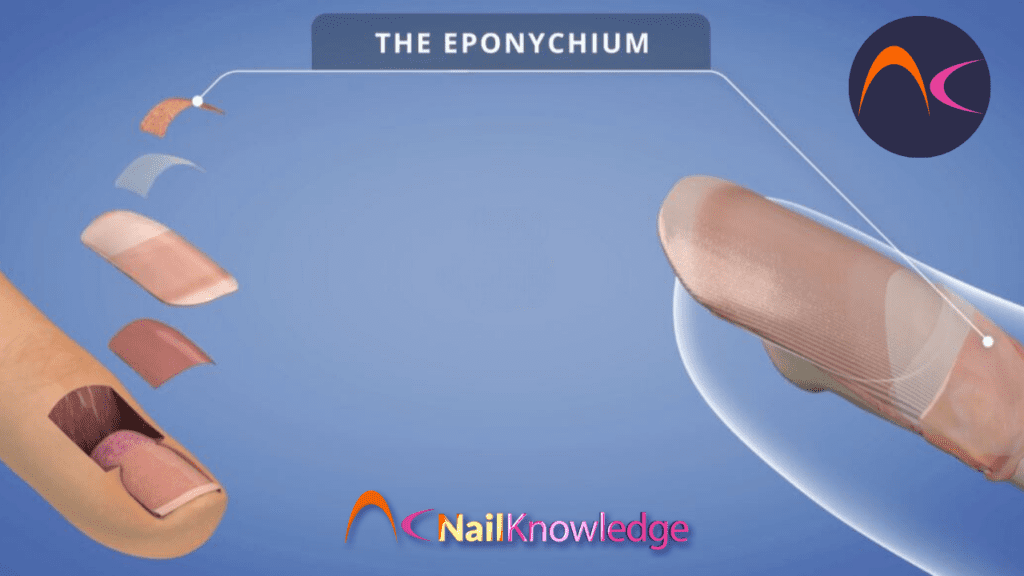
So, what exactly is the eponychium? Imagine it as a thin layer of specialized skin cells hidden underneath the proximal nail fold. It plays a crucial role in nail health, primarily responsible for producing the cuticle. Its main job? To form a protective barrier of non-living skin cells that shields your nail matrix from bacteria and germs—often referred to as opportunistic pathogens. Think of the eponychium as the mastermind behind the club’s security, keeping those unwanted guests out. Without its protection, your nails would be vulnerable to all sorts of intruders!

Cây Eponychium
Taken from our Animated Course The Essential Nail Diploma

What is the Cuticle?

Moving on to the cuticle—this is the part many people think they know.

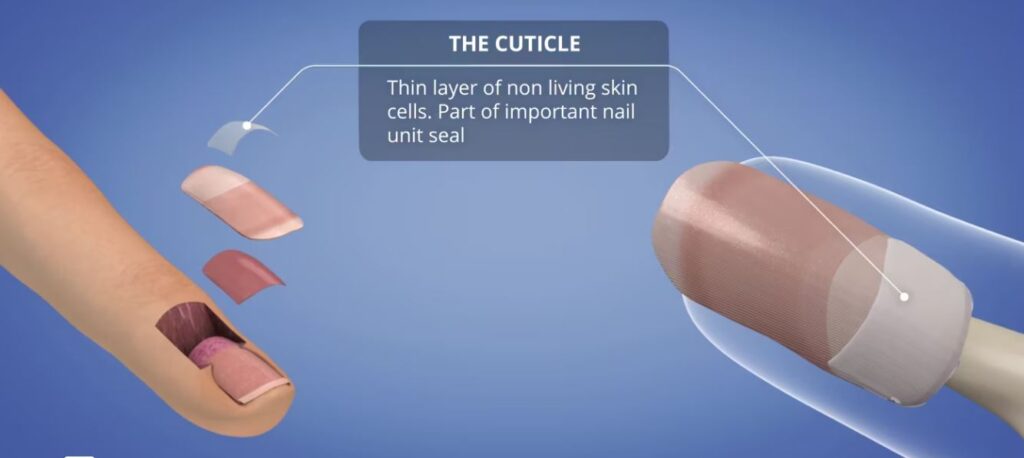
The cuticle is actually non-living skin that adheres tightly to your nail plate. If you think of the eponychium as the mastermind behind the club’s security, then the cuticle is the bouncer at the door. Why is this important? The cuticle forms a protective seal that prevents harmful agents from sneaking under your nail or reaching the crucial area of nail plate cell production. When this seal remains intact, your nail matrix is protected, continuously producing nail plate cells. Just as closing the door of a plane before take-off is crucial, maintaining the integrity of this cuticle seal is vital for the health of your nails—without it, there would be no nail plate!

The Nail Cuticle
Taken from our Animated Course The Essential Nail Diploma

Why the Confusion?

Now, you might wonder, why all the mix-up between the two? It’s easy to see why they’re often mistaken for one another—they’re neighbours, after all! Both reside in the same nail neighbourhood and work together to keep your nails looking fabulous and healthy. Plus, let’s be honest, even seasoned nail techs can find nail biology terms confusing, particularly when the focus is more on delivering a flawless mani-pedi than on discussing the finer points of giải phẫu móng tay.

The Importance of Distinguishing Between the Eponychium and Cuticle

Understanding the difference between the eponychium and the cuticle isn’t just nail tech jargon, it’s essential for proper nail care. Ever heard someone suggest cutting the cuticle? They might actually mean trimming excess living tissue that has dried out at the proximal nail fold as its almost impossible to trim the cuticle The good news is we can remove the cuticle safely from the nail plate with a quality oil and a curette, no scissors and no pain, just gorgeous nail plates ready for your favourite nail product. Knowing what’s what helps you avoid damaging your nails and ensures you’re actually taking care of them correctly. Would you rather treat your nails like delicate silk or just any old fabric? I thought so!

Further your Expertise on the Eponychium

Interested in enhancing your professional knowledge?  Why not explore our detailed master article on the nấm móng. This resource is tailored for nail technicians seeking to deepen their understanding of nail anatomy, ensuring precision and care in every procedure. Equip yourself with expert insights that elevate your practice above the rest. Our Knowledge Base serves as a comprehensive resource for all things related to nails!  

Phần kết luận

As a nail professional, whether you’re at your station in a salon or setting up for a client visit, keep these insights in mind. Understanding the difference between the eponychium and the cuticle is essential for avoiding common nail care errors that could affect your work and client satisfaction.

Thuộc chủ đề:BLOG, Thông tin chung, Phá vỡ huyền thoại, Công nghệ làm móng

Hiểu Bảy Tính Chất Quan Trọng Của Móng Tay Tự Nhiên Và Móng Tay Nhân Tạo – Phần 2 Độ Cứng

Độ cứng: Tính chất quan trọng thứ hai của móng tay tự nhiên và móng tay nhân tạo

Độ cứng là gì?

Hardness is often confused with strength, yet it’s important to distinguish between these two properties. Hardness specifically refers to a substance’s ability to resist surface scratching or denting. For example, glass is easy to shatter yet has a very hard surface. Diamonds, recognized as the hardest natural substance, can scratch glass and many other materials because of their superior hardness.

When it comes to nails, both natural and artificial, the level of hardness determines how likely they are to withstand surface damage such as scratches, stains, or peeling. The hardness of a nail can be noticeably different when it becomes softer than normal, making it more vulnerable to these issues, particularly during the removal of artificial nail coatings.

Tại sao độ cứng lại quan trọng đối với móng tay

Nail plates require a balanced level of hardness. If too hard, nails can become brittle, leading to issues like cracking and splitting. Conversely, overly soft nails are susceptible to peeling and damage from routine activities. Therefore, understanding and maintaining the correct hardness is crucial for the health and aesthetics of nail plates.

The comparison between nail plates and other materials can be quite illustrative. For instance, although a diamond is extremely hard, it isn’t necessarily the ideal hardness for a nail plate. Imagine nails as hard as diamonds; they would resist scratching but could become excessively brittle and impractical for everyday use.

Tác động của chất làm cứng móng tay

Chất làm cứng móng là sản phẩm được thiết kế để tăng độ cứng của móng. Tuy nhiên, chúng phải được sử dụng một cách thận trọng. Sử dụng chất làm cứng quá mức hoặc kéo dài có thể khiến móng trở nên quá cứng và giòn. Lý tưởng nhất là chỉ nên sử dụng chất làm cứng móng để đạt được mức độ cứng mong muốn và nên ngừng sử dụng khi đã đạt được mức độ này.

This concept aligns with the balance sought in other areas of life and nature. As Confucius famously said, “The green reed which bends in the wind is stronger than the mighty oak which breaks in a storm.” This analogy highlights the importance of flexibility within hardness; nails should have enough hardness to resist superficial damage but maintain enough flexibility to avoid breakage under stress.

Những cân nhắc khi phủ móng tay giả

Artificial nails also need to consider the balance between hardness and flexibility. Overly brittle artificial nails can lead to service breakdown, such as cracking and peeling. On the other hand, if artificial nails are too flexible, they may not provide the desired look or durability. Adjusting the hardness to achieve the right mix of rigidity and flexibility can significantly enhance the performance and longevity of artificial nails.

Cân bằng độ cứng để có sức khỏe móng tối ưu

Understanding and controlling the hardness of both natural and artificial nails is crucial for ensuring optimal performance and maintaining nail health. It allows nail care professionals to tailor treatments and products to the specific needs of their clients, ensuring both beauty and functionality are achieved.

Khám phá thêm các đặc tính chính của móng tay trong loạt bài gồm 7 phần của chúng tôi:

  • Sức mạnh của móng tay – Khám phá cách độ cứng của đinh ảnh hưởng đến hiệu suất và độ bền của chúng.
  • Độ cứng của móng tay – Hiểu rõ vai trò quan trọng của độ cứng đối với sức khỏe móng tay và cách duy trì sự cân bằng hoàn hảo.
  • Độ đàn hồi của móng tay – Hiểu rõ tầm quan trọng của sự dẻo dai trong việc ngăn ngừa móng tay gãy và duy trì độ bền.
  • Độ cứng của móng – Tìm hiểu điều gì khiến móng tay trở nên dẻo dai và đặc tính này khác biệt như thế nào so với độ bền và độ cứng.
  • Móng tay giòn – Tìm hiểu nguyên nhân khiến móng tay dễ gãy và cách phòng ngừa.
  • Khả năng kháng dung môi của móng tay – Tìm hiểu cách móng tay có thể chống lại tác hại của hóa chất và dung môi.
  • Mòn móng tay – Hiểu rõ các yếu tố ảnh hưởng đến khả năng chịu đựng của móng tay trước việc sử dụng thường xuyên và tác động của môi trường.

Thuộc chủ đề:Thông tin chung, Công nghệ làm móng

Hiểu Bảy Tính Chất Quan Trọng Của Móng Tay Tự Nhiên Và Móng Tay Nhân Tạo – Phần 1 Độ Bền

Có bảy đặc tính quan trọng của móng tay tự nhiên và móng tay nhân tạo thường quyết định cách móng tay của bạn hoạt động trong các tình huống thực tế.

Bảy đặc tính chính này, gồm độ bền, độ cứng, độ linh hoạt, độ dai, độ giòn, khả năng chống dung môi và độ mài mòn, đóng vai trò quan trọng trong việc hiểu cách thức hoạt động và ứng xử của móng tay tự nhiên và móng tay nhân tạo.

Interestingly, these same properties apply to both natural and artificial nail coatings. For instance, if a client snags their natural or artificial nail on something, how will that nail respond? Will it tear or crack or will it resist being damaged?

This often depends on one or more of these important properties. Let’s review them, so you can have a deeper understanding of how these properties can affect all types of nails.

Properly understanding these properties will help everyone, from nail enthusiasts to professionals, make better choices for nail care and maintenance.

Hiểu về độ bền của móng: Tính chất quan trọng đầu tiên của móng tay tự nhiên và móng tay nhân tạo

  1. Sức mạnh – What is Strength?

We use the word all the time in many ways; everything from the strength of a person’s character to muscle strength training; but nails don’t have muscles.

Of course, they certainly can have lots of character as any fan of nail art knows and they can certainly be strong, in fact they can be too strong, even dangerously strong!

Strength is defined as the ability of a material to “resist breaking under the stress of a heavy load or impact”. Bridges are good examples. They must be strong enough to hold all the crossing cars. In this case, the cars are the heavy load.

Thả một ly rượu vang xuống sàn gạch men và nó sẽ không đủ sức để chống lại tác động. Cũng vì lý do đó, một viên gạch men cứng sẽ vỡ nếu một chiếc chảo rán nặng bị thả xuống. Sức mạnh của một cành cây cho phép nó chống lại tải trọng bổ sung được tạo ra trong gió lớn. Cơ bắp của chúng ta phải đủ khỏe để chống lại việc bị xé toạc khi di chuyển những vật nặng. Sức mạnh của tóc cho phép nó chống lại sự gãy rụng khi được chải.

Why Nail Plates Need Strength—But Not Too Much

Why do nail plates need to be strong?  That is because we use them like tools. All the bending, picking, prying, poking, scratching and clawing we do with our nails is proof of their strength. 

Strength isn’t the only property that nail plates must possess. There are several other important properties to consider. Would you want nails like titanium alloy? It is very strong, but we don’t want or need our nail plates to be that strong. Not so strong that the nail plate would rip away from the nail bed and matrix area if caught on something.  It would be better if it broke instead, since the alternative would not be fun or pleasant and could cause serious, possibly irreversible damage to the nail bed and matrix.  Also, if client’s nails were that hard and inflexible, they could poke out someone’s eye, maybe their own!

Tất nhiên, chúng ta muốn móng tay chắc khỏe, nhưng không hẳn là chắc khỏe đến mức đó. Đúng không?

Điều quan trọng là móng tay phải gãy trong một số điều kiện nhất định, vì vậy chúng không được quá cứng. Móng tay được thiết kế để gãy tại một thời điểm nào đó trước khi có thể xảy ra tổn thương nghiêm trọng hơn, có khả năng vĩnh viễn.

The Issue with MMA: Why It’s Too Strong for Artificial Nails

This is one of the problems of the use of methyl methacrylate monomer (MMA), which is sometimes used as an ingredient in certain monomer liquid and polymer powder (L&P) formulations. MMA is too strong. Rather than break when impacted, the force will cause the natural nail to crack, rather than the artificial nail coating.

Nói cách khác, lớp phủ móng MMA quá mạnh để có thể hoạt động bình thường như một móng tay giả. Có những vấn đề khác với các đặc tính của MMA khiến nó trở thành một thành phần không mong muốn cho móng tay giả được thảo luận trong bài đăng trên blog này MMA và ngành công nghiệp làm móng.

Khám phá thêm các đặc tính chính của móng tay trong loạt bài gồm 7 phần của chúng tôi:

  • Sức mạnh của móng tay – Khám phá cách độ cứng của đinh ảnh hưởng đến hiệu suất và độ bền của chúng.
  • Độ cứng của móng tay – Hiểu rõ vai trò quan trọng của độ cứng đối với sức khỏe móng tay và cách duy trì sự cân bằng hoàn hảo.
  • Độ đàn hồi của móng tay – Hiểu rõ tầm quan trọng của sự dẻo dai trong việc ngăn ngừa móng tay gãy và duy trì độ bền.
  • Độ cứng của móng – Tìm hiểu điều gì khiến móng tay trở nên dẻo dai và đặc tính này khác biệt như thế nào so với độ bền và độ cứng.
  • Móng tay giòn – Tìm hiểu nguyên nhân khiến móng tay dễ gãy và cách phòng ngừa.
  • Khả năng kháng dung môi của móng tay – Tìm hiểu cách móng tay có thể chống lại tác hại của hóa chất và dung môi.
  • Mòn móng tay – Hiểu rõ các yếu tố ảnh hưởng đến khả năng chịu đựng của móng tay trước việc sử dụng thường xuyên và tác động của môi trường.

Thuộc chủ đề:Thông tin chung, Dịch vụ làm móng

  • « Chuyển đến Trang trước
  • Trang 1
  • Trang 2
  • Trang 3
  • Trang 4
  • Trang 5
  • Các trang tạm thời đã được bỏ qua …
  • Trang 30
  • Chuyển đến Trang sau »

Nâng cao kiến thức về làm móng

Tham gia bản tin của chúng tôi!
ĐĂNG KÝ...

Bản quyền © NailKnowledge

Kiến thức về móng tay

  • MyNailEra
  • Sách điện tử
  • Về chúng tôi
  • Các khóa học
  • Tin tức
  • Blog
  • Bản tin
  • Thuật ngữ

Chính sách

  • Trang riêng tư
  • Điều khoản và điều kiện
  • Chính sách Cookie

Ủng hộ

  • Liên hệ với chúng tôi
  • Gặp gỡ các chuyên gia
  • Hỏi các chuyên gia
  • Hỗ trợ hệ thống
  • Câu hỏi thường gặp
Vietnamese
Vietnamese
English Portuguese Spanish