• Saltar a la navegación principal
  • Saltar al contenido principal
  • Saltar al pie de página
Conocimientos de uñas

Conocimientos de uñas

  • Cursos
  • MyNailEra
  • Libros electrónicos gratuitos
  • Base de conocimientos
    • Base de conocimientos
    • Pregunte a los expertos
    • Glosario
  • Noticias
  • Blog
  • Inicio de sesión

Información general

Resistencia de las uñas: La cuarta propiedad clave de las uñas naturales y artificiales

In this fourth instalment of our series on the key properties of natural and artificial nails, we’ll focus on nail toughness. We’ve already discussed strength, hardness, and flexibility—each of these properties plays an essential role, but toughness is the combination of both strength and flexibility in balance. This perfect blend creates nails that are durable, resilient, and resistant to damage in everyday situations. Toughness is what we really want for our nails, ensuring they are both strong enough to withstand pressure and flexible enough to bend without breaking.

¿Qué es la dureza ungueal y por qué la necesitan las uñas?


La dureza se define como la capacidad de un material para absorber energía y deformarse sin romperse, lo que lo convierte en una combinación equilibrada de resistencia y flexibilidad. Las uñas, ya sean naturales o artificiales, tienen que ser duras para proteger las delicadas puntas de nuestros dedos. Cuanto más equilibradas estén las uñas entre resistencia y flexibilidad, más duras serán.

An excellent example of toughness can be found in nylon fishing lines. Although about the same thickness as cotton string, nylon is much more resistant to breakage due to its perfect balance of strength and flexibility. Similarly, the plastic rings used to hold soda cans together are incredibly tough, able to stretch without snapping. The same principle applies to both healthy hair and nail plates—they are tough materials because they balance strength and flexibility.

La relación entre la dureza y la tenacidad de las uñas


Nail toughness is closely related to hardness, another key property we’ve already explored. While hardness refers to a nail’s resistance to surface damage like scratching, toughness ensures that the nail can bend and absorb impact without cracking or breaking. Nails that are too hard without sufficient flexibility will become brittle, leading to breakage. On the other hand, nails that are too soft and flexible may not have the necessary durability to resist daily wear and tear.

Tanto en las uñas naturales como en las artificiales, el equilibrio de estas propiedades es crucial. Cuando las uñas son demasiado rígidas o demasiado blandas, se pierde dureza y las uñas se vuelven más susceptibles de sufrir daños. Por eso es necesario adaptar los productos y tratamientos para garantizar que las uñas tengan suficiente resistencia y flexibilidad para seguir siendo resistentes.

Por qué la dureza es importante tanto para las uñas naturales como para las artificiales


La dureza es una de las propiedades más importantes de las placas ungueales, ya que deben soportar las tensiones de actividades cotidianas como teclear, agarrar y la exposición a factores ambientales. Sin dureza, las uñas pueden volverse quebradizas, propensas a partirse o agrietarse. En el caso de las uñas artificiales, garantizar que los recubrimientos proporcionen suficiente tenacidad es esencial para evitar averías en el servicio, y la flexibilidad ayuda a evitar que se despeguen o levanten.

Cuando las uñas pierden dureza, suele deberse a que se ha alterado el equilibrio entre fuerza y flexibilidad. Demasiada fuerza sin suficiente flexibilidad puede hacer que las uñas se vuelvan quebradizas, mientras que demasiada flexibilidad sin suficiente fuerza puede debilitarlas. El resultado es una pérdida de durabilidad y una mayor susceptibilidad a los daños. Este delicado equilibrio es la razón por la que los profesionales del cuidado de las uñas deben ser conscientes de los tratamientos y productos que utilizan, asegurándose de que se mantiene la dureza.

Mejorar la resistencia de las uñas para una salud óptima


La clave para mejorar la dureza de las uñas es mantener el equilibrio adecuado entre fuerza y flexibilidad. En el caso de las uñas naturales, esto implica unas rutinas de cuidado adecuadas que incluyan la hidratación, la protección de las uñas frente a la exposición excesiva al agua y la evitación de productos químicos agresivos que puedan resecar y debilitar la placa ungueal. En el caso de las uñas artificiales, implica elegir los sistemas adecuados, como los que equilibran flexibilidad y resistencia, garantizando que las uñas puedan soportar el estrés de la vida diaria.

In conclusion, toughness is a vital property of nails, combining both strength and flexibility to create durable and resilient nail plates. By understanding and enhancing toughness, you can help ensure that your nails—whether natural or artificial—are equipped to handle the demands of everyday use.

Explore más propiedades clave de las uñas en nuestra serie de 7 partes:

  • Fuerza de las uñas – Discover how the strength of nails impacts their performance and durability.
  • Dureza de las uñas – Understand the crucial role of hardness in nail health and how to maintain the perfect balance.
  • Flexibilidad de las uñas – Understand the importance of flexibility in preventing nail breakage and maintaining resilience.
  • Resistencia de las uñas – Find out what makes nails tough and how this property differs from strength and hardness.
  • Uñas quebradizas – Learn what causes brittleness in nails and how to prevent it.
  • Resistencia a disolventes para uñas – Explore how nails can resist damage from chemicals and solvents.
  • Uñas – Understand the factors that affect how well nails withstand regular use and environmental exposure.

By focusing on toughness, and the critical balance between nail hardness and flexibility, you’ll gain deeper insights into maintaining the durability and health of both natural and artificial nails.
Publicado en: Información general, Servicios de uñas

Siete propiedades importantes de las uñas naturales y artificiales - Parte 3 Flexibilidad

Flexibilidad de las uñas: La tercera propiedad clave de las uñas naturales y artificiales

In this third part of our series on the key properties of natural and artificial nails, we move from strength and hardness to explore flexibility. As we have already discussed, strength is the ability of a material to resist breaking under pressure, while hardness determines how well a material can resist surface scratching or denting. Flexibility, however, is the capacity of a material to bend without breaking. Just as Confucius said, “The green reed which bends in the wind is stronger than the mighty oak which breaks in a storm,” flexibility is essential for nails to absorb impact and avoid damage. This balance between hardness and flexibility is what keeps nails resilient in everyday activities.

¿Qué es la flexibilidad y por qué es importante?

La flexibilidad permite que una sustancia se doble y absorba la fuerza sin agrietarse ni romperse. Esto es especialmente importante en el caso de las uñas, tanto naturales como artificiales, ya que evita que se rompan bajo presión. Las placas ungueales normales y sanas tienen un buen grado de flexibilidad, lo que significa que se doblan en lugar de romperse cuando están sometidas a presión. Por el contrario, las uñas inflexibles son más propensas a agrietarse y romperse, lo que puede provocar molestias y daños en la piel. lecho ungueal.

Hay varios factores que influyen en la flexibilidad de las uñas, como la edad, la dieta, el estado general de salud y la exposición a productos químicos agresivos o a las condiciones ambientales. Por ejemplo, la exposición prolongada o repetida a productos de limpieza, agua, tierra de jardín y abono y/o disolventes puede fragilizar las placas ungueales y reducir su flexibilidad, además de hacerlas propensas a las infecciones. Los profesionales del cuidado de las uñas deben reconocer este equilibrio y seleccionar tratamientos o sistemas de clavos that best suit the flexibility of their clients’ nails but also their clients habits, work and hobbies.

Dureza y flexibilidad de las uñas: Encontrar el equilibrio

While hardness and flexibility are often confused, they are distinct properties. Nail hardness refers to a nail’s resistance to surface damage like scratching or denting, while flexibility determines how well a nail can bend without breaking. A healthy nail needs both hardness and flexibility. Nails that are too hard may resist (surface) scratching but are at a greater risk of cracking or breaking under pressure. Conversely, overly flexible nails can become weak and prone to breakage.

For artificial nails, striking this balance is equally important. For example, cyanoacrylate-based systems, like fiberglass wraps, are highly flexible. However, they may not reinforce overly flexible natural nails and can lead to lifting, cracking or breakage. In contrast, systems that use monomer liquid and polymer powder, or UV gels, can provide greater strength and protection (depending on the ingredients) for weaker, more flexible nails.

Por qué demasiada flexibilidad puede ser un problema

While flexibility is necessary, too much of it can also lead to issues. Nails that are excessively flexible can become fragile and prone to damage. A prime example is the use of methyl methacrylate monomer (MMA) in artificial nails, which creates coatings that are too rigid and not flexible enough. This lack of flexibility causes the nail coating to resist bending with the natural nail, leading to a greater risk of severe nail bed damage.

For healthy nails, whether natural or artificial, it’s essential to maintain a degree of flexibility that allows the nail to bend without breaking, while still providing enough strength to withstand daily activities. Products that promote a balance of strength and flexibility matched to the condition of the natural nail are key to ensuring that nails remain healthy, durable, and aesthetically pleasing.

Mantener la flexibilidad de las uñas naturales y artificiales

To keep nails flexible, it is important to avoid overexposure to harsh chemicals and solvents, which can weaken the nail plate over time. Proper cleansing and the use of nail care products that moisturize and protect the nail can help maintain the flexibility necessary for nail health. When it comes to artificial nails, choosing products that match the natural nails so they can enhance both the appearance and durability of the nails is essential for health of the nails and durability of the enhancement, regardless of the product used.

En conclusión, la flexibilidad es una propiedad fundamental tanto de las uñas naturales como de las artificiales. Les permite ceder bajo presión, evitando grietas y roturas. Sin embargo, lograr el equilibrio adecuado entre dureza y flexibilidad de la uña es clave para mantener la salud de las uñas y su durabilidad y rendimiento.

Explore más propiedades clave de las uñas en nuestra serie de 7 partes:

  • Fuerza de las uñas – Discover how the strength of nails impacts their performance and durability.
  • Dureza de las uñas – Understand the crucial role of hardness in nail health and how to maintain the perfect balance.
  • Flexibilidad de las uñas – Understand the importance of flexibility in preventing nail breakage and maintaining resilience.
  • Resistencia de las uñas – Find out what makes nails tough and how this property differs from strength and hardness.
  • Uñas quebradizas – Learn what causes brittleness in nails and how to prevent it.
  • Resistencia a disolventes para uñas – Explore how nails can resist damage from chemicals and solvents.
  • Uñas – Understand the factors that affect how well nails withstand regular use and environmental exposure.

By learning more about flexibility and its interaction with other properties like nail hardness, you’ll gain valuable insights into how to maintain healthy, strong, and resilient nails.

Publicado en: Información general, Servicios de uñas

Por qué los profesionales de las uñas deben centrarse en el hiponiquio

El protector oculto

Como profesional de las uñas, sabes lo importante que es mantener unas uñas impecables, pero ¿cuántas veces hablamos realmente de la hiponiquio? It might not be the most glamorous part of the nail, but it’s one of the most crucial. If you’ve been overlooking it, now’s the time to change that. Let’s investigate why the hyponychium deserves your attention and how understanding it can elevate your nail care skills to a whole new level.

¿Qué es exactamente el hiponiquio?

The hyponychium is the area of skin right under the free edge of the nail plate—the part of the nail that extends past the fingertip. Think of it as the gatekeeper of the nail unit, forming a seal that keeps harmful bacteria, pathogens, and allergens out. It might look small and simple, but it plays a big role in keeping the sensitive areas of the nail bed and matrix protected. Neglecting this area could leave your clients vulnerable to infections or other nail issues, which brings us to our next point.

¿Por qué los técnicos de uñas deben preocuparse por el hiponiquio?

As nail professionals, your clients rely on you to not only make their nails look great but also to keep them healthy. The hyponychium is packed with nerve endings—sort of like a security system for the nail. If this protective seal is broken, those nerve endings kick into gear, alerting the body with discomfort or pain. This should be your first clue that something isn’t right. A compromised hyponychium can open the door for bacteria, fungal infections, and even onycholysis (when the nail plate starts separating from the nail bed).

En resumen: un hiponiquio sano significa unas uñas felices y sanas. Y eso significa clientes contentos.

Signos de que el hiponiquio necesita atención

Como técnico de uñas, conocer los signos del hiponiquio puede evitar problemas mayores. He aquí algunas cosas que debes tener en cuenta:

  • Engrosamiento o decoloración: Si el hiponiquio empieza a espesarse o a cambiar de color, podría ser un signo de infección. Si se sospecha de una infección fúngica, haz una prueba para saberlo con seguridad y trata en consecuencia.
  • Dolor o malestar: Your client mentions sensitivity or pain around the free edge—this could indicate that the seal has been compromised.
  • Onicólisis: If you notice the nail lifting from the nail bed, that’s a major red flag. This condition often stems from a damaged hyponychium and can lead to a more serious infection if not addressed.

El impacto del hiponiquio en la salud de las uñas

If the hyponychium is compromised, it doesn’t just affect the appearance of the nails—it can cause real health concerns for your client. Infections can develop, and untreated issues can even lead to long-term damage to the nail matrix. You don’t want that for your clients, and they don’t want to deal with it either.

¿Cómo proteger esta zona tan importante? La clave es manipular las uñas con cuidado. Limar demasiado el borde libre o utilizar herramientas demasiado agresivas puede dañar el hiponiquio. Además, asegúrate de animar a tus clientes a evitar malos hábitos como arrancarse las uñas, que pueden romper el sello e invitar a la infección.

Una buena higiene de las uñas es su mejor defensa.

Here’s what you can do as a nail professional to maintain a strong and healthy hyponychium for your clients:

  1. Archivado suave: Al dar forma a las uñas, evite el exceso de limado cerca del borde libre para proteger el hiponiquio.
  2. Limpio pero cuidadoso: Mantenga limpia la zona de la uña, pero evite pinchar o empujar demasiado fuerte el hiponiquio.
  3. Atención a los signos de infección: Esté siempre atento a la decoloración, engrosamiento o signos de incomodidad.
  4. Educar a los clientes: Enseñe a sus clientes la importancia del hiponiquio y las rutinas adecuadas de cuidado de las uñas para mantener esta zona intacta.
  5. Mantenimiento de la unidad de clavos: When applying oil, do so at the back side of the free edge, this way the oil first soaks around the hyponychium before it makes its way along the lateral nail folds to the PNF.

Final Thoughts: Don’t Overlook the Hyponychium

As a nail professional, your expertise goes beyond just aesthetics—your job is to protect the health of your clients’ nails. The hyponychium may be hidden, but it plays a critical role in nail health. By giving this small but mighty structure the attention it deserves, you’re ensuring your clients not only walk away with beautiful nails but with nails that are strong and healthy from the inside out.

So, next time you’re prepping a client’s nails, take a moment to think about the hyponychium.

It’s not just another part of the nail—it’s the silent protector that makes all the difference.

Publicado en: Información general, Servicios de uñas

Comprender el eponiquio frente a la cutícula

¿Alguna vez te han desconcertado los términos relacionados con las uñas que se utilizan en salones de belleza, aulas, materiales educativos o redes sociales?

You’re not alone! Today, we’re cracking the case on two often misunderstood heroes of nail anatomy: the eponychium and the cuticle. Ever mixed these two up? Let’s sort them out once and for all!

¿Qué es el eponiquio?

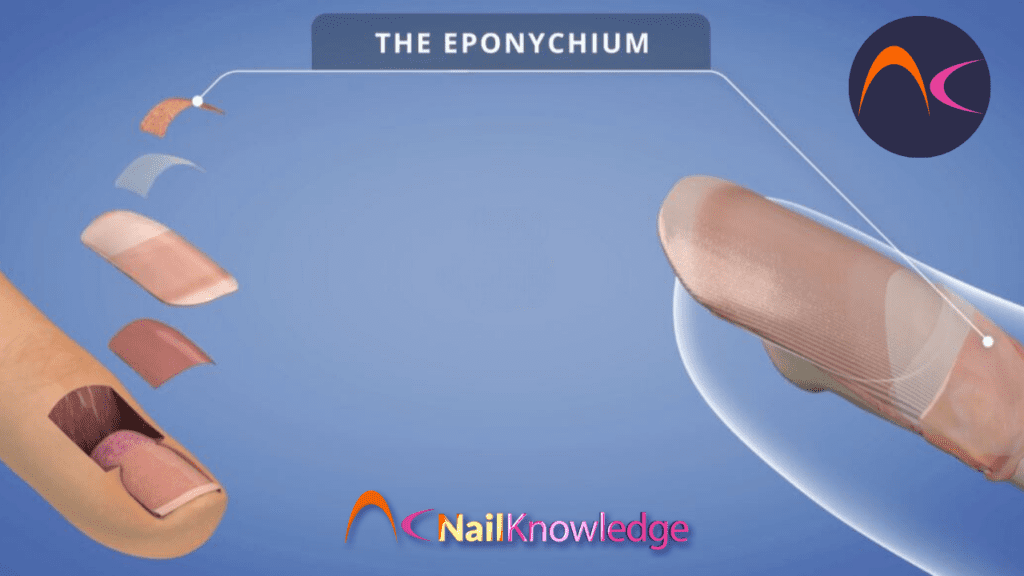
So, what exactly is the eponychium? Imagine it as a thin layer of specialized skin cells hidden underneath the proximal nail fold. It plays a crucial role in nail health, primarily responsible for producing the cuticle. Its main job? To form a protective barrier of non-living skin cells that shields your nail matrix from bacteria and germs—often referred to as opportunistic pathogens. Think of the eponychium as the mastermind behind the club’s security, keeping those unwanted guests out. Without its protection, your nails would be vulnerable to all sorts of intruders!

El eponiquio
Extraído de nuestro curso de animación El Diploma Esencial de Uñas

¿Qué es la cutícula?

Moving on to the cuticle—this is the part many people piense en lo saben.

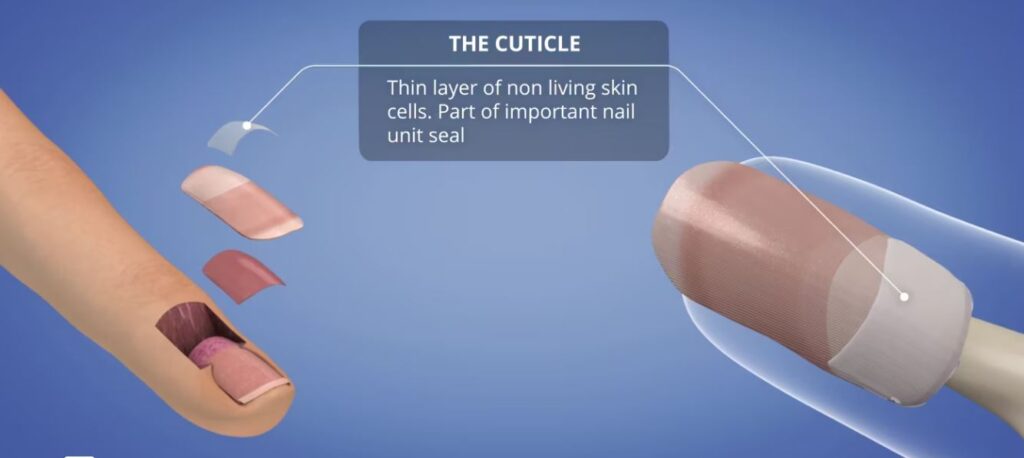
The cuticle is actually non-living skin that adheres tightly to your nail plate. If you think of the eponychium as the mastermind behind the club’s security, then the cuticle is the bouncer at the door. Why is this important? The cuticle forms a protective seal that prevents harmful agents from sneaking under your nail or reaching the crucial area of nail plate cell production. When this seal remains intact, your nail matrix is protected, continuously producing nail plate cells. Just as closing the door of a plane before take-off is crucial, maintaining the integrity of this cuticle seal is vital for the health of your nails—without it, there would be no nail plate!

La cutícula de las uñas
Extraído de nuestro curso de animación El Diploma Esencial de Uñas

¿Por qué la confusión?

Now, you might wonder, why all the mix-up between the two? It’s easy to see why they’re often mistaken for one another—they’re neighbours, after all! Both reside in the same nail neighbourhood and work together to keep your nails looking fabulous and healthy. Plus, let’s be honest, even seasoned nail techs can find nail biology terms confusing, particularly when the focus is more on delivering a flawless mani-pedi than on discussing the finer points of anatomía de la uña.

La importancia de distinguir entre eponiquio y cutícula

Understanding the difference between the eponychium and the cuticle isn’t just nail tech jargon, it’s essential for proper nail care. Ever heard someone suggest cutting the cuticle? They might actually mean trimming excess living tissue that has dried out at the proximal nail fold as its almost impossible to trim the cuticle The good news is we can remove the cuticle safely from the nail plate with a quality oil and a curette, no scissors and no pain, just gorgeous nail plates ready for your favourite nail product. Knowing what’s what helps you avoid damaging your nails and ensures you’re actually taking care of them correctly. Would you rather treat your nails like delicate silk or just any old fabric? I thought so!

Amplíe sus conocimientos sobre el eponiquio

Interested in enhancing your professional knowledge?  Why not explore our detailed master article on the eponychium. This resource is tailored for nail technicians seeking to deepen their understanding of nail anatomy, ensuring precision and care in every procedure. Equip yourself with expert insights that elevate your practice above the rest. Our Knowledge Base serves as a comprehensive resource for all things related to nails!  

Conclusión

As a nail professional, whether you’re at your station in a salon or setting up for a client visit, keep these insights in mind. Understanding the difference between the eponychium and the cuticle is essential for avoiding common nail care errors that could affect your work and client satisfaction.

Publicado en: BLOG, Información general, Acabar con los mitos, Tecnología de uñas

Siete propiedades importantes de las uñas naturales y artificiales - Parte 2 Dureza

La dureza: La segunda propiedad clave de las uñas naturales y artificiales

¿Qué es la dureza?

Hardness is often confused with strength, yet it’s important to distinguish between these two properties. Hardness specifically refers to a substance’s ability to resist surface scratching or denting. For example, glass is easy to shatter yet has a very hard surface. Diamonds, recognized as the hardest natural substance, can scratch glass and many other materials because of their superior hardness.

Cuando se trata de uñas, tanto naturales como artificiales, el nivel de dureza determina la probabilidad de que resistan daños superficiales como arañazos, manchas o descamación. La dureza de una uña puede ser notablemente diferente cuando se vuelve más blanda de lo normal, lo que la hace más vulnerable a estos problemas, sobre todo durante la retirada de los recubrimientos de uñas artificiales.

Por qué es importante la dureza de las placas de uñas

Las placas ungueales requieren un nivel equilibrado de dureza. Si son demasiado duras, pueden volverse quebradizas y provocar grietas y roturas. Por el contrario, unas uñas demasiado blandas son susceptibles de descamarse y dañarse con las actividades rutinarias. Por lo tanto, conocer y mantener la dureza correcta es crucial para la salud y la estética de las placas ungueales.

The comparison between nail plates and other materials can be quite illustrative. For instance, although a diamond is extremely hard, it isn’t necessarily the ideal hardness for a nail plate. Imagine nails as hard as diamonds; they would resist scratching but could become excessively brittle and impractical for everyday use.

El impacto de los endurecedores de uñas

Los endurecedores de uñas son productos diseñados para aumentar la dureza de las placas ungueales. Sin embargo, deben utilizarse con prudencia. El uso excesivo o prolongado de endurecedores puede hacer que las uñas se vuelvan demasiado duras y quebradizas. Idealmente, los endurecedores de uñas sólo deben utilizarse para alcanzar un nivel de rigidez deseable, y su uso debe interrumpirse una vez conseguido.

This concept aligns with the balance sought in other areas of life and nature. As Confucius famously said, “The green reed which bends in the wind is stronger than the mighty oak which breaks in a storm.” This analogy highlights the importance of flexibility within hardness; nails should have enough hardness to resist superficial damage but maintain enough flexibility to avoid breakage under stress.

Consideraciones sobre el recubrimiento de uñas artificiales

Artificial nails also need to consider the balance between hardness and flexibility. Overly brittle artificial nails can lead to service breakdown, such as cracking and peeling. On the other hand, if artificial nails are too flexible, they may not provide the desired look or durability. Adjusting the hardness to achieve the right mix of rigidity and flexibility can significantly enhance the performance and longevity of artificial nails.

Equilibrar la dureza para una salud óptima de las uñas

Conocer y controlar la dureza de las uñas naturales y artificiales es crucial para garantizar un rendimiento óptimo y mantener la salud de las uñas. Permite a los profesionales del cuidado de las uñas adaptar los tratamientos y productos a las necesidades específicas de sus clientes, garantizando tanto la belleza como la funcionalidad.

Explore más propiedades clave de las uñas en nuestra serie de 7 partes:

  • Fuerza de las uñas – Discover how the strength of nails impacts their performance and durability.
  • Dureza de las uñas – Understand the crucial role of hardness in nail health and how to maintain the perfect balance.
  • Flexibilidad de las uñas – Understand the importance of flexibility in preventing nail breakage and maintaining resilience.
  • Resistencia de las uñas – Find out what makes nails tough and how this property differs from strength and hardness.
  • Uñas quebradizas – Learn what causes brittleness in nails and how to prevent it.
  • Resistencia a disolventes para uñas – Explore how nails can resist damage from chemicals and solvents.
  • Uñas – Understand the factors that affect how well nails withstand regular use and environmental exposure.

Publicado en: Información general, Tecnología de uñas

Siete propiedades importantes de las uñas naturales y artificiales - Parte 1 Resistencia

Hay siete propiedades importantes de las uñas naturales y artificiales que a menudo son responsables de cómo se comportarán sus uñas en situaciones del mundo real.

Estas siete propiedades clave -resistencia, dureza, flexibilidad, tenacidad, fragilidad, resistencia a los disolventes y desgaste- son cruciales para comprender el comportamiento de las uñas naturales y artificiales.

Curiosamente, estas mismas propiedades se aplican tanto a los recubrimientos de uñas naturales como artificiales. Por ejemplo, si una clienta se engancha la uña natural o artificial con algo, ¿cómo responderá esa uña? ¿Se romperá o agrietará o resistirá el daño?

This often depends on one or more of these important properties. Let’s review them, so you can have a deeper understanding of how these properties can affect all types of nails.

Conocer bien estas propiedades ayudará a todos, desde los aficionados a las uñas hasta los profesionales, a tomar mejores decisiones para el cuidado y mantenimiento de las uñas.

Comprender la fuerza de las uñas: La primera propiedad clave de las uñas naturales y artificiales

  1. Fuerza – What is Strength?

We use the word all the time in many ways; everything from the strength of a person’s character to muscle strength training; but nails don’t have muscles.

Of course, they certainly can have lots of character as any fan of nail art knows and they can certainly be strong, in fact they can be too strong, even dangerously strong!

Strength is defined as the ability of a material to “resist breaking under the stress of a heavy load or impact”. Bridges are good examples. They must be strong enough to hold all the crossing cars. In this case, the cars are the heavy load.

Deje caer una copa de vino sobre un suelo de baldosas de cerámica y no tendrá fuerza para resistir el impacto. Por la misma razón, una baldosa de cerámica dura se rompería si se dejara caer una sartén pesada. La fuerza de la rama de un árbol le permite resistir la carga adicional que se crea cuando sopla un viento fuerte. Nuestros músculos deben ser lo bastante fuertes para resistir el desgarro al mover cargas pesadas. La fuerza del cabello le permite resistir la rotura al cepillarlo.

Why Nail Plates Need Strength—But Not Too Much

¿Por qué tienen que ser fuertes las placas de las uñas? Porque las utilizamos como herramientas. Todo lo que doblamos, cogemos, pinchamos, arañamos y arañamos con las uñas es una prueba de su resistencia. 

Strength isn’t the only property that nail plates must possess. There are several other important properties to consider. Would you want nails like titanium alloy? It is very strong, but we don’t want or need our nail plates to be that strong. Not so strong that the nail plate would rip away from the nail bed and matrix area if caught on something.  It would be better if it broke instead, since the alternative would not be fun or pleasant and could cause serious, possibly irreversible damage to the nail bed and matrix.  Also, if client’s nails were that hard and inflexible, they could poke out someone’s eye, maybe their own!

Por supuesto, queremos uñas fuertes, pero no tanto. ¿Verdad?

Es importante que la placa ungueal se rompa en determinadas condiciones, por lo que no deben ser demasiado fuertes. Las placas ungueales están diseñadas para romperse en algún momento antes de que puedan producirse daños más graves, potencialmente permanentes.

The Issue with MMA: Why It’s Too Strong for Artificial Nails

This is one of the problems of the use of methyl methacrylate monomer (MMA), which is sometimes used as an ingredient in certain monomer liquid and polymer powder (L&P) formulations. MMA is too strong. Rather than break when impacted, the force will cause the natural nail to crack, rather than the artificial nail coating.

En otras palabras, un recubrimiento de uñas de MMA es demasiado fuerte para funcionar correctamente como uña artificial. Hay otros problemas con las propiedades del MMA que lo convierten en un ingrediente indeseable para las uñas artificiales que se discuten en esta entrada del blog MMA y la industria de las uñas.

Explore más propiedades clave de las uñas en nuestra serie de 7 partes:

  • Fuerza de las uñas – Discover how the strength of nails impacts their performance and durability.
  • Dureza de las uñas – Understand the crucial role of hardness in nail health and how to maintain the perfect balance.
  • Flexibilidad de las uñas – Understand the importance of flexibility in preventing nail breakage and maintaining resilience.
  • Resistencia de las uñas – Find out what makes nails tough and how this property differs from strength and hardness.
  • Uñas quebradizas – Learn what causes brittleness in nails and how to prevent it.
  • Resistencia a disolventes para uñas – Explore how nails can resist damage from chemicals and solvents.
  • Uñas – Understand the factors that affect how well nails withstand regular use and environmental exposure.

Publicado en: Información general, Servicios de uñas

  • « Ir a la página anterior
  • Página 1
  • Página 2
  • Página 3
  • Página 4
  • Página 5
  • Páginas intermedias omitidas ...
  • Página 30
  • Ir a la página siguiente »

Mejora tus conocimientos sobre uñas

Suscríbase a nuestro boletín
SUSCRÍBETE...

Copyright © NailKnowledge

Conocimientos de uñas

  • MyNailEra
  • Libros electrónicos
  • Quiénes somos
  • Cursos
  • Noticias
  • Blog
  • Boletín
  • Glosario

Políticas

  • Página de privacidad
  • Condiciones generales
  • Política de cookies

Ayuda

  • Póngase en contacto con nosotros
  • Conozca a los expertos
  • Pregunte a los expertos
  • Soporte del sistema
  • Preguntas frecuentes
Spanish
Spanish
English Portuguese Vietnamese