• Skip to primary navigation
  • Skip to main content
  • Skip to footer
NailKnowledge

NailKnowledge

  • Courses
  • eBooks
  • eBook Basket
  • Knowledge Base
    • Knowledge Base
    • Ask the Experts
    • Glossary
  • News
  • Blog
  • Gallery
    • Nail Art Gallery
    • Nail Artists
    • Join the Elite
  • Login

Archives for December 1, 2023

The Science Behind the Nail Top Coat

Nail care goes beyond simply choosing the right nail polish color; it’s a captivating blend of science and art that produces incredible results. And in this exciting world of nail products, the unsung hero is none other than the humble nail top coat. Shall we have a look at the fascinating science behind this unassuming yet essential finishing touch.

The Glossy Finish of the Nail Top Coat

We all adore that mirror-like shine that a good top coat provides. But have you ever wondered how it works its magic? At its core, a top coat is designed to deliver a high-gloss finish that not only enhances the manicure but also offers protection.

The Science: Top coats contain film-forming ingredients that create a transparent shield over your nail polish. These ingredients are usually quick-drying and formulated to produce a gleaming surface. Think of it as a protective glass layer, made to preserve and enhance the colours beneath.

Durability and Chip Resistance

The last thing we want is for our perfect nail art or vibrant colour to chip or fade prematurely. A top coat plays a pivotal role in extending the life of your manicure, ensuring it stays intact for longer.

The Science: The formulation of a top coat often includes hardening agents like acrylic or polymer resins. These substances provide strength and resilience to your nail polish, making it more resistant to the wear and tear of daily life. It’s like giving your nails an invisible suit of armor.

Nail Top Coat Drying Time Acceleration

Waiting for your nails to dry can feel like an eternity, but a top coat can help speed up the process.

The Science: Many top coats are designed with fast-drying formulas that work their magic by evaporating quickly. This not only saves you precious time but also reduces the chances of smudging or denting your freshly painted nails.

Preventing Fading and Discoloration

Sunlight and daily activities can lead to nail polish fading or changing colour over time. A good nail top coat can come to the rescue.

The Science: Some top coats include UV filters or colour stabilisers that help shield your manicure from the harmful effects of sunlight. They act as a barrier against the elements, preserving the vibrancy of your nail polish. This is true for gel top coats too!

Nail Top Coat Smoothing Imperfections

If you’ve ever had a slightly uneven nail polish application, a top coat can be your saviour. It helps in smoothing out minor imperfections, giving your manicure a polished look.

The Science: Top coats may contain self-levelling ingredients to smooth out uneven surfaces, ensuring that your nails appear flawless and well-finished.

Longevity and Shine of the Nail Top Coat

A top coat isn’t just about aesthetics; it’s about making your manicure last.

The Science: The chemistry of a top coat involves the careful selection of ingredients to achieve not only a high-gloss finish but also long-lasting wear. It’s the science of balance, combining elements that deliver both shine and durability.

In conclusion, the seemingly simple nail top coat is a masterpiece of science and artistry. It enhances the beauty of your nails, protects your manicure, and ensures your nail art stays flawless. The next time you apply a top coat, you’ll have a deeper appreciation for the science that transforms your nails into dazzling works of art.

Step by step: How to fix a dent in your nail polish

  • The key is to ‘float’ the new color over the dent
  • When applying top coat, load your brush just enough that you dont have to go back over it – this will give the perfect finish.
Color coat damaged
Color coat damaged
Reapply smoothly, no pressure on brush
Reapply smoothly – no pressure on brush
Damage is smoothed out
Apply Top Coat – no pressure on brush
Nail Top Coat, pressure stripes
Pressure will give stripes
Applying Nail Top Coat
Smooth finish – damage can’t be seen

FAQ’s

1. What is the purpose of a nail top coat?
A nail top coat serves several essential purposes in nail care. It provides a glossy finish, enhances the longevity of your manicure, protects nail polish from chipping, and can also add strength to your nails. Essentially, it’s the final step that seals and perfects your nail look.

2. How do I apply a nail top coat for the best results?
To achieve the best results with a nail top coat, follow these steps:

  • Wait until your nail polish is almost dry (but not fully dry) before applying the top coat.
  • Apply a thin, floaty layer of top coat, starting from the base and ending with a gentle swipe along the tips of your nails to seal the edges.
  • Allow the top coat to dry completely for a glossy, chip-resistant finish.

3. Can I use a regular clear nail polish as a top coat?
While regular clear nail polish can provide some protection and shine, it’s not as effective as a dedicated nail top coat. Top coats are specifically formulated with ingredients like quick-drying resins and UV filters to provide superior gloss, durability, and protection. Using a specialized top coat will yield better results.

4. How often should I reapply a nail top coat?
To maintain the longevity and shine of your manicure, it’s a good practice to reapply a nail top coat every few days. This helps refresh the gloss and adds an extra layer of protection to prevent chipping and fading. You can also apply a fresh top coat as part of your regular nail maintenance routine when you notice signs of wear and tear.

Filed Under: General Information, Lotions, Potions and Polishes, Product Chemistry

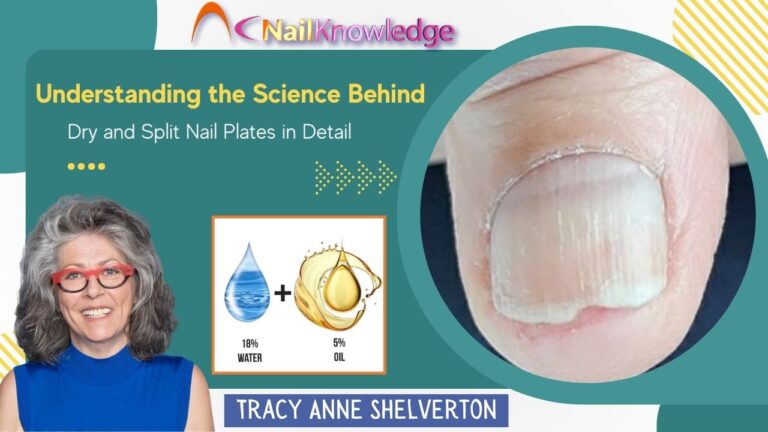
The Science Behind Dry and Split Nail Plates in Detail

First and foremost, let’s delve into the intricate science behind dry and split nail plates. Let’s understand the balance of oil and water within the nail plate and how it influences the health and strength of your nails.

A normal natural nail contains about 18% water and 5% oil. Optimal flexibility occurs when the nail plate holds around 25% moisture.

Natural Nails
Perfect Natural Nails
Water and oil percentage of the natural nail
Water & Oil Ratio in the Natural Nail

However, excessive water can weaken and damage the nail plate, similar to how a sponge shrinks as it dries out, leaving behind a dry and brittle nail plate. This process starts a vicious cycle that will only be stopped if we continue to add more moisture. It can take quite some time to recover the nail plate but as long as nail plate cells are being produced we will be successful.

before and after nail plate
Nail plate recovery – the lateral nail folds and the existence of the onychodermal band & hyponychium are now recovered and the difference is obvious, the proximal nail fold needs a little more time.

The Balancing Act: How Moisture Keeps Nail Plates Strong and Flexible

Nail plates that are consistently exposed to water, especially with soap, become soft and weak due to this ongoing process. Remember, soap dissolves oil. It takes a few hours for the nail plate to fully recover its normal ‘oil & water’ levels

Without a doubt, maintaining a proper moisture balance is essential for healthy natural nails. When the moisture balance is right, your natural nails can better withstand trauma due to their flexibility. Think of it like shock absorbers in a car or on a bicycle—they absorb the bumps in the road, ensuring you arrive without any bruises. Flexibility in the nail plate serves a similar purpose.

The Essential Oils: How They Nourish and Protect Nail Plates

5% Oil – Where Does It Come From?

These oils are produced in the nail bed and slowly penetrate through the nail plate from bottom to top, where they may eventually be washed away. These oils keep both the nail plate and the bed epithelium flexible. These oils are composed of ‘lipids,’ including squaleen and cholesterol.

Oil and water don’t naturally mix, so how can both penetrate the nail plate? It doesn’t seem logical for both to use the same channel, so could it be that they each take a different route? The scientific community hasn’t reached a definitive conclusion, but it’s suspected that they indeed take different paths. Here’s one possible explanation:

– Water enters the nail plate cell directly through the cell wall.

– Oil cannot penetrate the cell wall and instead seeps through the remaining spaces between the nail plate cells.

The Protective Power of Oils: How They Strengthen Your Dry and Split Nails

Oils plasticize the nail plate; they move much more slowly and evaporate less quickly. As a result, oil blocks both the entry and exit routes for water.

The outcome is less brittle, more flexible nails—stronger, in essence. Because the oil remains in the nail plate for a longer period, it has a significant effect on the overall condition of the nail plate.

But what if this balance is disrupted by trauma or conditions like eczema, psoriasis, lichen planus, or even a fungal infection? The nail plate and nail bed may become dehydrated. But what if everything seems normal otherwise?

Unraveling the Matrix: How Nail Plate Cells Are Formed and Why Imperfections Matter

For this, we need to examine the matrix where the nail plate cells are produced.

The matrix produces nail plate cells 24/7. When we are 21 its working to full capacity, after that it slows down.

Think of a tennis ball machine continuously spitting out tennis balls—this is how the matrix works. If something isn’t quite right there, cells may still be produced but not as perfectly as they should be. This creates weaker nail plate cells that may appear normal but lack the strength of perfectly formed nail plate cells.

There are of course exceptions. You don’t have to be old to have abnormal nail plate cells—it can happen to young people too if they are suffering from psoriasis, lichen planus, Alopecia or Eczema. Babies are sometimes born with nail matrix’ that are not yet fully formed although these catch up quickly after birth.

Nail Plate Pressure: How Imperfections Create Grooves and Valleys

Once on the nail bed, the nail plate is under pressure from all sides—the lateral side walls, the nail bed, and the proximal nail fold all stabilize the nail plate as it moves along the nail bed. This pressure is significant, and if a cell isn’t perfect, it collapses, creating grooves in the nail plate, with the weakest cells in the valley and the strongest cells on top of the hill, this is why buffing or filing the nail plate to make it even & shiny creates even more damage, you unwittingly remove the strongest links.

Sometimes little bead like structures are formed causing the nail plate to unravel.

Nail Grooves and Valleys
 Nail plate with groves 
Nail beads in the nail plate
Beaded Ridge nail plate (the ‘beads’ are visible at the top of the ridge as well as the groves)

The Domino Effect: How Neglect and Abnormal Cells Can Lead to Dry and Split Nails

Imagine that the nail plate doesn’t receive extra care from external oils, and suppose truly abnormal cells are produced that are under the same pressure from the side walls, etc., then, just like anything that dries out, the nail plate cells start to separate— its pure stress from dryness (think of paint on a wooden window, for example—if the seal is broken, it’s a downhill slide). If water then penetrates and that water evaporates, it causes more dehydration, and the puzzle pieces that make up our nail plate cells simply come apart—resulting in a horizontal split in the nail plate.

Figure 6
Figure 7

Figure 6. 28-01-2023 – you can see here how the nail plate crumbles at its weakest point. After about 5 months of intensive nail care on the 10-5-2023 the nail plates still have groves (that’s the defect in the nail matrix that we can do nothing about) but the nail plate is whole again, its in good condition and now flexibility keeps the nail plate cells together.

Figure 7. On the left, the nail groves are dry and cause the nail plate cells to spit verticaly and the nail plate is not sitting in the paronichium cup as it should. After intensive nail care, the nail plate is now in the paronichium cup, the lateral nail folds can do their job and the onychodermal band is visibly doing its job and the nail plate is no longer fractured.

Understand how this happens and what is needed to solve the problem will make your salon one of the busiest in the region and you will have salon clients for life.

It is however important to realize that non of these solutions are immediate – but – with time and goed nail unit care and maintenance you will achieve them.

Pictures: Tracy Anne Shelverton, Jozephine Frijters & Xuan Chu

Filed Under: General Information, Nail Conditions

Level Up Your Nail Insights

Join our Newsletter!
SUBSCRIBE...

Copyright © NailKnowledge

NailKnowledge

  • eBooks
  • About us
  • Courses
  • News
  • Blog
  • Newsletter
  • Glossary

Policies

  • Privacy Page
  • Terms & Conditions
  • Cookie Policy

Support

  • Contact Us
  • Meet the Experts
  • Ask the Experts
  • System Support
  • FAQs
English
English
Portuguese Spanish Vietnamese