Nail services e.g. manicure, nail enhancements etc. have evolved over decades. In each country they have evolved in many different ways. What one country believes to be safe another doesn’t. What one country uses for the nail unit terminology another country uses something different.
Mainstream nail services have evolved in different ways since the first half of the 20th century and has not, during that time, been associated with the medical profession. It has been purely cosmetic using products regulated by the Cosmetic Regulations for each country.
The terminology for areas and structures for the nail unit (even this is a relatively new term) has evolved with the growth of the global industry and used in education to describe and explain the purpose and function of each.
There has be NO global acceptance of terms, so descriptions of areas and structures are different everywhere! Who and what is correct?
The main commercial aspect of the variety of nail services has not strayed into the medical side; it is a cosmetic service (unless individual nail professionals are qualified to diagnose and treat minor conditions of the nails and skin, which is something that is gaining in popularity, but needs additional qualifications.)
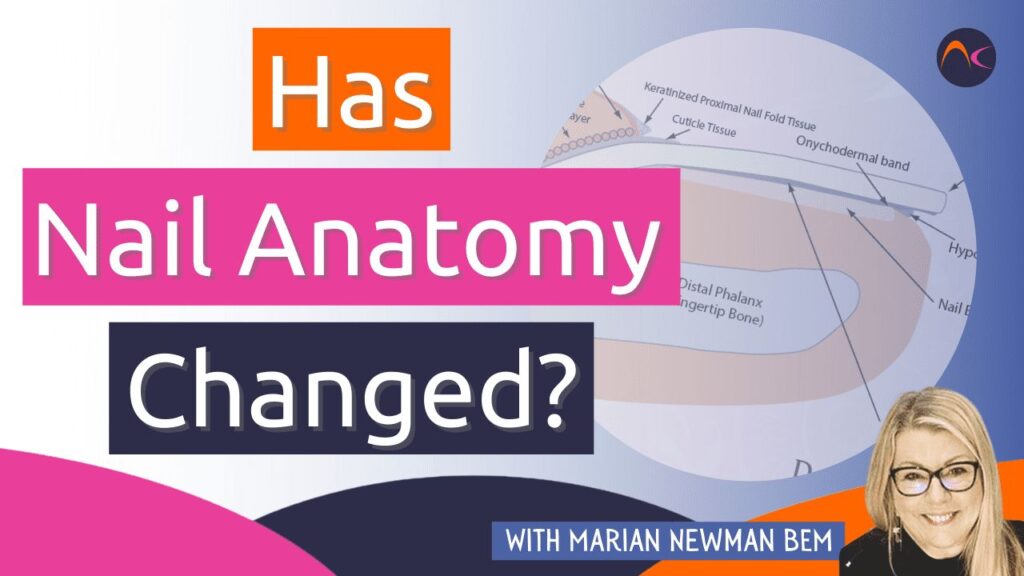
So, why is the cuticle no longer the clear frame of skin at the base of the nail plate? Why is the eponychium no longer visible but hidden under the proximal nail fold? Why is the nail root now the matrix?
Has the nail unit evolved into something else? No, it hasn’t.

Over the decades, terminology has evolved, geographically, into what is, largely, guesswork. This terminology has been taught for a very long time and change is difficult!
In a recent conversation with Doug Schoon, who published a cross-section of the nail unit with different terminology and labels, he explains – “nail professionals are not medically trained and there is such confusion with the parts of the nail unit anatomy. It is time that the professional nail industry catches up with the accurate terminology, structure, function and positioning of the nail unit structures that are in-line with the medical A&P.”
This may not be terminology that clients need to be aware of, but it is certainly something that nail professionals need to understand and refer to. This understanding will make the nail pro far more efficient with their services. But it is a hard mountain to climb as many do not agree with the proven science: the basis of ALL NailKnowledge education.
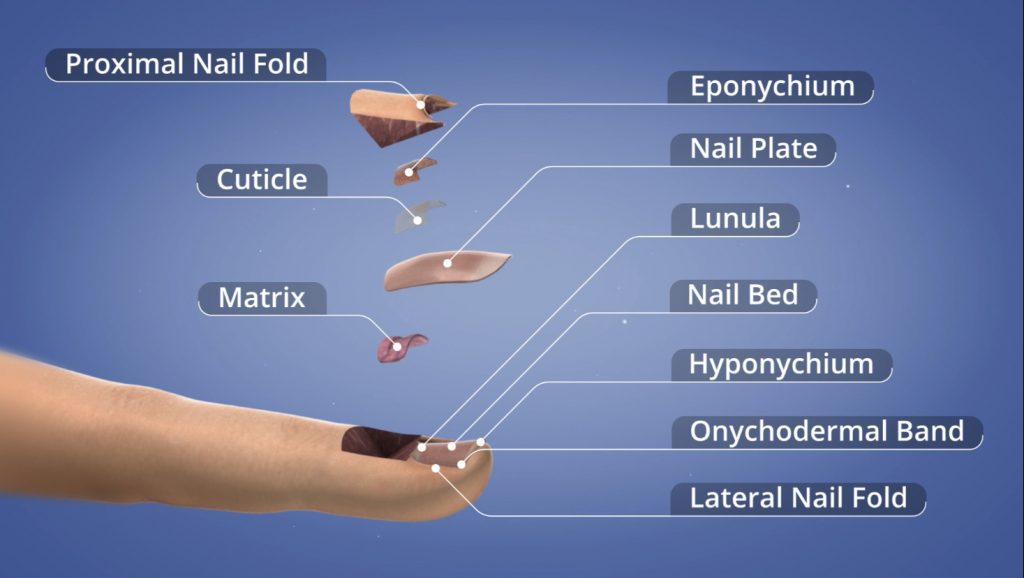
Let’s take ‘cuticle oil’: the accepted benefit of this is to help treat the skin at the base of the nail that is living and not necessarily the dead layer of skin adhered to the nail plate. How can brands change their product names to ‘Proximal Nail Fold Oil’? It doesn’t really have a ‘ring’ to it! So, you may have noticed that some brands have migrated to ‘Nail Oil’.
Consumers/clients need a curated explanation that reverberates with them. BUT as nail professionals we need to have a deep understanding of the nail unit, its structures and functions. It is time to start encouraging an accurate and global acceptance of the nail unit terminology.
Every country agrees on the A&P terminology for just about every other structure in the human body: bones, muscles, blood circulation, endocrine system etc. Why not the nail unit?
At NailKnowledge we use correct and accurate terminology, positioning and function. It’s time to stop the confusion and agree with the medical profession, anatomists and physiologists, and not make it up as we go along!