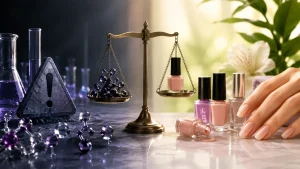
We recently received a question asking whether even tiny traces of known carcinogens in nail products are unsafe. This is a common concern, but the answer to this question can often be misunderstood.
To clarify, carcinogens are substances that can cause cancer, but it’s important to understand that not all carcinogens pose a risk at low exposure levels. In fact, many carcinogens are naturally present in everyday items like fruits and vegetables, but they are found in such small concentrations that they are not harmful.
We explain why the fear surrounding low-level exposure to carcinogens in nail products is often misleading and provide a clearer understanding of what truly constitutes a cancer risk.


Myths About Carcinogens in Nail Products: The Importance of Concentration
This is false and misleading information designed to frighten, not inform.
Here’s an example. What is acetaldehyde? It is a “naturally occurring carcinogen” found in most fruits and many vegetables. It even exists normally in “organically grown and certified” foods. So even organically grown foods also contain naturally occurring carcinogens, in fact, they contain many different carcinogens. That’s because most carcinogens are naturally occurring! Even so, they don’t pose a big risk because they occur in low concentrations. Concentration is the key.
Don’t be fooled. Many who want to frighten you, do NOT want you to realize that carcinogens don’t cause cancer if the exposure is kept to low levels. This is something that many do not understand. Just because something “could” cause cancer, doesn’t mean it “will” cause cancer.
Low-Level Carcinogen Exposure: Unlikely to Cause Cancer
Exposure must be high enough and for long enough or cancer is a pretty unlikely outcome. For instance, many foods, including mushrooms and apples contain significant amounts of naturally occurring formaldehyde. USDA Organic pineapples and tomatoes contain naturally derived 1,4-dioxane. Don’t worry, these carcinogens exist in small quantities considered to be safe by scientific experts, so they are NOT expected to be harmful. So clearly, just because a substance is a “known carcinogen” or “linked to cancer”, does NOT mean it will cause cancer.
Fear Tactics and Misinformation
That’s another piece of information tricksters and fear-mongers don’t want you to know- they use frightening sounding claims to deceive the public. I hope we can all agree, that mushrooms and pineapples don’t cause cancer, even though they contain known carcinogens. Fear-based activist groups don’t want you to know these facts, so you’ll never hear it from them. Why? They deceive people by saying there is “no safe level for carcinogens.” That is a load of nonsense.
A substance only becomes carcinogenic when safe concentrations are exceeded usually for prolonged periods. These substances are NOT “automatically” cancer causing and therefore dangerous, as these deceivers pretend. They demonize these substances and warn people that they must avoid them completely, but that’s just their money-making game of fear.
Formaldehyde’s Role in the Body and the Real Cancer Risk
Unfortunately, they’ve been successful in fooling the public into believing the many myths they create. All people, even babies, breathe out tiny amounts of formaldehyde. That’s because our body makes and uses formaldehyde to build proteins and other beneficial substances that it needs to function and live. Therefore, formaldehyde isn’t automatically capable of causing cancer, and only becomes a significant cancer risk in concentrations that are many, many thousands of times higher than what was ever found in nail polish or preservatives- two sources that are often cited by these fear-mongers.
Fear-Based Activism: Profiting from Deception and Misinformation
Why do fear-based activists intentionally deceive people in this way? They know that by frightening people, it is easier to get money/donations. It’s what floats their boat, so to speak. That’s why I recommend that you never give any fear-based activist groups any money, for any reason! Because after they pay themselves, they’ll use the rest to create even more deceptions and unwarranted fear. Why? That’s their business model… and that’s why they can’t be trusted to provide the facts.