What Do UV-Free Nail Lamps Actually Mean?
“UV-free nail lamps” are becoming more common in marketing, often positioned as a safer or more advanced alternative to traditional curing lamps.
But there’s an immediate problem.
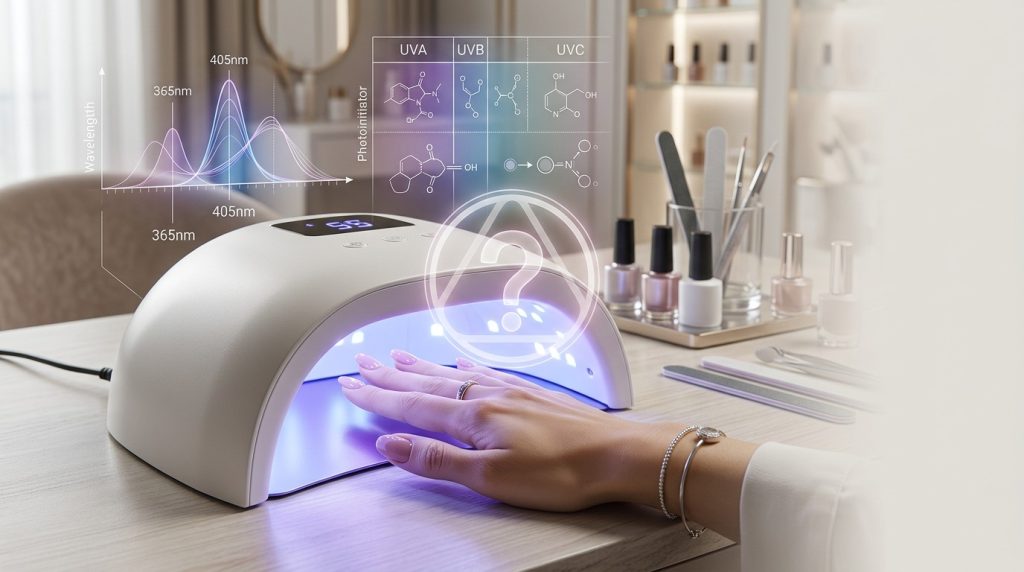
Gel products are designed to cure using specific wavelengths of light. If a lamp truly produced no UV at all, it would struggle to cure most gel systems effectively.
So what are these claims really saying?
Questions surrounding UV-free nail lamps continue to grow as more professionals look closely at the science behind gel curing.
In many cases, “UV-free” doesn’t mean the complete absence of ultraviolet wavelengths. Instead, it often reflects how the brand is choosing to define or present those wavelengths.

How Gel Products Cure Under LED Nail Lamps
Gel products contain ingredients called photoinitiators. These are responsible for starting the curing process when exposed to light.
Most nail gel systems are formulated to respond to wavelengths in the region of:
- 365 nanometres (nm)
- 405 nanometres (nm)
This range sits within, or directly alongside, UVA (ultraviolet A).
When the correct wavelength reaches the product:
- The photoinitiators activate
- A chemical reaction begins
- The gel hardens into a durable coating
Without that specific wavelength range, the reaction either slows significantly or does not complete properly.
Why “UV-Free” and “Gel Curing” Conflict
Here’s the key point.
If a lamp does not emit light within the wavelengths that photoinitiators require, it cannot reliably cure the product.
That means one of two things must be true:
- The lamp does emit UV or near-UV wavelengths, despite the claim
- Or the product is not curing correctly
There isn’t a third option that bypasses this requirement.
This is why claims of “UV-free gel curing” raise questions within the scientific and professional community.
Where the Confusion Comes From
Marketing Language vs Scientific Language
The word “UV” is often used loosely in marketing.
Some brands may describe their lamps as:
- “UV-free”
- “No harmful UV”
- “LED only”
However, LED refers to the type of light source, not the wavelength it emits.
An LED lamp can still produce wavelengths that fall within the UV or near-UV range.
In particular, light around 405 nm is sometimes described as “visible violet light,” even though it overlaps with the UV boundary and still activates gel photoinitiators.
Modern LED Lamps Are Already Narrow Band
Older UV lamps used broader wavelength output. Modern LED lamps are more targeted.
They typically emit:
- Narrower wavelength bands
- Focused energy within the curing range
This is often presented as an advancement, which it is. However, it does not mean the lamp is free from UV wavelengths altogether.
Can Visible Light Cure Gel Products?
Some manufacturers may adjust formulations to respond more efficiently to higher wavelengths.
While this can improve curing under certain lamps, it does not remove the need for wavelengths within the UV or near-UV range.
At present, standard nail gel systems still rely on this region to cure effectively.
Why Lamp Compatibility Matters for Nail Safety
Understanding how curing works is not just a technical detail. It has real safety implications.
If a lamp does not provide the correct wavelength:
- The gel may appear set on the surface
- The deeper layers may remain under-cured
Under-cured product can increase the risk of:
- Skin exposure to uncured chemicals
- Sensitisation and allergic reactions
- Reduced durability and premature breakdown
This is why compatibility between lamp and product is essential.
Testing the Science Behind UV-Free Nail Lamp Claims
Claims such as “UV-free curing” can be tested using spectrometry. This allows the exact wavelengths emitted by a lamp to be measured.
If a lamp genuinely produced no UV or near-UV wavelengths:
- It should show no output in the 365–405 nm region
- It would then be unable to cure most standard gel products effectively
Where strong claims are made, scientific evidence is the only reliable way to support them.
The Truth About Gel Curing Wavelengths
For nail professionals and learners, the most important point is simple.
Gel products cure because of exposure to specific wavelengths of light. Those wavelengths sit within the UV or near-UV range.
If a lamp cures gel effectively, it is providing those wavelengths, regardless of how it is described in marketing.
Safe Practice When Using Gel Curing Lamps
To support safe and effective curing:
- Always use lamps recommended by the product manufacturer
- Avoid mixing lamps and gel systems without confirmation of compatibility
- Follow manufacturer instructions for curing
- Be cautious of claims that sound reassuring but lack clear explanation
Clear understanding leads to safer practice and more reliable results.