
Query:
I was told that the bonds holding together the nail plate run longitudinally to help stop lengthwise splits and this meant that it was better to “remove shine” in direction of nail growth or these bonds could be broken. But you said before that the direction of nail filing doesn’t matter. Can you explain?
Answer:
The image below shows how keratin fibrils inside the nail cells all lay in one direction across the width of the nail plate. This prevents cracking down the length of the nail plate.
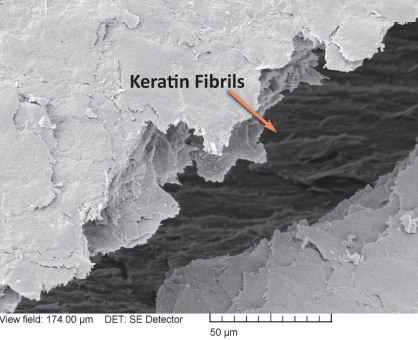
The arrangement of keratin fibrils causes the nail plate to crack across its width. How? These fibrils act like speed bumps to slow down the spread of cracks that would split the plate. Instead, they cause these cracks to change directions and to run between the keratin fibrils, not across them. This arrangement does influence how cracks spread, but this has little to do with filing the surface of the nail plate. The filing doesn’t cause cracks in the nail plate, it just abrades away the surface of the nail plate. Each nail cell is connected to other nail cells from many different directions, including from above and below. I have personally conducted studies on various directions of filing that did not show that a specific direction caused additional nail damage.


In short, I know of no reason why the nail plate should only be filed in the direction of growth. It is far more important to use a light touch and avoid abrasives lower than 180 grit on the natural nail, 240 grit is best for natural nails, in my own opinion.