• Pular para navegação primária
  • Pular para o conteúdo principal
  • Pular Rodapé
NailKnowledge

NailKnowledge

  • Cursos
  • Livros eletrônicos
  • Cesta de livros eletrônicos
  • Base de conhecimento
    • Base de conhecimento
    • Pergunte aos especialistas
    • Glossário
  • Notícias
  • Blog
  • Galeria
    • Galeria de arte para unhas
    • Artistas de unhas
    • Junte-se à elite
  • Login

Arquivos para 1º de dezembro de 2023

A ciência por trás do revestimento superior para unhas

Nail care goes beyond simply choosing the right nail polish color; it’s a captivating blend of science and art that produces incredible results. And in this exciting world of nail products, the unsung hero is none other than the humble nail top coat. Shall we have a look at the fascinating science behind this unassuming yet essential finishing touch.

O acabamento brilhante do revestimento superior para unhas

We all adore that mirror-like shine that a good top coat provides. But have you ever wondered how it works its magic? At its core, a top coat is designed to deliver a high-gloss finish that not only enhances the manicure but also offers protection.

A ciência: Top coats contain film-forming ingredients that create a transparent shield over your nail polish. These ingredients are usually quick-drying and formulated to produce a gleaming surface. Think of it as a protective glass layer, made to preserve and enhance the colours beneath.

Durabilidade e resistência a lascas

The last thing we want is for our perfect nail art or vibrant colour to chip or fade prematurely. A top coat plays a pivotal role in extending the life of your manicure, ensuring it stays intact for longer.

A ciência: The formulation of a top coat often includes hardening agents like acrylic or polymer resins. These substances provide strength and resilience to your nail polish, making it more resistant to the wear and tear of daily life. It’s like giving your nails an invisible suit of armor.

Aceleração do tempo de secagem do Nail Top Coat

Esperar que suas unhas sequem pode parecer uma eternidade, mas uma cobertura pode ajudar a acelerar o processo.

A ciência: Muitos top coats são projetados com fórmulas de secagem rápida que fazem sua mágica evaporando rapidamente. Isso não apenas economiza seu precioso tempo, mas também reduz as chances de borrar ou amassar as unhas recém-pintadas.

Prevenção de desbotamento e descoloração

A luz solar e as atividades diárias podem fazer com que o esmalte das unhas desbote ou mude de cor com o tempo. Uma boa cobertura para unhas pode ajudar.

A ciência: Some top coats include UV filters or colour stabilisers that help shield your manicure from the harmful effects of sunlight. They act as a barrier against the elements, preserving the vibrancy of your nail polish. This is true for gel top coats too!

Nail Top Coat Smoothing Imperfections (Top Coat para Unhas que Suaviza Imperfeições)

If you’ve ever had a slightly uneven nail polish application, a top coat can be your saviour. It helps in smoothing out minor imperfections, giving your manicure a polished look.

A ciência: As camadas superiores podem conter ingredientes autonivelantes para suavizar superfícies irregulares, garantindo que suas unhas pareçam perfeitas e bem acabadas.

Longevidade e brilho do revestimento superior para unhas

A top coat isn’t just about aesthetics; it’s about making your manicure last.

A ciência: The chemistry of a top coat involves the careful selection of ingredients to achieve not only a high-gloss finish but also long-lasting wear. It’s the science of balance, combining elements that deliver both shine and durability.

In conclusion, the seemingly simple nail top coat is a masterpiece of science and artistry. It enhances the beauty of your nails, protects your manicure, and ensures your nail art stays flawless. The next time you apply a top coat, you’ll have a deeper appreciation for the science that transforms your nails into dazzling works of art.

Passo a passo: Como consertar um amassado em seu esmalte de unha

  • The key is to ‘float’ the new color over the dent
  • When applying top coat, load your brush just enough that you dont have to go back over it – this will give the perfect finish.
Revestimento colorido danificado
Reaplicar suavemente, sem pressão no pincel
Reapply smoothly – no pressure on brush
Os danos são suavizados
Apply Top Coat – no pressure on brush
Nail Top Coat, listras de pressão
A pressão dará listras
Aplicação da cobertura para unhas
Smooth finish – damage can’t be seen

FAQ’s

1. Qual é a finalidade de uma cobertura para unhas?
A nail top coat serves several essential purposes in nail care. It provides a glossy finish, enhances the longevity of your manicure, protects nail polish from chipping, and can also add strength to your nails. Essentially, it’s the final step that seals and perfects your nail look.

2. Como aplico uma cobertura de unhas para obter os melhores resultados?
Para obter os melhores resultados com uma cobertura para unhas, siga estas etapas:

  • Espere até que o esmalte esteja quase seco (mas não totalmente) antes de aplicar a camada superior.
  • Apply a thin, floaty layer of top coat, starting from the base and ending with a gentle swipe along the tips of your nails to seal the edges.
  • Deixe a camada superior secar completamente para obter um acabamento brilhante e resistente a lascas.

3. Posso usar um esmalte transparente comum como cobertura?
While regular clear nail polish can provide some protection and shine, it’s not as effective as a dedicated nail top coat. Top coats are specifically formulated with ingredients like quick-drying resins and UV filters to provide superior gloss, durability, and protection. Using a specialized top coat will yield better results.

4. Com que frequência devo reaplicar uma cobertura de unhas?
To maintain the longevity and shine of your manicure, it’s a good practice to reapply a nail top coat every few days. This helps refresh the gloss and adds an extra layer of protection to prevent chipping and fading. You can also apply a fresh top coat as part of your regular nail maintenance routine when you notice signs of wear and tear.

Arquivado em: Informações gerais, Loções, poções e esmaltes, Química dos produtos

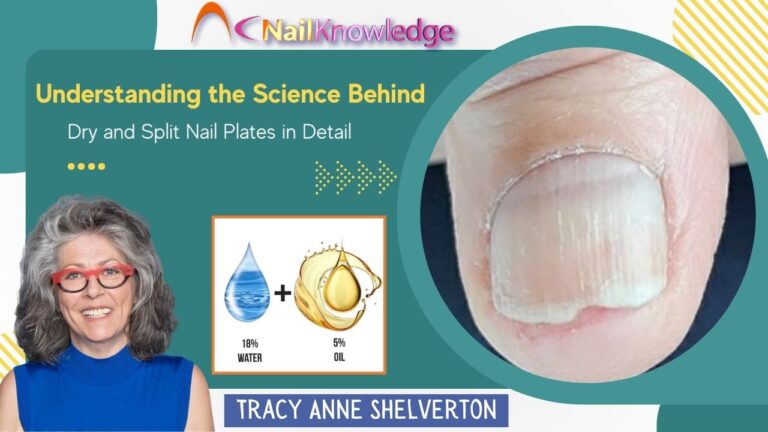
A ciência por trás das placas de unhas secas e rachadas em detalhes

First and foremost, let’s delve into the intricate science behind dry and split nail plates. Let’s understand the balance of oil and water within the nail plate and how it influences the health and strength of your nails.

A normal natural nail contains about 18% water and 5% oil. Optimal flexibility occurs when the nail plate holds around 25% moisture.

Unhas naturais
Unhas naturais perfeitas
Porcentagem de água e óleo da unha natural
Proporção de água e óleo na unha natural

However, excessive water can weaken and damage the nail plate, similar to how a sponge shrinks as it dries out, leaving behind a dry and brittle nail plate. This process starts a vicious cycle that will only be stopped if we continue to add more moisture. It can take quite some time to recover the nail plate but as long as nail plate cells are being produced we will be successful.

Antes e depois da placa ungueal
Nail plate recovery – the lateral nail folds and the existence of the onychodermal band & hyponychium are now recovered and the difference is obvious, the proximal nail fold needs a little more time.

O ato de equilíbrio: Como a umidade mantém as placas ungueais fortes e flexíveis

Nail plates that are consistently exposed to water, especially with soap, become soft and weak due to this ongoing process. Remember, soap dissolves oil. It takes a few hours for the nail plate to fully recover its normal ‘oil & water’ levels

Without a doubt, maintaining a proper moisture balance is essential for healthy natural nails. When the moisture balance is right, your natural nails can better withstand trauma due to their flexibility. Think of it like shock absorbers in a car or on a bicycle—they absorb the bumps in the road, ensuring you arrive without any bruises. Flexibility in the nail plate serves a similar purpose.

Os óleos essenciais: Como Eles Nutrem e Protegem as Placas de Unhas

5% Oil – Where Does It Come From?

These oils are produced in the nail bed and slowly penetrate through the nail plate from bottom to top, where they may eventually be washed away. These oils keep both the nail plate and the bed epithelium flexible. These oils are composed of ‘lipids,’ including squaleen and cholesterol.

Oil and water don’t naturally mix, so how can both penetrate the nail plate? It doesn’t seem logical for both to use the same channel, so could it be that they each take a different route? The scientific community hasn’t reached a definitive conclusion, but it’s suspected that they indeed take different paths. Here’s one possible explanation:

– Water enters the nail plate cell directly through the cell wall.

– Oil cannot penetrate the cell wall and instead seeps through the remaining spaces between the nail plate cells.

O poder protetor dos óleos: Como eles fortalecem suas unhas secas e rachadas

Os óleos plastificam a placa ungueal; eles se movem muito mais lentamente e evaporam menos rapidamente. Como resultado, o óleo bloqueia as rotas de entrada e saída de água.

The outcome is less brittle, more flexible nails—stronger, in essence. Because the oil remains in the nail plate for a longer period, it has a significant effect on the overall condition of the nail plate.

But what if this balance is disrupted by trauma or conditions like eczema, psoriasis, lichen planus, or even a fungal infection? The nail plate and nail bed may become dehydrated. But what if everything seems normal otherwise?

Desvendando a Matriz: Como as células da placa ungueal são formadas e por que as imperfeições são importantes

For this, we need to examine the matrix where the nail plate cells are produced.

A matriz produz células da placa ungueal 24 horas por dia, 7 dias por semana. Quando temos 21 anos, ela está funcionando em sua capacidade máxima, mas depois disso fica mais lenta.

Think of a tennis ball machine continuously spitting out tennis balls—this is how the matrix works. If something isn’t quite right there, cells may still be produced but not as perfectly as they should be. This creates weaker nail plate cells that may appear normal but lack the strength of perfectly formed nail plate cells.

There are of course exceptions. You don’t have to be old to have abnormal nail plate cells—it can happen to young people too if they are suffering from psoriasis, lichen planus, Alopecia or Eczema. Babies are sometimes born with nail matrix’ that are not yet fully formed although these catch up quickly after birth.

Pressão na placa ungueal: como as imperfeições criam sulcos e vales

Once on the nail bed, the nail plate is under pressure from all sides—the lateral side walls, the nail bed, and the proximal nail fold all stabilize the nail plate as it moves along the nail bed. This pressure is significant, and if a cell isn’t perfect, it collapses, creating ranhuras na unha plate, with the weakest cells in the valley and the strongest cells on top of the hill, this is why buffing or filing the nail plate to make it even & shiny creates even more damage, you unwittingly remove the Links mais fortes.

Às vezes, pequenas estruturas semelhantes a contas são formadas, fazendo com que a placa ungueal se desfaça.

Ranhuras e vales para pregos
 Placa de unha com ranhuras 
Contas de unha na placa ungueal
Beaded Ridge nail plate (the ‘beads’ are visible at the top of the ridge as well as the groves)

O efeito dominó: como a negligência e as células anormais podem levar a unhas secas e rachadas

Imagine that the nail plate doesn’t receive extra care from external oils, and suppose truly abnormal cells are produced that are under the same pressure from the side walls, etc., then, just like anything that dries out, the nail plate cells start to separate— its pure stress from dryness (think of paint on a wooden window, for example—if the seal is broken, it’s a downhill slide). If water then penetrates and that water evaporates, it causes more dehydration, and the puzzle pieces that make up our nail plate cells simply come apart—resulting in a horizontal split in the nail plate.

Figura 6
Figura 7

Figura 6. 28-01-2023 – you can see here how the nail plate crumbles at its weakest point. After about 5 months of intensive nail care on the 10-5-2023 the nail plates still have groves (that’s the defect in the nail matrix that we can do nothing about) but the nail plate is whole again, its in good condition and now flexibility keeps the nail plate cells together.

Figura 7. On the left, the nail groves are dry and cause the nail plate cells to spit verticaly and the nail plate is not sitting in the paronichium cup as it should. After intensive nail care, the nail plate is now in the paronichium cup, the lateral nail folds can do their job and the onychodermal band is visibly doing its job and the nail plate is no longer fractured.

Entender como isso acontece e o que é necessário para resolver o problema fará com que seu salão seja um dos mais movimentados da região e você terá clientes para toda a vida.

It is however important to realize that non of these solutions are immediate – but – with time and goed nail unit care and maintenance you will achieve them.

Fotos: Tracy Anne Shelverton, Jozephine Frijters e Xuan Chu

Arquivado em: Informações gerais, Condições das unhas

Aumente o nível de suas percepções sobre as unhas

Participe de nosso boletim informativo!
ASSINAR...

Direitos autorais © NailKnowledge

NailKnowledge

  • Livros eletrônicos
  • Sobre nós
  • Cursos
  • Notícias
  • Blog
  • Boletim informativo
  • Glossário

Políticas

  • Página de privacidade
  • Termos e condições
  • Política de cookies

Suporte

  • Entre em contato conosco
  • Conheça os especialistas
  • Pergunte aos especialistas
  • Suporte ao sistema
  • Perguntas frequentes
Portuguese
Portuguese
English Spanish Vietnamese