• Skip to primary navigation
  • Skip to main content
  • Skip to footer
NailKnowledge

NailKnowledge

  • Courses
  • MyNailEra
  • Free eBooks
  • Knowledge Base
    • Knowledge Base
    • Ask the Experts
    • Glossary
  • Blog
  • Login
Why are UV Gels so thick

Why are UV Gels so thick?

August 9, 2024 by Doug Schoon

347 Views

Was this article helpful?
Error submitting rating

We are asked this question all the time: “Why are UV gels so thick, and can anything be added to thin them out?”

While it might be tempting to modify the consistency of your UV gels, it’s important to understand the science behind their formulation. Adding anything to thin out UV gels can disrupt their chemistry, potentially leading to serious issues, including adverse skin reactions.

The Risks of Thinning UV Gels

Nothing should ever be added to UV gels to make them thinner, because this can disrupt the chemistry and adversely affect cure. The result could be an increased risk of developing an adverse skin reaction, including the potential for permanent allergic reactions.

The Importance of Not Adding Solvents to UV Gels

Never add solvents or any type of thinner to a UV gel unless instructed to do so by the manufacturer’s directions or improper cure becomes a greater possibility. If instructed by the manufacturer to do so, precisely follow those directions or problems can occur.   

Why UV Gels Are Thick: The Role of Oligomers

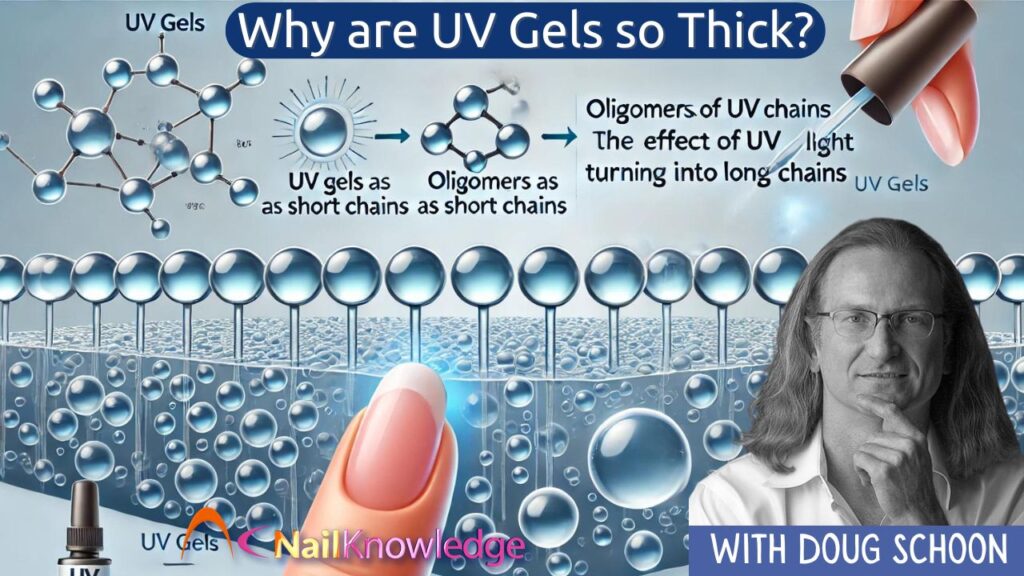
The base ingredients are called “oligomers” which are molecules that have been partially pre-polymerized into short chains.  These short chains are more prone to be tangled, than small molecules, which makes the product feel thicker or more “viscous”. Then when UV gels are exposed to UV energy, these short chains join to create the very long chains that solidify to create the final polymer coating.

This is done so the UV gel can cure more quickly than it normally would.  Very much like precooking food so it can be more quickly finished in the microwave.  The oligomers are the reason these products are thicker than other types of nail coatings and adding solvents to thin them will result in the creation of a significantly weaker nail coating.

Was this article helpful?
Error submitting rating

Categorised: UV Gel

Related Articles

Curing Tension in Gel Nails

Excessive Curing Tension in Gel Nails

Let’s talk about curing tension in gel nails, something most gel nail lovers have experienced but might not fully understand.…

Read More
How gel polish cures

Gel Polish Curing Explained: Behaviour, Lamps and Common Problems

Gel polish curing is a chemical process, not simply a matter of time spent under a lamp. Many common problems…

Read More
UV Curing - thin layers for perfect nails

UV Curing: Why Thin Layers Matter for Perfect Nails

When it comes to working with gels, UV curing is one of the most important steps in creating long-lasting, safe…

Read More
Nail peeling after gel

Nails Peeling Off After Gel? Here’s What You Need to Know

If you’ve had gel nails applied and within a week they’ve started to lift, only to leave your natural nails…

Read More
Hard Gel vs Bottled Builder

Hard Gel vs Bottled Builder

In recent years, the debate of hard gel vs bottled builder has taken centre stage in the nail industry. Though…

Read More
White Spots on Nails Damage or Dehydration

White Spots on Nails After Gel Removal

White Spots on Nails: Damage or Dehydration? White spots on nails after gel removal are a common concern among nail…

Read More

Level Up Your Nail Insights

Join our Newsletter!
SUBSCRIBE...

Copyright © NailKnowledge

NailKnowledge

  • MyNailEra
  • eBooks
  • About us
  • Courses
  • News
  • Blog
  • Newsletter
  • Glossary

Policies

  • Privacy Page
  • Terms & Conditions
  • Cookie Policy

Support

  • Contact Us
  • Meet the Experts
  • Ask the Experts
  • System Support
  • FAQs
English
English
Portuguese Spanish Vietnamese