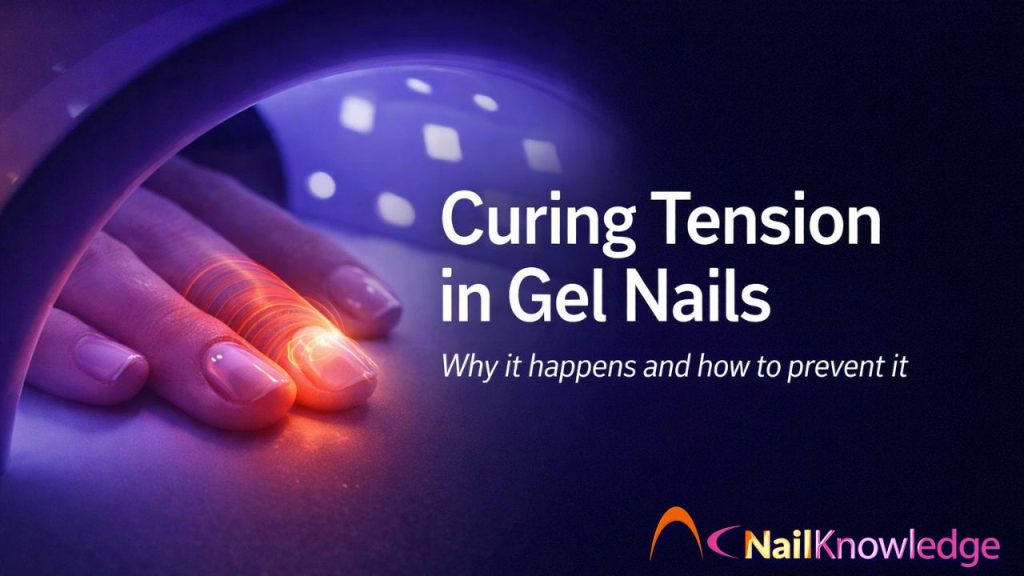
Let’s talk about curing tension in gel nails, something most gel nail lovers have experienced but might not fully understand. That weird burning or tightening sensation during curing is a classic sign of curing tension in gel nails. You know the one, you’re sitting there with your hands under the UV or LED lamp, admiring your fresh set, when suddenly… ouch. That sharp zap of heat hits, and you’re left wondering, “Is this normal?”
That sensation? It’s usually a sign of excessive curing tension, a problem that’s far more common than you might think. And while it might seem like just a harmless side effect of the gel curing process, it can actually be a warning signal that your nails aren’t entirely happy.
Let’s break it all down, what it is, why it happens, and how to stop it in its tracks.


What Is Curing Tension in Gel Nails?
Excessive curing tension refers to the intense pulling or tightening sensation some people feel when gel polish is hardening under a UV or LED lamp. It often feels like a sudden spike of heat or pressure, especially during the first 10 seconds of curing.
But what’s actually going on?
When gel products cure, they undergo a chemical reaction, a process called polymerisation. The gel transforms from a liquid or semi-liquid state into a hard, solid layer. This shift causes the molecules in the gel to rapidly bind together and shrink slightly. That shrinkage creates tension between the gel and your natural nail plate.
Now, if too much product is applied, or if the formula is too strong, or the curing happens too fast (as with a high-powered lamp), that tension ramps up, and so does the discomfort.
Think of it like trying to quickly shrink-wrap a soft surface. If the wrap tightens too fast or too forcefully, something’s going to pull or snap. Your nail plate ends up caught in the crossfire.
Why Does It Happen?
There isn’t just one culprit behind excessive curing tension. Several factors can be at play, often stacking on top of one another:
- Thick Application: More product means more shrinkage. If layers are applied too thick, the internal heat generated during curing has a harder time dissipating evenly.
- High-Powered Lamps: Super strong LED lamps can over-cure the gel, accelerating the reaction and intensifying the heat and tension.
- Over-Filed or Damaged Nails: If your natural nails have been over-buffed or thinned out, they’re more vulnerable to the stress of curing.
- Highly Reactive Products: Some gel formulas are more aggressive than others. Hard gels, for instance, are more prone to causing tension than soft gels or builder-in-a-bottle types.
- Inadequate Cooling Time: Going straight from one coat to the next without giving nails a few seconds to cool down can build up internal stress.
So yes, while it’s normal to feel a little warmth during curing, that sharp, painful jolt? Not normal, and not necessary.
How to Prevent Curing Tension in Gel Nails
The good news? You don’t have to suffer for beauty. With a few thoughtful tweaks, you can drastically reduce, or eliminate, excessive curing tension altogether.
1. Apply Thin Layers
It’s tempting to slap on a thick coat to speed things up, but patience is your best friend here. Thin, even layers cure more efficiently and generate less heat. Less bulk = less shrinkage = less tension. Simple maths.
2. Use a Lower-Powered Lamp (or Cure in Pulses)
Some lamps even have a “low heat mode” which ramps up the intensity gradually, a great option if you regularly experience curing discomfort.
3. Choose the Right Product
Every brand is different. If you consistently feel that burning tension, consider switching to a better quality ingredients. Look for formulas labelled “low heat,” “soak-off,” or “for sensitive nails.” They typically have less reactive ingredients, reducing the risk of excessive curing tension.
4. Protect the Nail Plate
Be kind to your natural nails. Avoid over-filing, and always use a gentle touch when prepping. A healthy, intact nail plate is far more resilient to the stress of curing. Think of it like a foundation — if the base is weak, the structure on top is more likely to crack or lift.
5. Let Nails Cool Between Layers
It might feel like a small thing, but giving your nails 10-15 seconds to cool between layers can make a huge difference. It gives the previous layer a chance to stabilise before adding more heat and tension on top.
Long-Term Risks of Ignoring It
If excessive curing tension is left unchecked, it doesn’t just cause temporary pain, it can lead to long-term issues. These include:
- Nail Separation: The gel pulling away from the nail plate can cause lifting, which leads to premature chipping or peeling.
- Nail Plate Damage: Repeated exposure to extreme heat and tension can cause permanent thinning or sensitivity.
- Infections: If lifting creates gaps, moisture can sneak in, creating a breeding ground for bacteria or fungus.
In short, ignoring the signs isn’t just uncomfortable, it can put the health of your nails at risk.
Is Gel Curing Still an Exothermic Reaction?
Yes. Gel curing has always been, and remains, an exothermic chemical reaction. As polymer chains form during curing, each new molecular bond releases a small amount of heat. When thousands of these reactions happen rapidly, that heat becomes noticeable on the nail. This chemistry has not changed and has not been dismissed. The reason this blog focuses on curing tension is because heat sensation is influenced not only by chemical heat release, but also by how quickly the product shrinks and bonds to the nail plate. Rapid polymerisation increases internal stress and pressure on sensitive tissue, which can make the warmth feel sharper or more intense. In practice, both processes happen together. The chemistry creates the heat, and curing tension and shrinkage influence how strongly it is felt.
Final Thoughts
There’s no denying the magic of a fresh gel manicure, the shine, the strength, the longevity. But that beauty should never come at the cost of your nail health or comfort.
Excessive curing tension is your body’s way of saying, “Hey, something’s not quite right here.” And like most things in beauty, prevention is easier (and less painful) than repair.
So next time you feel that jolt, take a step back. Reassess your technique, your products, and your tools. With a few mindful adjustments, you can keep your nails looking flawless, without the fire.