• Skip to primary navigation
  • Skip to main content
  • Skip to footer
NailKnowledge

NailKnowledge

  • Courses
  • eBooks
  • eBook Basket
  • Knowledge Base
    • Knowledge Base
    • Ask the Experts
    • Glossary
  • News
  • Blog
  • Gallery
    • Nail Art Gallery
    • Nail Artists
    • Join the Elite
  • Login

Product Chemistry

Excessive Curing Tension in Gel Nails

Let’s talk about curing tension in gel nails, something most gel nail lovers have experienced but might not fully understand. That weird burning or tightening sensation during curing is a classic sign of curing tension in gel nails. You know the one, you’re sitting there with your hands under the UV or LED lamp, admiring your fresh set, when suddenly… ouch. That sharp zap of heat hits, and you’re left wondering, “Is this normal?”

That sensation? It’s usually a sign of excessive curing tension, a problem that’s far more common than you might think. And while it might seem like just a harmless side effect of the gel curing process, it can actually be a warning signal that your nails aren’t entirely happy.

Let’s break it all down, what it is, why it happens, and how to stop it in its tracks.

What Is Curing Tension in Gel Nails?

Excessive curing tension refers to the intense pulling or tightening sensation some people feel when gel polish is hardening under a UV or LED lamp. It often feels like a sudden spike of heat or pressure, especially during the first 10 seconds of curing.

But what’s actually going on?

When gel products cure, they undergo a chemical reaction, a process called polymerisation. The gel transforms from a liquid or semi-liquid state into a hard, solid layer. This shift causes the molecules in the gel to rapidly bind together and shrink slightly. That shrinkage creates tension between the gel and your natural nail plate.

Now, if too much product is applied, or if the formula is too strong, or the curing happens too fast (as with a high-powered lamp), that tension ramps up, and so does the discomfort.

Think of it like trying to quickly shrink-wrap a soft surface. If the wrap tightens too fast or too forcefully, something’s going to pull or snap. Your nail plate ends up caught in the crossfire.

Why Does It Happen?

There isn’t just one culprit behind excessive curing tension. Several factors can be at play, often stacking on top of one another:

  • Thick Application: More product means more shrinkage. If layers are applied too thick, the internal heat generated during curing has a harder time dissipating evenly.
  • High-Powered Lamps: Super strong LED lamps can over-cure the gel, accelerating the reaction and intensifying the heat and tension.
  • Over-Filed or Damaged Nails: If your natural nails have been over-buffed or thinned out, they’re more vulnerable to the stress of curing.
  • Highly Reactive Products: Some gel formulas are more aggressive than others. Hard gels, for instance, are more prone to causing tension than soft gels or builder-in-a-bottle types.
  • Inadequate Cooling Time: Going straight from one coat to the next without giving nails a few seconds to cool down can build up internal stress.

So yes, while it’s normal to feel a little warmth during curing, that sharp, painful jolt? Not normal, and not necessary.

How to Prevent Curing Tension in Gel Nails

The good news? You don’t have to suffer for beauty. With a few thoughtful tweaks, you can drastically reduce, or eliminate, excessive curing tension altogether.

1. Apply Thin Layers

It’s tempting to slap on a thick coat to speed things up, but patience is your best friend here. Thin, even layers cure more efficiently and generate less heat. Less bulk = less shrinkage = less tension. Simple maths.

2. Use a Lower-Powered Lamp (or Cure in Pulses)

Some lamps even have a “low heat mode” which ramps up the intensity gradually, a great option if you regularly experience curing discomfort. 

3. Choose the Right Product

Every brand is different. If you consistently feel that burning tension, consider switching to a better quality ingredients. Look for formulas labelled “low heat,” “soak-off,” or “for sensitive nails.” They typically have less reactive ingredients, reducing the risk of excessive curing tension.

4. Protect the Nail Plate

Be kind to your natural nails. Avoid over-filing, and always use a gentle touch when prepping. A healthy, intact nail plate is far more resilient to the stress of curing. Think of it like a foundation — if the base is weak, the structure on top is more likely to crack or lift.

5. Let Nails Cool Between Layers

It might feel like a small thing, but giving your nails 10-15 seconds to cool between layers can make a huge difference. It gives the previous layer a chance to stabilise before adding more heat and tension on top.

Long-Term Risks of Ignoring It

If excessive curing tension is left unchecked, it doesn’t just cause temporary pain, it can lead to long-term issues. These include:

  • Nail Separation: The gel pulling away from the nail plate can cause lifting, which leads to premature chipping or peeling.
  • Nail Plate Damage: Repeated exposure to extreme heat and tension can cause permanent thinning or sensitivity.
  • Infections: If lifting creates gaps, moisture can sneak in, creating a breeding ground for bacteria or fungus.

In short, ignoring the signs isn’t just uncomfortable, it can put the health of your nails at risk.

Is Gel Curing Still an Exothermic Reaction?

Yes. Gel curing has always been, and remains, an exothermic chemical reaction. As polymer chains form during curing, each new molecular bond releases a small amount of heat. When thousands of these reactions happen rapidly, that heat becomes noticeable on the nail. This chemistry has not changed and has not been dismissed. The reason this blog focuses on curing tension is because heat sensation is influenced not only by chemical heat release, but also by how quickly the product shrinks and bonds to the nail plate. Rapid polymerisation increases internal stress and pressure on sensitive tissue, which can make the warmth feel sharper or more intense. In practice, both processes happen together. The chemistry creates the heat, and curing tension and shrinkage influence how strongly it is felt.

Final Thoughts

There’s no denying the magic of a fresh gel manicure, the shine, the strength, the longevity. But that beauty should never come at the cost of your nail health or comfort.

Excessive curing tension is your body’s way of saying, “Hey, something’s not quite right here.” And like most things in beauty, prevention is easier (and less painful) than repair.

So next time you feel that jolt, take a step back. Reassess your technique, your products, and your tools. With a few mindful adjustments, you can keep your nails looking flawless, without the fire.


Filed Under: Lotions, Potions and Polishes, UV Gel

Gel Polish Curing Explained: Behaviour, Lamps and Common Problems

Gel polish curing is a chemical process, not simply a matter of time spent under a lamp. Many common problems such as wrinkling, tacky layers, bubbles, or shrinkage are often misunderstood as application faults, when they are more accurately explained by how gel chemistry interacts with light energy during curing.

Understanding gel polish curing helps explain why different products behave differently, even when applied correctly.

Gel polish curing is a chemical reaction

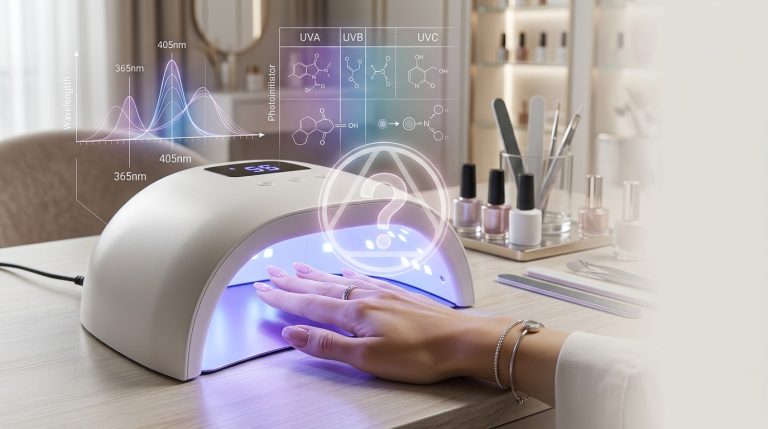
Gel polish cures through a process called polymerisation. This reaction begins when specific ingredients in the gel, known as photoinitiators, absorb ultraviolet light within it’s designed curing range. Once activated, these molecules trigger the gel to link together and harden.

If the gel does not receive the correct type or amount of light energy, the curing reaction may be incomplete, uneven, or unstable.

Why curing behaviour differs between gel products

Not all gels are formulated in the same way. Differences in pigment load, viscosity, and photoinitiator type all influence how light penetrates the product and how the curing reaction progresses.

This is why some gels cure with a tacky surface while others cure dry. In many systems, a tacky inhibition layer is intentional and supports adhesion between layers, while other products are designed to fully cure without residue.

Curing behaviour is therefore a result of formulation and design, not simply curing time.

Wrinkling and shrinkage during curing

Wrinkling during curing usually occurs when the surface of the gel cures faster than the layer beneath it. As curing continues, movement in the uncured layer can cause the upper surface to distort.

Shrinkage is also a normal part of gel polish curing. As the gel polymerises, it tightens slightly. Excessive shrinkage, particularly away from the sidewalls, is often linked to curing imbalance rather than a single application. When we apply too much product, that shrinking can also cause our product to wrinkle.

Both effects are influenced by formulation, layer thickness, and how quickly the curing reaction occurs.

Micro-bubbles and curing irregularities

Micro-bubbles that appear after curing are commonly the result of trapped air or uneven curing behaviour. As the gel solidifies, gas may be released if curing progresses inconsistently through the product.

This behaviour is affected by how thick the gel is, how much pigment it contains, and how the curing light penetrates the product.

Lamp wavelength and gel polish curing

Gel polish curing depends on whether the curing lamp emits light within the wavelength range required by the gel’s photoinitiators. If the lamp output does not match the gel formulation, curing may be incomplete or uneven, even if the time in the lamp is increased.

This is why curing performance is not determined by time alone. Lamp compatibility (using a matching lamp) plays a critical role in achieving a stable and complete cure.

The misconception of over-curing

Over-curing is often misunderstood. Leaving a gel under a lamp for longer does not usually damage the product. Issues arise when the curing reaction happens too rapidly, often due to a lamp output that is too intense or mismatched for the gel formulation.

In these cases, the problem lies with curing compatibility rather than excessive exposure time.

Why understanding gel polish curing matters

Many visible curing problems share the same underlying cause: imbalance between gel formulation and curing conditions. Without understanding this relationship, troubleshooting becomes guesswork and is impossible to achieve.

NailKnowledge education focuses on explaining curing behaviour so that problems are understood at a chemical level rather than treated as isolated faults.

Filed Under: Lotions, Potions and Polishes, UV Gel

Mixing Nail Brands and Lamps

A real-world case of mixing nail brands and lamps

Mixing nail brands and lamps is a common temptation for professionals, especially when transitioning to new systems. One technician recently shared her story: despite strict hygiene standards and properly maintained lamps, she faced client issues such as lifting, splinter hemorrhages, and what appeared to be a fungal infection. Concerned that her products were to blame, she considered switching to a hypoallergenic brand but asked if she could safely keep her existing colours and top coat while using a new lamp and builder gel.

This raised a difficult question: could the products or the curing system be to blame? The technician began exploring the option of switching to a hypoallergenic brand but asked if it would be safe to use a new brand’s lamp and builder gel while keeping her existing colours and top coat.

This scenario reflects a common dilemma in the nail industry, especially when transitioning between systems while managing costs.

Nail conditions linked to lifting and mixed systems

The word “fungus***” is often used by clients to describe any discolouration or problem under a nail, but true onychomycosis (fungal infection) develops slowly and is rarely caused by nail services alone. In many cases, what appears to be fungus is actually a bacterial issue such as Pseudomonas, sometimes called a “greenie.” This thrives in the space between the natural nail plate and lifted product.

***A fungal infection can be proved or ruled out using a test – it cannot be diagnosed by eye, even medical specialists or medical hand specialists can only suspect a fungal infection until proven otherwise.

**Bacterial infections could be a problem if your client is suffering from some kind of immune disorder or diabetes so be very careful and never ‘assume’

Lifting may be triggered by poor adhesion, trauma, over-filing, or incomplete curing. It is rarely the fault of the product alone. Recognising the difference is essential. Bacterial  infections are managed differently from true fungal infection, which requires medical treatment.

Splinter hemorrhages and nail damage explained

Splinter hemorrhages are small streaks of blood beneath the nail plate. These are nearly always caused by trauma, but that does not necessarily mean one dramatic knock, repeated tapping, subtle pressure, or a nail coating that is overly rigid or unbalanced is the only reason, it can be an accumulation of more than one cause.

While these marks can worry clients, they are not usually caused by the products themselves. However, poor adhesion and repeated cycles of lifting and reapplication can make the nail plate more vulnerable to damage and by definition the nail bed more vulnerable.

Allergies and sensitivity from under-cured gels

Allergic contact dermatitis linked to nail products has been on the rise. Builder gels and hybrid products have come under scrutiny due to the frequency of reactions reported by both clients and professionals.

The key driver of these reactions is exposure to uncured or under-cured ingredients. Even when a coating looks hardened, if it has not cured completely, monomers remain present. These can penetrate the nail plate and irritate the surrounding skin, eventually leading to allergy. Once developed, an allergy to nail products is permanent.

A hypoallergenic system can reduce, but not remove, this risk. The greatest safeguard is correct curing and keeping all uncured product away from any and all living skin.

Why mixing nail brands and lamps is risky

Each professional gel system is designed, tested, and certified as a complete unit: base coat, builder or colour, top coat, and lamp. The lamp’s wavelength output, intensity, and cure time are matched precisely to the photoinitiators in that brand’s gel.

When technicians attempt to mix systems, for example by curing one brand’s colour coat under another brand’s lamp, there is no guarantee of complete cure. The coating may harden on the surface but remain only partially polymerised beneath. This is one of the leading causes of both service breakdown and allergic reactions.

According to NailKnowledge, nails cured under the wrong lamp may never fully cure, even after weeks. Filing or removing these coatings later releases uncured dust that can cause skin irritation and long-term sensitivity.

Phasing in a hypoallergenic system without mixing products

The financial reality is that not every professional can replace all products at once. However, trying to combine systems to save costs is not a safe solution. A smarter approach is to phase in a new hypoallergenic system gradually but keep each client service consistent.

That means if a client books for the hypoallergenic option, you use the same brand for base, builder, colour, top, and lamp. For other clients, you continue to use your existing full system. What you must avoid is cross-curing — using a lamp and builder from one system while keeping another brand’s colour or top coat.

This way you can manage costs while ensuring the safety of your clients and yourself.

The hidden danger of under-curing when mixing systems

One of the challenges is that under-curing is not always obvious. A nail may feel hard, look shiny, and even wear well, yet still contain uncured material beneath the surface. Over time, this hidden weakness can cause lifting, allow bacteria to grow in gaps, and expose both client and technician to sensitising dust during removal.

This explains why some issues are blamed on “bad product” when the real cause lies in mixing systems or using the wrong lamp.

Professional standards and insurance risks with mixed products

There is also a serious professional risk when dealing with clients who present with suspected infections or damage. If a client shows signs of bacterial or fungal involvement, the service should be stopped immediately and the client referred to a medical professional. Proceeding in such cases is not only unsafe but also invalidates insurance coverage.

Ignoring these guidelines can leave a professional personally liable if a client files a claim. Proper record-keeping and responsible referral protect both the client and the technician.

Key takeaways for nail Key lessons on mixing nail brands and lamps for professionals

  • Nail infections and splinter hemorrhages often arise from lifting, trauma, or incomplete curing rather than product faults.
  • Allergic reactions are increasing due to exposure to under-cured products. Once an allergy is developed, it is lifelong.
  • Mixing nail brands and lamps introduces a significant risk of incomplete curing. This risk is invisible and accumulates over time.
  • Transition to hypoallergenic systems should be phased in service-by-service, ensuring all products and the lamp are from the same brand for each client.
  • Always refer clients with suspected infections to a medical professional before offering further services.

Conclusion

The temptation to mix systems is understandable, especially with financial pressures, but the evidence shows it is not safe. Lamps and gels are not interchangeable. The best course for nail professionals is to use each system as it was designed and to phase in new products as complete sets.

Client trust and long-term safety depend on professional standards, and cutting corners by mixing nail brands and lamps can lead to problems that are far more costly than any short-term savings.

Filed Under: Nail Services, Product Chemistry

UV Curing: Why Thin Layers Matter for Perfect Nails

When it comes to working with gels, UV curing is one of the most important steps in creating long-lasting, safe nail services. But how much do you really know about how UV light works inside your products?

The truth is, UV light doesn’t travel very far. That means the way you apply and cure your gels makes all the difference between strong, beautiful nails and soft, under-cured layers that can cause problems later.

What Is UV Light Curing and Why It Matters for Nail Techs

Think of UV light as a tool that hardens your gels. But like any tool, it has limits. UV light can only go so deep before it gets blocked, absorbed, or reflected. Even your natural nail plate has built-in UV protection, about the same as wearing SPF 40 sunscreen.

This is why you never see a sunburn on the nail bed. The nail plate stops most of the light. And it’s the same with gels: the thicker or darker the product, the harder it is for UV light to reach the bottom.

Understanding Depth of Cure in Gel Products

If you apply a gel coat that’s too thick, the top may look shiny and cured, but underneath it can still be soft or gooey. That’s under-curing, and it’s a common problem.

Simple rule:

  • Apply thin, even coats.
  • Cure each layer fully before applying the next.
  • Avoid blobs or extra-thick applications.

Imagine your gel layer like two sheets of paper stacked together, that’s about the right thickness for good UV curing.

The “Umbrella Effect” in Dark and Glitter Shades

Clear or light shades allow UV light to pass through easily, so they’re simpler to cure. But dark gels like black, deep red, or chocolate brown, and glitter-packed gels behave differently.

Scientists call it the “umbrella effect.” The pigments and glitter pieces act like tiny umbrellas, casting shadows that block UV light from reaching the bottom layers. This is why dark or glitter gels are trickier to cure and are specially formulated by manufacturers.

Best practice for nail techs:

  • Apply dark or glitter colors in extra-thin coats.
  • Cure each layer for a full minute.

Why over-curing doesn’t work

Many nail techs think leaving the hand in the lamp longer will “fix” under-curing. Unfortunately, that’s not the case:

  • Photoinitiators have limits: These are the ingredients that react to UV light to cure the gel. Once they’re all used up, the reaction is complete. More time won’t make a difference.
  • Blocked light can’t be fixed: If the gel is too thick or pigmented, the bottom layers never get enough UV. Extra minutes won’t help because the light simply doesn’t reach them.
  • Heat spikes explained: Heat spikes happen during the early stage of curing when lots of gel hardens quickly and releases heat. This is strongest if the layer is too thick or if the lamp has very high UV intensity. Once the reaction is complete, extra curing won’t create more heat, but it also won’t improve the cure.

👉 This is why thin, even layers with the correct lamp are far more effective than trying to cure longer.

Safety Risks of Improper Curing

When gel isn’t fully cured, it’s not just a service issue. The uncured product can stay soft inside the layer and even seep into the sidewalls, cuticle area, or around the seals of the nail. Once it touches living skin, repeated exposure can trigger allergic reactions that may last a lifetime.

That’s why proper UV curing is essential for both safety and performance:

  • Use the lamp recommended by the gel brand.
  • Apply thin, even layers so light reaches all the way through.
  • Keep product away from skin at all times.
  • Make sure every layer is fully cured before adding the next.

Best Practices for Successful UV Curing Every Time

UV curing is most effective in thin, even layers. By applying product correctly and curing with the right lamp, you’ll achieve beautiful, durable nails while also keeping your clients’ skin safe.

✅ UV Curing Do’s & Don’ts for Nail Techs

✅ Do

  • Apply thin, even layers for better curing.
  • Cure each layer fully before applying the next.
  • Use the lamp recommended by your gel brand.
  • Keep gels off the skin to avoid allergies.
  • Apply dark and glitter gels extra thin and cure for at least one minute.

❌ Don’t

  • Apply blobs or thick coats (they won’t cure properly).
  • Assume curing longer than 2 minutes will fix under-curing.
  • Mix and match lamps with different gel brands.
  • Ignore sticky, soft, or gooey layers — that’s a sign of under-curing.
  • Let uncured gel touch your skin or your client’s.

Filed Under: UV Gel

Nails Peeling Off After Gel? Here’s What You Need to Know

If you’ve had gel nails applied and within a week they’ve started to lift, only to leave your natural nails peeling off in layers, you’re not alone. A question that comes up all the time is: “Why are my nails peeling off after gel, even though I’m using nail repair products?” It’s not only frustrating but also painful and confusing. Let’s explore the real reasons behind this common problem and the best ways to deal with it, based on science, not just salon gossip.

Understanding Nails Peeling Off After Gel

When nails start to peel or flake after gel polish, it’s usually a case of nail plate delamination where the top layers of your nail separate. This happens when the structural bonds within the nail are compromised. While it might look like a product failure, in most cases, it’s a result of how the gel manicure was applied, maintained, or removed.

The good news? It’s a repairable condition with the right care and approach.

What Causes Peeling After Gel Nails?

Let’s take a look at some of the most common culprits:

Over-filing during prep
If the nail technician files too much of your natural nail to help the gel stick, the nail plate becomes thinner and weaker. This makes it prone to splitting and peeling.

Peeling or picking off gel polish
This is one of the most damaging habits. Gel polish bonds tightly to the nail surface, and if you peel it off manually, you’re often taking off layers of your nail plate with it.

Aggressive removal techniques
Long acetone soaks, scraping with metal tools, or over-buffing can cause the surface of the nail to break down, leading to brittleness and peeling.

Chemical dehydration
Soaking in solvents like acetone or non-acetone removers (especially more than twice a month) can remove surface oils and temporarily take away some surface moisture, which can make the nail look “dry.” This isn’t true dehydration, just a short-term surface effect. When that happens, any damage already in the nail plate will look worse. If the nail has been weakened by filing, trauma, or previous peeling, repeated soaking can make it less flexible and more likely to peel, crack, or split.

Pre-existing nail weaknesses
Sometimes gel polish masks problems that are already there. Once the coating is removed, underlying issues like thinness, ridges, or brittleness become apparent and the nails start to flake.

Is It Just Delamination or Something More?

There are different types of nail peeling. The most common, superficial delamination, is usually caused by trauma or environmental stress (like water exposure or chemicals). However, in more persistent or severe cases, nail peeling could be a sign of an underlying condition such as onychoschizis (a deeper form of delamination often linked to psoriasis), or fungal infections.

To get a deeper understanding of the biological causes of nail peeling, visit this science-backed article on peeling and flaking nails. It outlines everything from environmental damage to medical causes like thyroid imbalances and nutrient deficiencies.

How to Heal Peeling Nails After Gel

Recovery takes time, typically around 3 to 6 months, depending on how much of the nail plate was damaged. But you can support the process with consistent care.

1. Take a break from coatings
Avoid all polishes, gels, and artificial enhancements for at least a few months. Anything that requires filing or acetone will just slow healing.

2. Use nail oil religiously
Apply cuticle oil 2 to 3 times a day. Look for ingredients like jojoba oil or vitamin E. These help to rehydrate and rebond the nail layers naturally.

3. Protect your nails
Keep them trimmed to prevent catching, and wear gloves when cleaning or washing dishes. Water exposure can cause the nails to swell and then crack when they dry again.

4. Moisturise after washing
Use a hand cream or lotion that includes humectants like urea or glycerin, which draw moisture into the skin and nails.

5. Be patient with repair products
Products like OPI Repair Mode can help, but they need to be part of a broader care routine. They work best when used alongside oils and physical protection, not as a standalone solution.

How to Prevent It Next Time

Once your nails are healthy again, you might want to go back to gel, and that’s fine, as long as you take a few precautions:

  • Ask your nail tech to skip aggressive buffing and only do what’s necessary for adhesion
  • Ensure correct soak-off removal (no picking or scraping)
  • Take a break from gels every few months to allow your nails to recover naturally
  • Continue using oil and moisturiser, even when your nails are coated

When to See a Specialist

If your nails don’t improve after a couple of months, or if you notice signs of infection (like discolouration, odour, or thickening), it’s worth seeing a dermatologist or a qualified hand specialist. Conditions like eczema, fungal infections, or nutrient deficiencies may be at play, and they need a more targeted approach.

Final Thoughts

Having nails peeling off after gel can be disheartening, especially when you’re doing your best to look after them. But the key lies in understanding the root cause, not just treating the symptoms. Whether it’s poor removal techniques, dehydration, or an underlying condition, knowing what’s going on allows you to respond effectively.

Remember: healthy nails aren’t just about the polish. They’re about daily habits, protection, and science-backed care. With the right approach, and a bit of patience, you’ll be back to strong, resilient nails that can handle whatever look you’re after.

And if you want to go deeper into the biology and advanced causes of nail peeling, make sure to read this in-depth expert blog on why nails peel and flake. It’s packed with insights from nail science professionals and offers a more complete picture for anyone serious about nail health.

Filed Under: Nail Conditions, UV Gel

Hard Gel vs Bottled Builder

In recent years, the debate of hard gel vs bottled builder has taken centre stage in the nail industry. Though the term “builder” has exploded in popularity, many forget that builder gel has existed for decades, originally in the form of traditional hard gel in a pot. With bottled builders becoming the go-to for many salons, there’s a growing need to revisit the true differences between these products. Whether you’re a seasoned nail technician or still finding your feet, understanding the strengths and limitations of each system is key to delivering the right prescriptive service for every client.

Let’s break it down. Each type of builder gel has its strengths and weaknesses, and the key is to know when and how to use them.

Hard Gel Benefits: Why It’s a Top Choice in the Hard Gel vs Bottled Builder Debate

• Weak or brittle nails – If your client has weak or brittle nails that need extra support and strength, hard gel is a great choice. Hard gel tends to be thicker in viscosity and provides a super strong base, making it ideal for adding extra support and protection to natural nails effortlessly.
• Long Enhancements – Applying hard gel with a gel brush allows for precise application, and easier to control when sculpting and creating desired shapes. Its better suited to longer nail services as structure needs to be created.
• Durability – If your client is looking for long-lasting nail enhancements that can withstand tough daily use, maybe they have an active profession where they are using their hands regularly, then hard gel is the way to go. Hard gel can last up to three to four weeks, making it a durable option for clients who need an impact resistant product.
• Versatility – Hard gel is a versatile product that can be used for a variety of nail enhancements, including nail extensions, overlays, and sculpted nails. It can be easily shaped and filed to create the desired nail shape and length, making it perfect for creating custom nail designs. Used exactly like its bottled sibling is simple, some nail professionals enjoy using a gel brush VS the generic brush found in a bottle.
• Designs – You can mix colours and add glitters and pigments to Hard Gels for a customised look. Encapsulation is a great technique to produce show stopping designs for your customers.
• Professional Finish – Using a gel brush to apply hard gel can result in a more controllable application resulting in a smooth, even finish which also means less filing.

Bottled Builder Gel: When It Wins in the Hard Gel vs Bottled Builder Comparison

• Natural Nail Overlays – Bottled builders are great for clients looking for a simple overlay on their natural nail for added strength and durability. It tends to be thinner and more flexible than a hard gel (although every brand’s formulation differs), making it perfect for a more natural look.
• Quick Application – Some nail professionals will find that a bottled builder is quicker to apply, making it a great choice for a faster nail service. Bottled builders come with a brush applicator like its gel polish cousin, making it easy to apply directly onto the nails without the need for a separate gel brush.
• Portability – Bottled builders are compact and therefore easy to transport, making it convenient for mobile nail technicians or traveling professionals. Due to a huge variety of shades now available transporting a wider range in bottles is far more convenient.
• Removal – Due to the thinner viscosity of these gels, soaking to remove becomes an option. Soaking of these gels will take longer than a gel polish removal due to the strengthening properties, so careful consideration should be made when selecting to either soak off or infill on each service for what is effectively a semi permeant coating.

There’s No One-Size-Fits-All

Understanding the differences between hard gel vs bottled builder is vital for tailoring your service to each individual. There is no universal answer, just the right option for the right nail and client. That’s the beauty of being a well-informed nail technician.

Offering both systems in your salon gives you the ability to prescribe exactly what your client’s nails need, not just what they think they want based on a quick scroll through Instagram. One client might need the rock-solid structure of hard gel for their lifestyle, while another might love the ease and subtlety of a bottled builder.

And let’s not forget, sometimes all a client needs is a good-quality gel polish service. Stronger doesn’t always mean better, especially if the nail bed underneath isn’t ready for it. Think of it like building a house; you need a solid foundation, or the whole thing can crumble. Flexibility is often just as important as strength.

So, next time you’re faced with the choice, ask the right questions. What does the client’s daily routine look like? Do they need strength or flexibility? Longevity or quick removal? Once you answer that, the decision between hard gel vs bottled builder becomes far easier to make.

In conclusion, stay curious and keep learning. Having multiple systems at your fingertips empowers you as a nail professional. Don’t fall into trends without questioning them. And never forget, just because it’s bottled, doesn’t mean it’s better.

Filed Under: Lotions, Potions and Polishes, UV Gel

  • Page 1
  • Page 2
  • Page 3
  • Interim pages omitted …
  • Page 20
  • Go to Next Page »

Level Up Your Nail Insights

Join our Newsletter!
SUBSCRIBE...

Copyright © NailKnowledge

NailKnowledge

  • eBooks
  • About us
  • Courses
  • News
  • Blog
  • Newsletter
  • Glossary

Policies

  • Privacy Page
  • Terms & Conditions
  • Cookie Policy

Support

  • Contact Us
  • Meet the Experts
  • Ask the Experts
  • System Support
  • FAQs
English
English
Portuguese Spanish Vietnamese