• Skip to primary navigation
  • Skip to main content
  • Skip to footer
NailKnowledge

NailKnowledge

  • Courses
  • eBooks
  • eBook Basket
  • Knowledge Base
    • Knowledge Base
    • Ask the Experts
    • Glossary
  • News
  • Blog
  • Gallery
    • Nail Art Gallery
    • Nail Artists
    • Join the Elite
  • Login

General Information

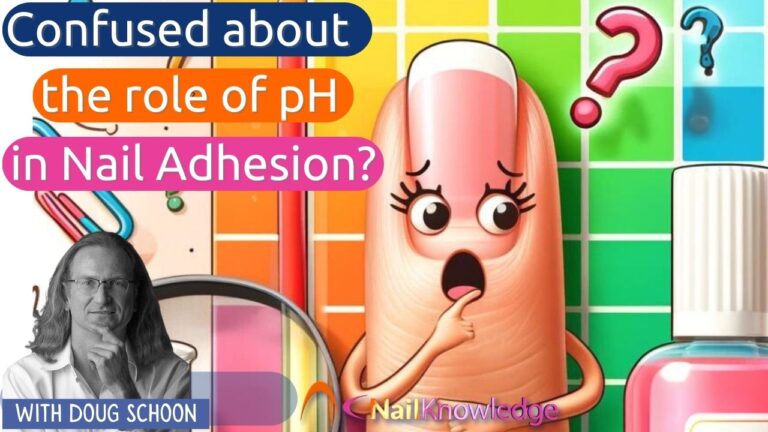
Confused about the role of pH in nail adhesion?

Let’s clear things up!

As I stated previously, only water has pH.

Exploring the Role of pH and UV in Nail Adhesion Promoters

When nail plate adhesion promoters are mixed with water, it is their effect on the water’s pH that is measured. When this is done the water can become alkaline, acidic or neutral. HEMA is well known for its adhesion promoting ability produces a neutral pH in water. Other adhesion promoters can make the water alkaline, some acidic. So, clearly pH does not determine if something is an adhesion promoter.

Yes, in some cases pH can play a small role, but so does UV. UV causes polymerization of the gel which certainly promotes adhesion, but UV has no pH. So, obviously, there is much more to adhesion, than pH.

Understanding the Chemistry of UV Gel Adhesion to Nail Plates


Adhesion is caused by the ingredients in the UV gel. Many ingredients are repelled by the surface of the nail plate. However, some are strongly attracted to the nail plate surface. Why? These ingredients create chemical bonds with the nail plate surface, which is the reason for their attraction. The chemical bonds with the nail plate surface is what causes attraction and adhesion, not pH.

There are three main types of bonds, which I’ve listed in order of their adhesive strength.

1. Hydrogen bonds are the weakest, but many of them can work together to create a significant amount of adhesion strength. However, they can be easily disrupted by things like heat, moisture, and mechanical stress. These bonds are constantly changing positions, so they tend not to be very strong, but are still highly influential and always play a useful role.

2. Ionic bonds are stronger than hydrogen bonds and form by an attraction between opposite positive and negative charges on the ingredient and the nail plate’s surface. The strength of these can be influenced pH, in this way pH plays a small indirect role. These bonds, like hydrogen bonds can still be reversible.

3. Covalent bonds are the strongest of the three types of bonds by far. Covalent bonds are highly stable and resistant to external factors, providing the most durable and long-lasting adhesion. They are generally considered irreversible since they require significant energy to break them.

Factors Influencing Nail Product Adhesion

Other factors also affect adhesion, such as how well the product can flow into small nooks and crannies, which is a property called “wetting”. This important property is improved by properly cleaning the nail plate. So, you can see many things, including the cleanliness and condition of the nail plate, affect adhesion. A well-designed nail product will often use a combination of these bonds to achieve the best possible adhesion.

The Risks of Acidic Gel Bases in Nail Products

What about the so-called “acidic gel bases?

Some of these contain acrylic acid. This ingredient uses all three of these types of bonds to improve adhesion, even so I do NOT recommend using products that contain this ingredient. Is a strong skin irritant and likely is responsible for many allergic reactions in the nail industry. In fact, I estimate it is more likely to cause skin problems than HEMA.

Beware! Avoid skin contact and never use this on a broken or cracked nail plate.

Filed Under: General Information, Lotions, Potions and Polishes, Myth Busting, Product Chemistry

Ensuring Safety and Compliance in Cosmetic Grade Nail Products

As a seasoned expert in cosmetic chemistry and nail product safety, I often encounter queries from professionals in the nail industry who are eager to understand how to ensure their products are not only effective but also compliant with stringent safety and regulatory standards.

One such question recently highlighted the challenges of developing a nail art paint using an airbrush medium labeled as non-toxic, yet lacking in transparency concerning its ingredients. This medium, combined with FDA-approved pigments, raises important considerations about the term “cosmetic grade” and what it truly entails for product safety and market readiness.

In this article, I will address the critical aspects of ingredient transparency, regulatory compliance, and the specific challenges associated with formulating and labeling cosmetic products in the nail industry. The focus will be on helping professionals navigate the complex regulatory landscape, ensuring that their products meet the safety standards required in the U.S. and abroad, and understanding why comprehensive knowledge of both ingredients and regulations is essential for success in this field. By clarifying these elements, I aim to empower nail technicians and manufacturers with the knowledge needed to confidently produce and sell safe, compliant cosmetic products.

Navigating Ingredient Transparency in Nail Product Labeling

This question covers a lot of territory, so I couldn’t tell you all that you need to know, but I’ll do my best to answer. I’m sure others have similar questions about this. 

First, “non-toxic” is a marketing term with no real definition, so don’t be impressed by this claim. Anyone who sells a cosmetic product is required to know the ingredients, so they can list them on the label and on the product’s Safety Data Sheet or SDS (aka MSDS). They also must make sure the ingredients are not prohibited and determine the proper ingredient name to place on the label. This information is obtained from the International Dictionary of Cosmetic Ingredients (INCI Dictionary) it’s a list of names for cosmetic ingredients. 

Product manufacturers must ensure that all ingredients used are listed on the label and the correct INCI name is used for all ingredients. It is unlikely that any cosmetic product would be allowed to avoid listing the ingredients by claiming that it’s a proprietary blend unless you have trade secret status and that is a hard claim to make if you don’t know the ingredients. Even so, without the ingredient listing, the product couldn’t be sold outside the US, because Europe, Canada, Australia, and Japan will all insist on knowing the ingredients. Also, anyone who brings a new cosmetic product to market is expected to ensure all ingredients are safe for cosmetic use and not restricted from use in cosmetics.

The Importance of FDA Approval for Cosmetic Grade Colorants in Nail Products

Since the nail technician who asked this question is in the USA, it would be very important for her to ensure the colorants and pigments are FDA approved for use, specifically in cosmetics. That’s what is meant when the term “cosmetic grade” is used. To keep from being repetitive, I’ll use the word “colorants” to mean anything that is intended to impart color, including liquid dyes and solid pigments. It is very important to understand that the FDA and other agencies in different countries have approved a large number of colorants, but most are not approved for cosmetic uses. They represent a different “grade of material” that is considered non-cosmetic grade.

This is usually due to the chemical composition of the substance and how it is intended to be used. Non-cosmetic colorants may not be safe for use in nail products, so they should be avoided. For instance, if a non-cosmetic pigment which is based on nickel were used in nail products, it could trigger allergic reactions in those with nickel allergies. It’s estimated that 1 in 10 women in the US have nickel allergies, largely from wearing inexpensive jewelry that is plated with nickel… so you see how this could be a problem.

Only a relatively few colorants are considered safe for use in cosmetics and many countries closely regulate and control the use of all cosmetic colorants. Only those specifically approved for use in cosmetics may be added to any cosmetic product, including artificial nail products. Those that are not specifically approved for cosmetics are NOT allowed to be added to cosmetics. The EU and other countries also have requirements similar to the US, so this is a universally accepted concept.

Ensuring Compliance with Safety and Labeling Standards for Nail Products

Product sellers are also required to develop and actively distribute product Safety Data Sheets to nail professionals who use their products and to update these sheets regularly. Those are the basic requirements, but it is also important to know that all seller are responsible to provide safe product, as well as to provide safe usage directions, and any warnings or precautions.

Warnings and precautions MUST be prominently displayed, which means created so that nail technicians can see and read them. Everyone in the USA who sells cosmetics must package them in accordance with the Fair Packaging and Labeling Act, which is federal labeling act.  Other countries have their own similar packaging standards. More information on the this act can be found at the US Federal Trade Commission’s website and you use the handy search box feature search for the “Fair Packaging and Labeling Act”.

The Crucial Role of Regulatory Consultants in the Nail Cosmetics Industry

My recommendation to anyone thinking of selling a cosmetic product into the nail industry is to find a good regulatory consultant to ensure that your products and packaging meet the requirements of each place/region where your products are sold.  That is very important. 

You can check with one of the many cosmetic associations such as the ICMAD or PCPC, for a referral.  ICMAD is an acronym for Independent Cosmetic Manufacturers and Distributors. The PCPC is the Personal Care Products Council. Both have websites and both can refer you to knowledgeable regulatory specialists.

There are rules and regulations in every country which must be adhered to.  Now you can see it’s a myth that cosmetics aren’t regulated. Ha!  There are so many regulations, some think too many, but for some there are never enough regulations.  Some are constantly trying to force unnecessary regulations on top of the existing ones, which in my view is a foolish waste of time and resources.

Complexity of Cosmetic Regulations and Their Importance in Product Safety

Cosmetics are more heavily regulated than some activist’s groups would like you to believe.  I’m sure some of you are saying, I had no idea it was so complicated. And I’ll tell you the process is far more complicated that it seems. That’s why I recommend that anyone selling cosmetic products to seek the help of a professional who specializes in cosmetic regulations and make sure you are doing things right.  Regulations and standards for arts and crafts products are entirely different from cosmetic requirements. Some confuse the two and this should be avoided.  

Here’s what I mean- some have asked me why it isn’t safe to use art and craft colorants or glitters when the product’s website and literature and Safety Data Sheet say they are “safe” for use.  Some don’t understand that this means the colorants are safe for the “intended use” arts and crafts and that does NOT include cosmetic use. Just because these are safe for use in a craft project, doesn’t mean they are safe for nail products or other cosmetics.

Inhaling filings and dusts that containing non-cosmetic colorants could cause problems for nail technicians. And overexposure can lead to rather serious allergic reactions.  Whenever an ingredient is purchased for use in a cosmetic product, the manufacturer should clarify to all companies that the ingredient is for use in a cosmetic and explain the intended purpose is so the ingredient manufacturer could let them know if it is approved for that usage.  

Anyone who manufactures or sells cosmetics are required to do many things, most of which help to ensure the products are safe when used as directed. Manufacturing and/or selling a cosmetic is serious business with serious responsibilities, which is why I recommend that all involved ensure they are compliant with all requirements.

Filed Under: General Information, Myth Busting

Nailing the Truth: How to Separate Fact from Fiction in Nail Care

In the ever-evolving world of nail care, the line between fact and fiction can often seem as fine as a freshly filed nail. One of the recurring challenges that both professionals and enthusiasts face is the abundance of misinformation swirling through the industry, from fellow nail technicians to the very manufacturers of our tools and products. A common concern, expressed poignantly by a reader, captures the essence of this struggle: ‘I do my research, but there is so much incorrect information coming from other nail technicians and even from manufacturers. How am I supposed to separate the facts from the myths?’

At NailKnowledge, we continually address myths and clarify doubts through a myriad of questions posed by our readers. Today, we delve into some of the most entrenched myths to reveal the truths hidden beneath the glossy veneer of the surface.

Filing Away Myths: The Socratic Method in Nail Care

Determining fact from fiction is an age-old problem that has existed since the beginning of civilization.  In other words, misinformation has always been a problem. The best solution to this dilemma was discovered about 2500 years ago by a Greek philosopher named Socrates. Socrates and the people living in his time didn’t have to deal with the all the baloney circulated on the Internet or by the news media, but they sure did have their own fair share of myths and misinformation to deal with. So, Socrates developed a method to help him get the facts and he taught this method to his followers.

His method was so extremely successful that people regularly use it to this day! This method is used by judges, lawyers, reporters, detectives and scientists looking for facts and clues about the facts, but anyone can use this method because it is very simple, yet highly effective.

Socrates’s method can be boiled down to just these two words, “Question Answers”.  Yes, it is that simple, yet it is powerful! Don’t just accept what you are told. That is how nail technicians are often fooled. Instead, ask lots of questions, and keep asking until you are satisfied you fully understand. It’s all about the questions you ask.  Here are some examples for you to try.

Polishing the Truth: The Power of Open-Ended Questions in Nail Care

The best way to get answers is to ask open ended questions. Start with the simplest question of all…  Ask “Why”? When someone tells you something you suspect is incorrect, ask them this question, “Why do you believe this is true?” And listen carefully to their answer for clues about what they are really saying.

Or ask “How do you know this?” Another interesting question is, “Where does your information come from?” and “What does this mean?” Or my personal favorite, “Please help me understand why I should believe this?” Or, “Why is this information important?” If you don’t understand their explanation say, “Explain that to me in a different way so that I can understand.”  Or “What does that mean?”  These are just a few examples of the type of open-ended questions that can help you to do better research and get a deeper understanding about any issue.

Uncovering Layers: The Revealing Power of Persistent Questions in Nail Care

Those who don’t know what they are talking about will have a hard time answering such questions. Those who want to deceive you, will not like being questioned. In either case, if someone doesn’t know the facts, it will be obvious when these types of questions are asked.  And those who don’t want you to know the facts, will become uncomfortable.

When people ask me questions like this, I love it!  This provides an opportunity to explain in greater detail and lets me know the questioner is interested.  It’s an opportunity to provide more detailed information, which I always appreciate. Don’t stop asking “why” and “how” until you get to the root of the issue and feel you understand the facts. You’ll learn that some don’t know why they believe, they just do and will have no clear answer to your questions.

Beyond the Surface: The Importance of Questioning in Nail Care

Finally, don’t just accept what you hear or read and don’t just look at the headlines and expect you know the facts. Headlines are often intended to fool people, since those writing the headlines know most won’t take the time to read the article and won’t ask questions. Many are afraid to ask questions, but now you understand the tricks used by professionals who ask questions for a living.

With practice, you’ll find it’s easy.  Take the time to Question Answers! And you’ll be the wiser for it. Like anything, it takes practice- so dig in and don’t give up until you get the answers to your questions.

Filed Under: General Information, Myth Busting

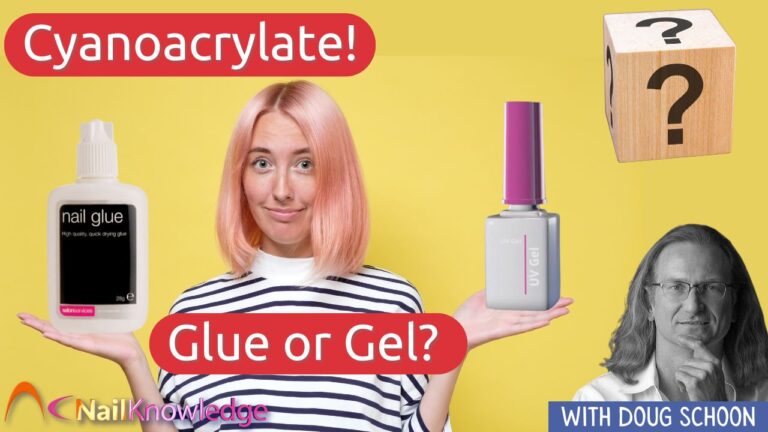
Cyanoacrylate: Understanding Its Dual Role as Glue and Gel in Nail Products

Terminology can often become a point of confusion among professionals and clients alike. A common query we encounter pertains to the use of the term “gel” in relation to products containing cyanoacrylate. A compound traditionally recognized as a type of glue. This issue underscores a broader challenge in the industry: understanding the distinctions and overlaps between different product categories.

This article aims to clarify these nuances, exploring how one ingredient can indeed fit into multiple product definitions, and why precise language is crucial in the beauty industry to enhance professionalism and reduce misunderstandings.

Versatile Uses of Cyanoacrylates in the Beauty Industry

Cyanoacrylates are monomers from the acrylic family that are used for many purposes in the beauty industry. For instance, they are used as tip adhesives for nails, used to adhere rhinestones and other accessories to nails, they’re also used to create fiberglass and silk wraps, and they are regularly used as eyelash adhesives.  They are also sold as “no-light nail gels” and for so-called “dip” systems. 

In all cases, they are considered adhesives, since they stick to the nail plate and more commonly they are called “glue”.  Cyanoacrylates can be thin and watery or thickened to a gel-like consistency.  Some mistake the term “gel” to mean only UV-curing gels. UV curing gels are called “gels” because of their gel-like consistency. In other words, not all gels are UV-curing.  The word “gel” describes the consistency of the product, not its chemistry or composition.

Hair gels for instance are thickened to a high viscosity, which is why they’re called gels. Therefore, it is entirely proper to refer to a thickened cyanoacrylate as a gel.  Nail professionals should understand that not all gels are UV curing gels. That’s why when referring to UV gels, they should not just be called “gels”- which is an overly simplistic name. 

The Importance of Precise Terminology in Professional Nail Care

This is a great example of why it is important to use more descriptive terms when talking about nail products, if for no other reason, to reduce confusion.

Another example of this are the sophisticated, high tech monomer blends used to create artificial nail products.  These products are among the most scientifically advanced products in the beauty industry, yet nail professionals refer to them as “liquid”. The polymer powders are equally sophisticated and complex, yet they are simply called “powders”.

If nail techs want clients to recognize them as professionals, they would be wise to use more professional terms, such as UV gel, monomers and polymers.

Filed Under: General Information, Lotions, Potions and Polishes

Manicures Before Enhancements: Building a Solid Base

It is not a good idea to skip gaining a manicure qualification and go straight to UV gel polish or enhancements.

That is like learning how to colour hair without understanding hair!

Why Manicure Training is Essential

A manicure qualification is not a 1-day course. There is a lot of anatomy and physiology to learn (and not just read about), nail and skin conditions including those that are considered to be contra-indications. There is also a lot of practice in providing a manicure including painting. Ideally, there should be several case studies as every individual is different. The case studies should follow a treatment plan which can be amended if needed. The recommended teaching hours for regulated qualification of Providing a manicure treatment is 50 hours+.

Addressing Gaps in Traditional Manicure Training

It is becoming obvious from questions being asked on SM platforms that manicure training is being skipped. Many nail professionals don’t know how to use traditional nail polish (it dries too quickly when they are used to using UV gel polish), they are unaware of common nail and skin conditions and do not know how to give good home care advice.

Manicuring is the basis of all nail services. Do not skip this important first step!

Filed Under: General Information, Nail Services

The Real Causes of Nail Plate Yellowing

Unveiling the Mystery of Nail Plate Yellowing

We often receive questions about nail care issues that both perplex and frustrate professionals and clients alike. One recurring topic that sparks a lot of curiosity and concern revolves around nail plate yellowing. Many believe that this discoloration is primarily caused by the pigments in nail polish. However, recent inquiries and expert insights suggest that other elements, such as nitrocellulose and various colorants, might play a significant role.

This article delves into the intricacies of what really causes nail plate yellowing, backed by expert analysis and industry knowledge, to shed light on this common but misunderstood issue.

Understanding Nail Discoloration: Colorants and Their Impact

Pigments are not likely to stain the nail plate. They are too large to penetrate. Dyes and Lakes are other types of colorants that are often used, and many can and DO stain the nail plate. There are three different reds and one yellow colorant that have been reported as the most likely to stain the nail plate. The reds colorants are listed on product ingredient label as Red no. 6, Red no. 7, or Red no. 34.  In the European Union, all three of these red colorants would be sold under their color index number “15850”. The yellow that is reported to cause a lot of staining is Yellow #5 Lake, which in the European Union is labelled as “19140”.

The Role of Nitrocellulose in Nail Yellowing: Quality Matters

It is true that some grades of nitrocellulose can stain as well.  But the more expensive, higher quality grades are much less likely to discolor. Smaller companies that don’t sell much nail polish often use these inferior grades, since the best grades are too expensive when purchased in low quantities and the larger companies buy up all the high-quality nitrocellulose. When it does stain, nitrocellulose tends to be a more brownish-yellow stain, while discoloration caused by colorants tend to be the light yellowish tones or other odd shades, such as green.

Examining Base Coats: Nitrocellulose and Nail Plate Vulnerability

If this base coat contained nitrocellulose and no colorants, the nitrocellulose is a possible suspect. However, a high-quality base coat should not stain the nail plate, unless its surface is damaged. Damaged nail plates are much more likely to pick up stains, even from some foods stains or clothing. Damaged nail plates will absorb stains more easily than healthy nail plates. To say the nitrocellulose is responsible for nail yellowing is an over simplification. Marketers tend to oversimplify things for three reasons,

  • They don’t understand the issues, so instead of giving the facts they just keep it simple to hide their lack of understanding.
  • Many nail techs often don’t understand these issues, so the message must be kept simple.
  • Marketers focus on only what helps them sell their products and often exaggerate the information.

It is definitely an over simplification to say that nitrocellulose is what stains the nail plate. More likely the causes are “dyes” and “lakes”.

Filed Under: General Information, Nail Conditions

  • « Go to Previous Page
  • Page 1
  • Interim pages omitted …
  • Page 5
  • Page 6
  • Page 7
  • Page 8
  • Page 9
  • Interim pages omitted …
  • Page 30
  • Go to Next Page »

Level Up Your Nail Insights

Join our Newsletter!
SUBSCRIBE...

Copyright © NailKnowledge

NailKnowledge

  • eBooks
  • About us
  • Courses
  • News
  • Blog
  • Newsletter
  • Glossary

Policies

  • Privacy Page
  • Terms & Conditions
  • Cookie Policy

Support

  • Contact Us
  • Ask the Experts
  • System Support
  • FAQs
English
English
Portuguese Spanish Vietnamese