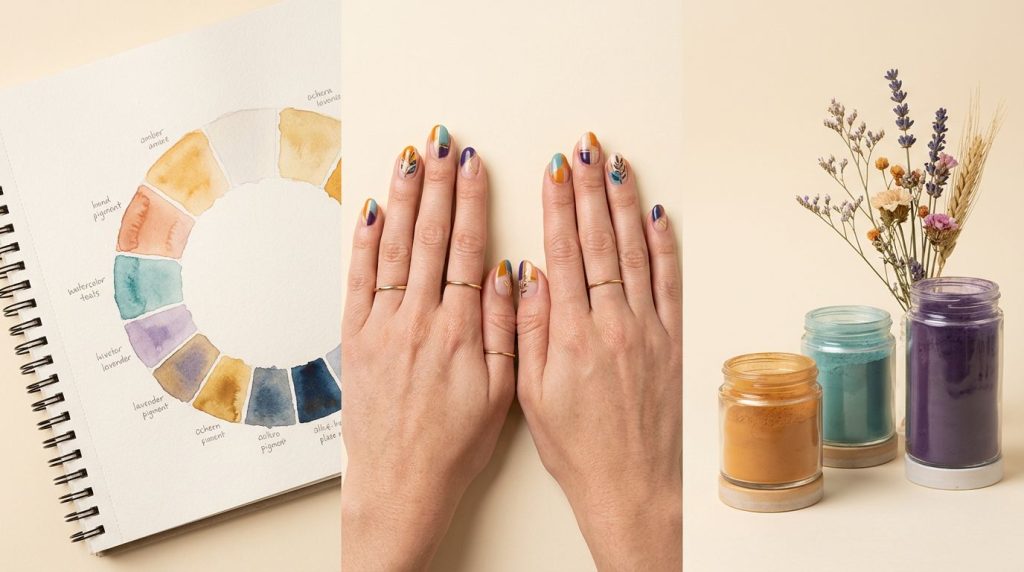
What Is the Colour Wheel for Nails?
Most people pick nail colours on instinct. Something catches your eye on the shelf, it feels right for the season, and that’s that. But there’s a whole science running underneath those instincts, and understanding the colour wheel for nails can genuinely change the way you approach every set. Colour theory isn’t just for artists and designers. It’s a framework built on how light, pigment, and human perception work together, and it applies directly to your nails.
The colour wheel is a circular arrangement of colours organised by their relationships to each other. It starts with three primary colours: red, yellow, and blue. Mix two primaries and you get a secondary colour. Orange, green, and violet sit between them. Mix a primary with a secondary and you get a tertiary, like red-orange or blue-green. That’s twelve positions on a wheel, and every nail colour you’ve ever loved sits somewhere on it.
Simple concept. Powerful results when you actually use it.


The Science Behind Colour in Nail Design
Here’s where it gets genuinely interesting. Colour isn’t a property of an object. It’s a perception. When light hits a surface, some wavelengths get absorbed and others bounce back. Your eye has three types of cone cells, each sensitive to different parts of the light spectrum: roughly red, green, and blue. Your brain then combines those signals and interprets them as a specific colour.
So when you look at a coral nail polish, you’re not seeing coral in the product. You’re seeing the wavelengths the pigment didn’t absorb, bouncing back to your eye, interpreted by your brain. That’s why lighting changes everything. A colour that looks warm and peachy under salon lighting can appear almost orange under cool daylight. The pigment hasn’t changed. The light source has, and so the reflected wavelengths shift.
Your brain also reads contrast and harmony automatically. It compares colours to each other, not in isolation. That’s why a colour can look completely different depending on what sits next to it.
Understanding Colour Relationships on the Wheel
Once you understand the wheel’s structure, the relationships between colours start to make logical sense rather than feeling like guesswork.
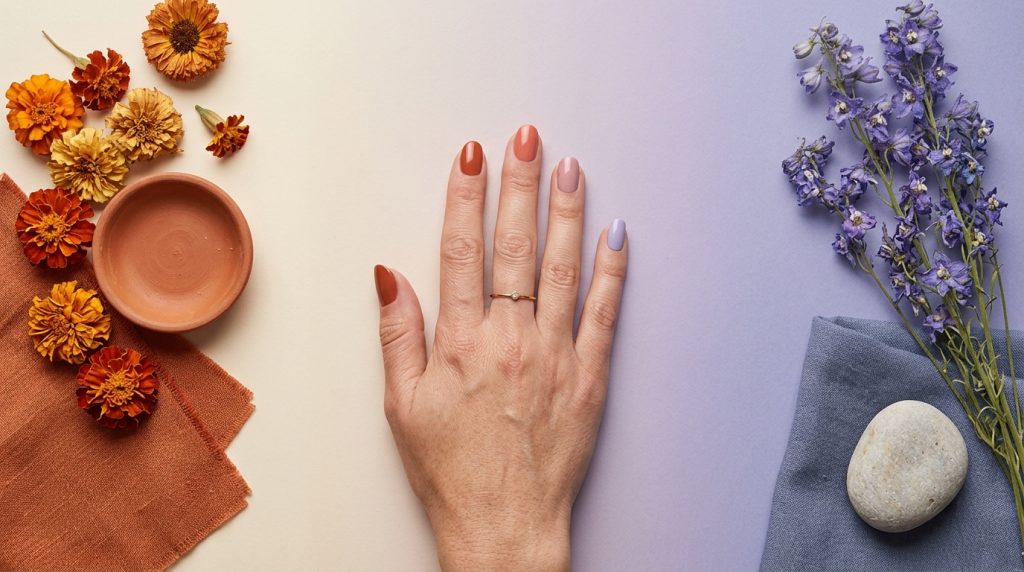
Complementary colours sit directly opposite each other on the wheel. Blue and orange. Red and green. Purple and yellow. Because they reflect completely different wavelengths, placing them side by side creates maximum contrast. Your eye moves between them. Used well, this is striking and dynamic. Used carelessly, it’s visually chaotic, especially on the small canvas of a nail.
Analogous colours sit next to each other on the wheel. Think terracotta, burnt orange, and warm yellow. Because they share similar wavelengths, they feel harmonious and cohesive. Analogous nail colour combinations tend to feel effortless and sophisticated. They’re also forgiving, since the tones naturally support each other rather than compete.
Triadic schemes use three colours spaced equally around the wheel. Red, yellow, and blue. Or orange, green, and violet. These create balanced contrast without the visual tension of complementary pairings.
Triadic nail art designs tend to feel playful and bold while still feeling considered.
Warm vs Cool Colours in Nail Design
The warm and cool divide is one of the most practical tools in nail colour theory. Warm colours sit in the red, orange, and yellow half of the wheel. Cool colours live in the blue, green, and purple half. But here’s the detail that most people miss: every colour has a warm or cool version within its own family.
A red can lean warm (think tomato, brick) or cool (think raspberry, cherry). A nude can read warm (peach, caramel) or cool (taupe, mauve). When you mix a warm-leaning colour with a cool-leaning one without intention, the result can look muddy or simply “off” without any obvious reason why.
Skin tone interaction makes this even more important for nails specifically. Warm skin tones tend to harmonise with warm nail colours. Cool skin tones often suit cool shades. But contrast works too: a deep, cool burgundy on warm skin creates a striking effect precisely because of that tension.
Knowing the difference lets you make that choice deliberately, rather than stumbling into it.
How Pigments Behave in Nail Products
This is where nail colour theory parts ways from standard art theory, and where the science gets specific to your nails.
Not all colours behave the same way in gel or acrylic. Opacity varies enormously between pigments. Some colours, particularly yellows, oranges, and certain reds, have naturally lower opacity. They may need multiple layers to read as true to the bottle colour. Others, like deep blacks and bright whites, are highly opaque and can overpower a blend if you’re not careful.
Transparency also affects how colours interact when layered. A sheer warm pink over a cool base can shift the overall tone in ways that aren’t obvious until the product sets. Undertones matter more than surface colour in these situations. Two nudes that look similar in the bottle can behave very differently on the nail if one has a pink undertone and the other pulls yellow.
Some pigments also neutralise each other. Mixing complementary pigments in the same formula doesn’t create vibrant contrast. Instead, it creates a dulled, greyed tone, because the opposing wavelengths cancel each other out. That’s why some custom colour mixing produces a muddy finish rather than the expected bright blend.
How to Choose Better Nail Colour Combinations
Start with the wheel. Identify where your chosen colour sits and decide which relationship you want to use. Complementary for drama. Analogous for harmony. Triadic for balance.
Then check undertones. Make sure the colours you’re combining share a warm or cool lean, unless you’re deliberately using contrast as a design feature. A set built on warm terracotta, warm gold, and warm nude will always feel cohesive. All three speak the same tonal language.
Also consider the nail as a small surface. What reads as balanced contrast on a large canvas can feel overwhelming at nail scale. Simpler combinations often land better. A two-colour complementary pairing with a clear accent nail tends to be more effective than five competing colours across ten nails.
When in doubt, go simpler. You can always add complexity once the foundation is solid.
Common Mistakes When Using the Colour Wheel
The most common issue isn’t choosing the wrong colours. It’s ignoring undertones while focusing only on surface colour. Two colours can look like they match in the bottle but clash visually on the nail because one pulls warm and the other pulls cool.
Too many competing colours is another frequent problem. Triadic schemes work because the three colours come together with intention and balance. Randomly adding a fourth or fifth colour without a structural reason breaks that balance and creates visual noise.
Lack of contrast is the quieter mistake. Analogous combinations are beautiful, but if the values (light and dark levels) are too similar across all the colours, the design loses definition. A small shift in value, one slightly deeper or lighter shade within the analogous group, adds dimension without disrupting harmony.
Finally, think about scale. A colour that looks rich and complex in swatch form can disappear or overwhelm at nail size. So always consider how a colour reads at small scale, not just how it looks in the bottle.
The Key Takeaway
Colour theory for nails isn’t abstract. It’s grounded in how your eye perceives light, how pigments interact with each other, and how the brain reads harmony and contrast. Every confident, well-composed nail look you’ve admired has these principles working behind it, whether the person creating it knew it consciously or not.
Understanding the science gives you the ability to make those choices deliberately. That’s the difference between a set that looks good by luck and one that looks good by design.
Knowing the theory is one layer. Applying it through actual product, with real gel or acrylic behaving in real ways, requires technique built on that foundation. Colour science in applied arts consistently shows that practitioners who understand the underlying principles make faster, more confident decisions at every stage of their work.
Understanding colour theory is genuinely exciting, but translating that knowledge into beautiful results on actual nails takes guided practice. Knowing why colours work is the foundation. Knowing how to apply that in product is the next step.
If you want to take your colour knowledge further, MyNailEra brings together tutorials from 12 award-winning nail artists who work with these principles every day. Era, your personal nail coach, can also give you feedback on your own colour choices, so you can see exactly how your combinations are reading and where to refine them. Explore MyNailEra to see how it works.