The dip system is popular with many nail professionals. It does seem to be a bit like Marmite though: you either love it or hate it!
Some like the strength it can provide. But the strength can prove to be a bit too brittle for some nails. Others don’t like the rather lengthy process to remove it.
There are 2 methods of use: one involves a UV cured gel where the polymer powder is sprinkled into the uncured gel, then cured; the other involves a cyanoacrylate liquid and an activator or hardener. These are products similar to the fiberglass system but use the powder for strength and colour rather than strips of fiberglass for the added strength.
Cyanoacrylate is a product that has been used for a very long time for many different applications. It is essentially an adhesive that can be manufactured in many different viscosities and grades. At its lowest grade, it is what is known as ‘Superglue’ which is not for cosmetic use. The highest grade (and most expensive) is for medical use such as skin closures. Just below the medical grade are several products that are for cosmetic use such as a tip adhesive, the coating in the dip and fiberglass systems, and eyelash adhesive. A cyanoacrylate is even used in the detection of fingerprints in forensic science.
As with all acrylate nail coatings, it cures or polymerizes. But unlike the L&P system and UV gel, the polymer chains are not cross-linked in quite the same way. This means it is not as strong and needs additional help such as fiberglass strips or polymer powders.
It is the moisture in the air that starts the polymerization process. If a cyanoacrylate is applied to a nail it will eventually cure but the result is very flexible. To speed up this process and create a harder coating, an activator or accelerator is used which is a catalyst controlling the speed of curing. The method of doing this needs practice and understanding as it is an exothermic reaction. If it is too fast, it creates a lot of heat which, when on a nail, can burn the nail plate and be very painful. It also creates a very brittle coating.
The dip system is probably more popular in the US but I have noticed on several US forums (and Google) there is discussion about ‘Dip Flu’! This isn’t a medical term but a description of a set of symptoms that can appear after providing nail services using a dip system, usually the cyanoacrylate version. The symptoms are usually a runny nose, watering eyes, headache, sneezing, coughing, sore chest, nausea. It can last a couple of hours to several days.
Let us look into it in more detail. Is it an allergic reaction or is it an irritation? Is it the polymer powder or is it the cyanoacrylate? There are many alternatives that are, possibly, all correct depending on the circumstances.


The “dip flu” symptoms recognized are clearly a respiratory reaction rather than a skin reaction. This suggests it must have been inhaled.
The polymer powder is not a specifically light product such as a very fine dust that will stay in the atmosphere. For hygiene reasons, it should not be used in large quantities. It is better to decant a small amount into a small receptacle for dipping, and then discard it. If it is used in a strong draft it could be blown about. There have been several reports now that, when a polymer powder manufactured for the L&P system is used, the polymer beads are coated with benzoyl peroxide which can be an irritant and allergen, and therefore could cause a skin reaction.
The cyanoacrylate, on the other hand, does have vapours that can be a strong irritant. Also, when a catalyst is used and it is too fast, there are even fumes. If anyone has gotten too close to cyanoacrylate that is curing, they will remember the effect it can have on the eyes! This is the most likely cause of any respiratory effect.
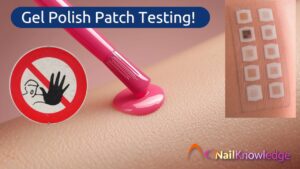
The only way to tell if this ‘dip flu’ is an allergy or a result of an irritation (that can easily turn into an allergy) is to have a patch test. If an individual is allergic to all acrylates, then cyanoacrylate will be in this group.
It is FAR better to take steps for prevention rather than have to suffer symptoms and take medication! Nail services really should NOT require medication to carry them out or wear them!
So, “dip flu”; who knew? Well it does seem to be a ‘thing’ but a ‘thing’ that is easily avoidable:
– understand the science
– understand your specific products
– work cleanly and accurately
– work in a well-ventilated atmosphere
– use vapour extraction
– wear a mask and eye protection
– if you are experiencing symptoms of any kind, have a dermatological patch test