The Myth That Keeps Spreading
Walk into almost any nail salon after a gel removal and someone will mention it. Japanese manicure nails often get held up as the gold-standard recovery treatment. The promise sounds compelling: natural ingredients, conditioning pastes, a beautiful gloss, and nails that feel stronger afterwards. But how much of that is real, and how much is wishful thinking dressed up in clever marketing?
The truth is more nuanced, and more important, than most beauty content lets on. So let’s get into it.
💡 Key Takeaway
Japanese manicure nails can improve how your nails look and feel, but they cannot repair structural damage that may result from aggressive filing or poor gel removal. The visible nail plate consists of non-living cells, so no conditioning paste can rebuild layers that abrasion has removed. If your nails are already thin, prioritise protection and new growth over further buffing.

What Japanese Manicure Nails Actually Involve
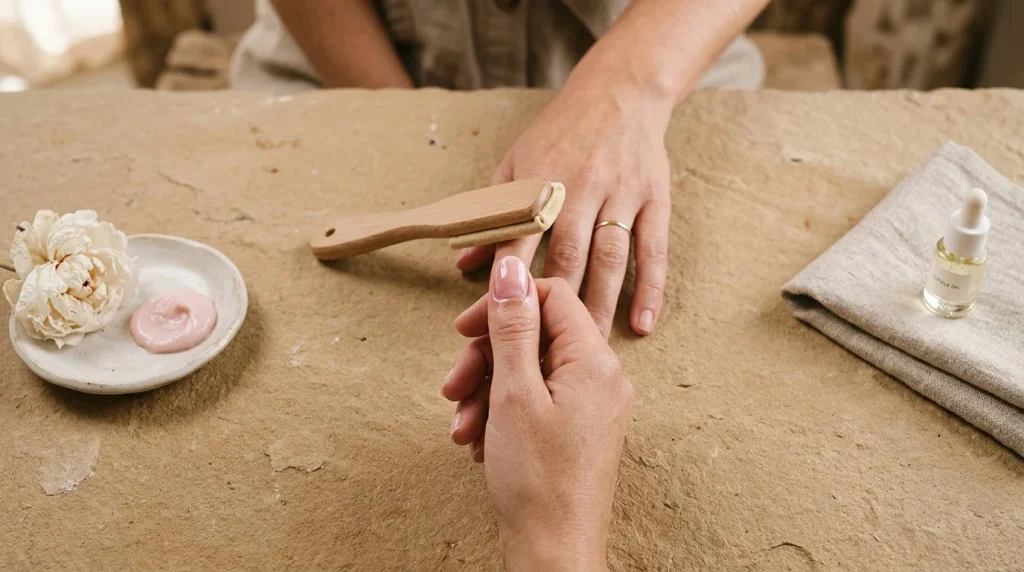
A traditional Japanese manicure is a natural nail care treatment focused on improving the appearance and condition of the nails and surrounding skin. Unlike gel polish or nail enhancements, it doesn’t apply a coloured coating or artificial layer. Instead, it uses conditioning pastes, oils and specialised polishing tools to create a smooth, glossy finish on the natural nail.
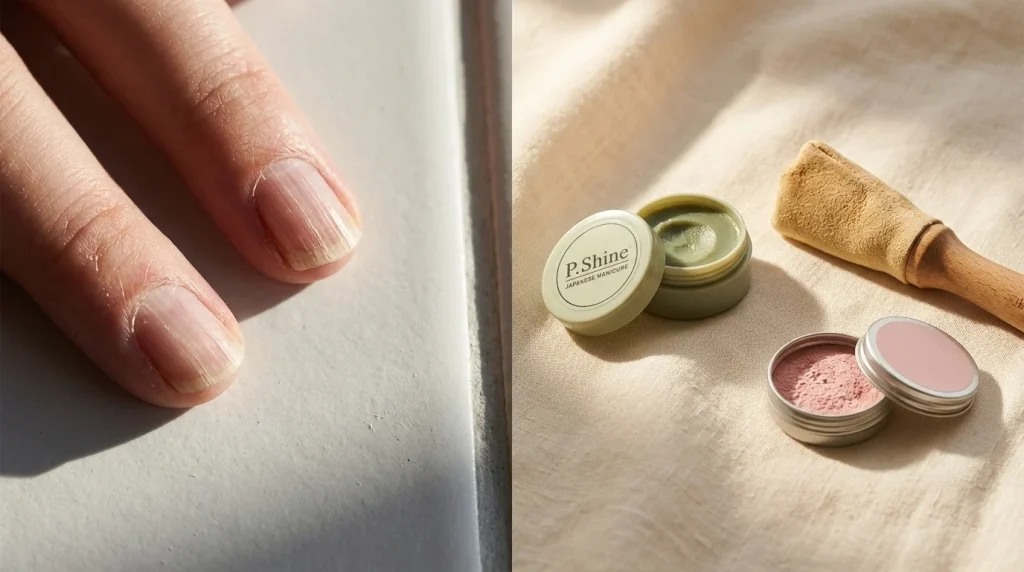
The most recognised system is P.Shine. It combines a conditioning paste, a finishing powder and chamois-style polishing tools. The result is a subtle, healthy-looking sheen that many people find genuinely beautiful. No colour, no coating, just the nail itself looking its best.
Where things get complicated is in the marketing language. Words like “repair”, “restore” and “strengthen” appear constantly in descriptions of these treatments. For someone whose nails look dull and feel fragile after gel removal, those words carry enormous persuasive weight.
Why the Natural Nail Cannot Simply Be Repaired
To understand what a Japanese manicure can and cannot do, you need to understand one fundamental fact about nail biology. The nail plate grows from living cells deep within the nail matrix, sitting under the skin at the base of your nail. As those cells develop, they become keratinised and push forward, forming the hard plate you can see and paint.
By the time any part of the nail plate is visible, those cells are no longer living.
This matters enormously. Unlike skin, which can regenerate damaged cells, the visible nail plate cannot repair itself from within. If buffing or aggressive filing removes layers of the nail plate, those layers are gone. No cosmetic product applied to the surface can recreate them. You’ll need to wait for new nail to grow forward from the matrix.
For more detail on how nail matrix health shapes what grows, the article on what happens when the nail matrix is damaged explains the biology clearly.
A Japanese manicure, however beautifully formulated, works on a non-living surface. It can improve how that surface looks and feels. It cannot biologically regenerate what abrasion has removed.
What the Ingredients in Japanese Manicure Nails Actually Do
This doesn’t mean the ingredients are useless. It means we need to be accurate about what they actually do.
P.Shine’s published formulation includes ingredients such as glycerin, squalane, tocopheryl acetate, phytosterols and ceramide NP. Each of these has a legitimate cosmetic role.
Glycerin is a humectant. It attracts and retains moisture, which can improve the feel and flexibility of the nail surface. Flexible nails generally snap less under pressure, so that’s genuinely useful.
But attracting moisture isn’t the same as rebuilding structure.
Squalane is an emollient that provides lubrication and surface conditioning. For dry or brittle nails, good lubrication can reduce friction and improve how the nail behaves. Again, useful. But not structural repair.
Tocopheryl acetate is a form of vitamin E used for skin and surface conditioning. Think of it as a surface treatment, not a rebuilding agent. Its presence in a nail paste doesn’t mean the product can repair nail plate damage or stimulate growth.
Ceramides are lipids that play important roles in biological barrier structures. In cosmetic products, they contribute to conditioning and moisture management. But a ceramide-containing paste cannot rebuild nail plate layers that abrasion has removed. The chemistry simply doesn’t work that way.
The polishing components in these systems create the characteristic gloss. That shine reflects a cosmetic outcome. It tells you nothing about structural change beneath the surface.
The Buffing Problem Nobody Talks About
Here’s where the real risk lies, and it’s a risk that rarely comes up in glowing treatment reviews.
Buffing sits at the centre of the Japanese manicure process. It smooths surface irregularities and creates the polished finish. But abrasive buffing physically affects the nail plate surface. Depending on the abrasive and the pressure applied, it removes small amounts of nail material.
Removing nail material does not make the remaining nail stronger. It makes it thinner.
Now consider the growth rate of a fingernail: roughly 3 millimetres per month. A complete nail takes around four to six months to grow out fully. The same section of nail plate sits in place for months before it reaches the free edge.
If someone receives a Japanese manicure every two to three weeks, that section of nail may face buffing several times before it grows out. Each session removes a small amount of material. The nail plate doesn’t replace what abrasion removed between appointments.
Over time, this cumulative effect may contribute to progressive thinning of the nail plate. For nails that were already healthy and of normal thickness, the risk is lower but still worth understanding. For nails that gel removal has already thinned, additional abrasive buffing may make a fragile situation worse.
Japanese Manicure Nails After Gel Removal: What You Need to Know
Gel polish doesn’t automatically damage the natural nail. The nail plate sits beneath the coating, and wearing gel alone doesn’t harm it. Damage is most commonly associated with removal: excessive filing, harsh scraping, or peeling the product away rather than allowing it to soak off properly. These actions physically strip layers of the nail plate along with the coating.
For a thorough look at why removal technique matters so much, the piece on safe gel removal with foil wraps explains the science behind why acetone needs proper contact time to do its job without forcing the nail.
It’s also worth knowing that nails sometimes feel more flexible immediately after gel removal because of changes in moisture content. That temporary softness can feel alarming, but it isn’t always a sign that the nail plate has thinned.
When the nail plate genuinely has thinned, the priority is protection, not more abrasion.
A Japanese manicure involving repeated buffing on an already compromised nail may contribute to further thinning, even if the finished nail looks temporarily smoother and shinier. Looking healthier and being healthier aren’t the same thing.
When Japanese Manicure Nails Can Be a Good Choice
None of this means you should avoid Japanese manicures entirely. For nails of normal thickness that haven’t faced excessive filing, a treatment using minimal abrasion can provide real cosmetic benefits. Conditioning the surface, improving lubrication and creating a beautiful natural finish are all worthwhile goals.
The key phrase is minimal abrasion.
A practitioner who assesses the nail plate’s current condition and adjusts their technique accordingly makes all the difference. If your nails are healthy, a Japanese manicure can be a lovely, low-intervention option, particularly if you want a break from coloured polish.
If your nails are already thin or damaged, a better approach may be conditioning treatments that skip abrasive polishing altogether. Nail oils, appropriate hydration and simply protecting the nail while new growth comes through often deliver more benefit than any polishing system. Understanding what genuinely helps damaged nails recover versus what only improves their appearance is one of the most useful things anyone interested in nail health can learn.
Common Claims About Japanese Manicure Nails: Fact or Fiction?
“Japanese manicures heal damaged nails.” Not quite. They can improve the cosmetic condition of the nail surface. But no cosmetic treatment can biologically regenerate missing nail plate layers.
“The ingredients nourish the nail.” Some ingredients improve lubrication, flexibility and surface condition. But the visible nail plate consists of non-living cells, so they don’t receive nourishment the way skin does.
“Regular buffing makes nails stronger.” Abrasive buffing modifies or removes surface material. Excessive or repeated buffing can reduce nail plate thickness, which may reduce mechanical strength.
“A shiny nail is a healthy nail.” Shine is a cosmetic characteristic. It reveals nothing about the nail’s actual thickness, structural integrity or resilience.
“Japanese manicures are ideal for thin nails.” Not automatically. Nails that aggressive filing or removal has already thinned shouldn’t face further abrasive polishing.
Protecting the Natural Nail Comes First
Japanese manicure nails can look genuinely beautiful, and the conditioning ingredients in quality systems like P.Shine offer real cosmetic value. But the treatment has limits that its marketing often glosses over.
The natural nail plate is a remarkable structure. Once abrasion or poor removal technique removes material from it, no cosmetic product can restore those layers within the existing nail. Recovery depends on new growth, and that takes months.
Repeated buffing during that recovery period may continue to thin the nail rather than help it.
Understanding these distinctions protects your nails from treatments that may look restorative while quietly causing further harm. According to research published in the Journal of the American Academy of Dermatology, the nail plate’s keratin structure cannot regenerate through topical application alone, which is why protection and patience remain the most evidence-based approach to nail recovery.
Getting a Japanese manicure to look polished and feel conditioned is a perfectly reasonable choice. Getting one because you believe it will repair structural damage rests on a misunderstanding of what cosmetic treatments can actually do. The available evidence supports this position, even when the marketing suggests otherwise.
Achieving genuinely healthy nails after damage takes patience, protection and realistic expectations. No paste, powder or polishing tool can shortcut the biology.
Knowing the science behind nail structure and conditioning treatments changes every decision you make for your nails. That kind of informed approach, grounded in how nails actually work, separates short-term cosmetic fixes from real, lasting nail health. Building that knowledge properly takes more than a single article.
The NailKnowledge App, has your very own personal nail coach, who can help you apply nail science directly to your own nails as they are right now. The verified learning content, built on an expert-reviewed library, gives you the foundation to make genuinely smart choices about nail health. Start your learning journey on NailKnowledge App today.