• Skip to primary navigation
  • Skip to main content
  • Skip to footer
NailKnowledge

NailKnowledge

  • Courses
  • MyNailEra
  • Free eBooks
  • Knowledge Base
    • Knowledge Base
    • Ask the Experts
    • Glossary
  • News
  • Blog
  • Login

Nail Conditions

Are We Being Too Cautious with Nail Clients?

Can you be too cautious? Yes, I believe we can.

Managing Anxiety in the Face of the Allergy Epidemic in Nail Services

The current rise in allergy concerns has caused significant anxiety among many nail professionals, making them more cautious with nail clients, to the point where some may even consider refusing service to all clients due to fear of allergic reactions.

All the nail and skin conditions that we are seeing these days have always been around and those with several years of experience will have come across them many times. Still, it’s only now that the huge anxiety has set in causing so many mental health issues.

True and severe allergies often present with a distinct set of obvious symptoms, including hyperkeratosis, onycholysis, splinter haemorrhages and discolouration, often appearing together.

The incidence of one of these does not necessarily mean an allergy. The ONLY way to be sure is with a dermatology patch test but NB not all dermatologists are qualified to provide acrylate tests.

Addressing Concerns Over Minor Nail Marks in Nail Services

There are far too many posts on SM with tiny marks on maybe one nail to ask if it is ok to go ahead with the service. Professionals are getting freaked out by the possibility it will develop into an allergy.

Small marks or areas for concern are probably nothing more than a bit of trauma. It does mean that some caution must be observed by convincing the client they must return in two weeks so the nail can be checked. So, either remove the rating or buff off to a clear layer so the nail and nail bed can be seen. If the symptom has got worse then remove all products. If it has grown out a little but no worse just continue as normal.

Maintaining Confidence and Caution in Nail Services

Everyone needs to calm down as not every mark is the start of an allergy! It is better to be confident you are using a good quality product, have a guarantee that the lamp will provide a proper cure and you are applying safely, not too thick or touching the skin.

Filed Under: Health and Safety, Nail Conditions, Nail Services

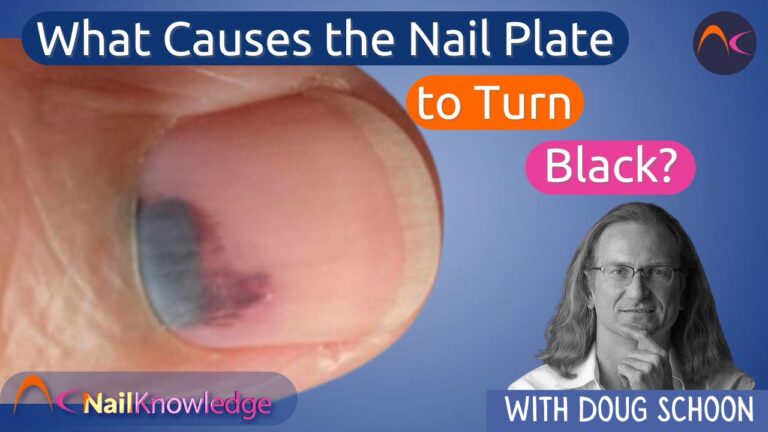
What causes the nail plate to turn black or darkly colored?

Several things can cause the nail plate to turn black, or at least darkly colored. One of the most common causes of darkly colored nail plates is physical damage that leads to bruising of the nail bed.

Splinter Hemorrhages: Causes and Effects

Hard bangs or knocks to the nail plate can lead to breaks in the tiny blood vessels in the nail bed, which can cause them to leak. These are called splinter hemorrhages and most often appear like tiny black lines running along with the direction of nail growth.

Splinter hemorrhages are most often caused by physical trauma to the nail bed causing bleed underneath the plate.
Splinter hemorrhages underneath the nail plate.

When the damage is more severe, larger amounts of blood collect underneath the plate. A significant amount of damage could lead to blackening of the entire nail plate. The blood on the nail bed may appear to be red at first, but will eventually turn black. This black stain could persist for months after the damaged nail bed heals.

Hemorrage: Blood collecting underneath the nail plate

Impact of Drugs and Diseases on Nail Discoloration

Certain drugs can affect the matrix cells and this can lead to dark discolorations of the nail plate. For instance, drugs containing metallic silver can cause dark black stains, as well as a surgical scrub used in hospitals which contain the ingredient “chlorohexine”.

Nail Staining from drugs containing metallic silver
Staining from drugs containing metallic silver

Diseases of the nail or illness somewhere else in the body may also cause the nail matrix cells to produce darkly discolored nail plates. For example, diabetes can cause the nail plate to yellow and nail psoriasis often leads to nail plates that are pitted, more porous and pick up stains more easily.

Nail Psoriasis – Pitted Nail Plate

Nail Discoloration Due to Chronic Diseases and Other Factors

Chronic diseases such as kidney or liver problems can cause nails to blacken.  Tumors in the nail matrix or surrounding areas can also cause dark discolorations in the nail plate, which is something that nail technicians should watch for. However, it is fairly common and normal for people with very dark skin to develop black strips that run the length of the nail plate.  This can happen because excessive amounts of melanin in the skin can find its way into the nail plate.

Erythronychia
Yellow Nail Syndrome

Nail Discoloration and When to Seek Medical Advice

When this occurs on nails of those with African or Asian ancestries, this may be normal. However, when this occurs on nail plates of those with light colored skin such as Caucasians, in rare instances this can be a sign of potential trouble. Such nail plates should be examined by a medical professional to determine the causes, which could be one of many disorders. 

Finally, this change in coloration could indicate a nail infection, so in any case this type of change should be cause for concern. I recommend refraining from treating this nail until it can be examined by a medical professional to determine if an infection is present.

Filed Under: General Information, Nail Conditions

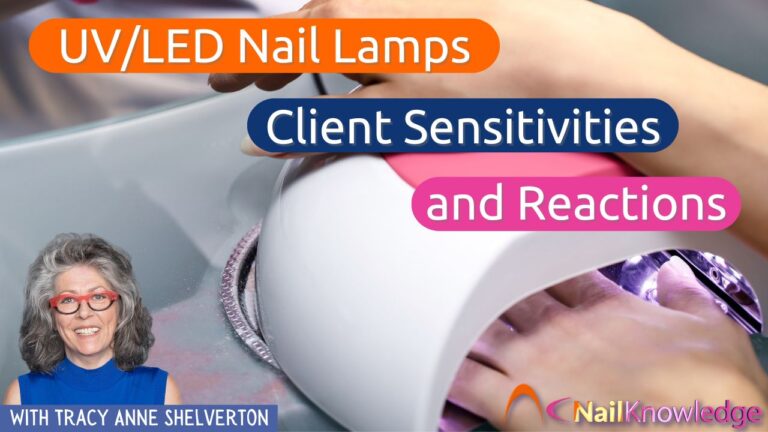
UV/LED Nail Lamps: Understanding Client Sensitivities and Reactions

UV and LED curing lights have become indispensable tools for achieving long-lasting, glossy manicures. However, some nail technicians encounter clients who report adverse reactions during the curing process, raising concerns about potential allergies to these lights.

This article aims to demystify the issue, clarifying the nature of these reactions and exploring how they are more likely linked to the products used and individual sensitivities rather than an allergy to the light itself. By understanding the underlying causes and implementing mindful practices, nail professionals can enhance client safety and comfort, ensuring a positive experience for those enjoying the benefits of gel-based manicures.

Key Considerations for UV/LED Nail Curing Sessions

When clients experience discomfort or adverse reactions during a UV or LED nail curing session, it’s crucial for nail technicians to understand the possible underlying causes. While it’s uncommon for individuals to be directly allergic to UV or LED light, various factors related to the curing process can trigger reactions. Here are four key points to consider that can help professionals address and mitigate these sensitivities effectively.

Understanding Photosensitivity in Nail Care

Photosensitivity: Some individuals have conditions that make their skin unusually sensitive to UV light, such as polymorphic light eruption or lupus. These conditions can exacerbate skin reactions to UV exposure, whether it comes from the sun or a UV nail lamp. Recognizing these conditions can help nail technicians provide safer, more accommodating services to clients with these sensitivities.

The Impact of Phototoxic Reactions on Nail Treatments

Phototoxic Reactions: Certain medications and topical products can cause phototoxic reactions, where the skin becomes more sensitive to UV light. This increased sensitivity means that while general sunlight might not cause a reaction, the concentrated exposure from a nail lamp could trigger an adverse response. Understanding these triggers is essential for managing client care during nail treatments.

Distinguishing Allergic Reactions in Nail Enhancements

Allergic Reactions: Misinterpretations can occur when clients react to nail treatments. Often, what is believed to be a reaction to the UV/LED light is actually an allergic response to ingredients in gel polishes or acrylics. These reactions are particularly likely if the nail products are not fully cured, resulting in prolonged skin contact with reactive substances. Educating clients about these potential allergens can help prevent misdiagnosis and ensure appropriate measures are taken.

Recognizing Heat Sensitivity During UV/LED Curing

Heat Sensitivity: Discomfort or a burning sensation during UV/LED curing can often be attributed to the heat emitted by the lamp, especially if gel layers are too thick or the lamp’s intensity is too high. Understanding and adjusting the curing process to accommodate clients who are sensitive to heat can enhance the overall experience and safety of nail treatments.

Enhancing Safety in UV/LED Nail Treatments

So, while it’s not an allergy to the light per se, there are various factors related to UV/LED exposure during nail treatments that can cause discomfort or reactions. It’s always a good idea to ensure proper application techniques and to use high-quality, hypoallergenic products to minimize these issues and avoid removing essential skin layers with an efile, it takes away the last valuable layer of skin that is ultimately important for your clients wellbeing.

If a client has a known photosensitivity or skin condition, or is undergoing chemotherapy or immunotherapy its not smart to continue and it is best to recommend alternative nail treatments that don’t require UV curing. There are plenty of other options available you just have to be prepared to look and learn new techniques.

The Importance of Discernment in Nail Product Selection

In a world where artificial nail products appear too beautiful to be problematic, it’s important to recognize when to say no, understand the reasons behind it, and offer alternative options.

Filed Under: Lotions, Potions and Polishes, Nail Conditions, Nail Services, UV Gel

The Real Causes of Nail Plate Yellowing

Unveiling the Mystery of Nail Plate Yellowing

We often receive questions about nail care issues that both perplex and frustrate professionals and clients alike. One recurring topic that sparks a lot of curiosity and concern revolves around nail plate yellowing. Many believe that this discoloration is primarily caused by the pigments in nail polish. However, recent inquiries and expert insights suggest that other elements, such as nitrocellulose and various colorants, might play a significant role.

This article delves into the intricacies of what really causes nail plate yellowing, backed by expert analysis and industry knowledge, to shed light on this common but misunderstood issue.

Understanding Nail Discoloration: Colorants and Their Impact

Pigments are not likely to stain the nail plate. They are too large to penetrate. Dyes and Lakes are other types of colorants that are often used, and many can and DO stain the nail plate. There are three different reds and one yellow colorant that have been reported as the most likely to stain the nail plate. The reds colorants are listed on product ingredient label as Red no. 6, Red no. 7, or Red no. 34.  In the European Union, all three of these red colorants would be sold under their color index number “15850”. The yellow that is reported to cause a lot of staining is Yellow #5 Lake, which in the European Union is labelled as “19140”.

The Role of Nitrocellulose in Nail Yellowing: Quality Matters

It is true that some grades of nitrocellulose can stain as well.  But the more expensive, higher quality grades are much less likely to discolor. Smaller companies that don’t sell much nail polish often use these inferior grades, since the best grades are too expensive when purchased in low quantities and the larger companies buy up all the high-quality nitrocellulose. When it does stain, nitrocellulose tends to be a more brownish-yellow stain, while discoloration caused by colorants tend to be the light yellowish tones or other odd shades, such as green.

Examining Base Coats: Nitrocellulose and Nail Plate Vulnerability

If this base coat contained nitrocellulose and no colorants, the nitrocellulose is a possible suspect. However, a high-quality base coat should not stain the nail plate, unless its surface is damaged. Damaged nail plates are much more likely to pick up stains, even from some foods stains or clothing. Damaged nail plates will absorb stains more easily than healthy nail plates. To say the nitrocellulose is responsible for nail yellowing is an over simplification. Marketers tend to oversimplify things for three reasons,

  • They don’t understand the issues, so instead of giving the facts they just keep it simple to hide their lack of understanding.
  • Many nail techs often don’t understand these issues, so the message must be kept simple.
  • Marketers focus on only what helps them sell their products and often exaggerate the information.

It is definitely an over simplification to say that nitrocellulose is what stains the nail plate. More likely the causes are “dyes” and “lakes”.

Filed Under: General Information, Nail Conditions

Understanding Staple Nails and Solutions

Navigating Nail Transformations

Nail health is a reflection of our overall well-being, but sometimes, even without apparent reason, our nails can undergo unexpected changes. Among these is the development of what some may notice as staple-like appearances, where nails, typically curved, begin to grow out squared.

We explore the unique condition known as “staple nails,” and its possible causes, and suggest ways to manage and potentially improve this nail phenomenon.

The Phenomenon of Staple Nails

staple nails
Staple Nails – looks very much like an office staple

This condition is characterised by a nail plate with squared front that looks very much like an office staple. This change can start subtly with one nail and others can be affected too or not. It’s a noticeable shift that can leave many puzzled about their nail health.

Underlying Causes for Staple Nails

There are several factors that might contribute to the development of staple nails, and understanding these can be key to managing the condition.

Psoriasis and Nail Changes

Psoriasis is a common skin condition that can also affect the nails or the nail bed, leading to various changes, including the squaring of the nail plate. This occurs as the nail bed swells, putting the nail plate under extreme pressure and causing it to deform.

Compromised Blood Supply

Another possible cause for staple nails is a damaged blood supply to the nail matrix. When the blood supply is compromised, it may result in weaker nail plate cells. These weakened cells can cause the nail plate to buckle, creating squared corners instead of the usual rounded edges.

Aging and Nail Cell Formation

As we age, the formation of nail plate cells can alter, leading to weaker cells that are more prone to buckling under pressure. This change contributes significantly to the appearance of staple nails, highlighting the impact of aging on nail health.

Practical Advice for Staple Nails

To manage this condition effectively, keeping the nails flexible and well-moisturised is crucial. Regular use of a high-quality nail and skin oil can help maintain nail flexibility and prevent the nail plate from fracturing, especially at the free edges. For those seeking an alternative to oils, a rinse solution containing moisturising components like allantoin and urea can be used several times a day to help retain moisture and prevent dryness, which can exacerbate the problem.

It’s also important to choose the right type of artificial nail products if you use them. Opt for flexible, soak-off products to minimize the risk of further damaging the nail plate during removal.

Final Thoughts: Managing Nail Health Amidst Changes

Staple nails may be an unusual and unexpected nail condition, but with proper care and attention to nail health, it is possible to manage this issue. Keeping the nails short, flexible, and moisturised, and avoiding harsh treatments can help mitigate the effects of staple nails.

As always, if nail problems persist, consulting a healthcare or dermatological expert is recommended to rule out any underlying conditions that may need specific treatment.

Filed Under: General Information, Nail Conditions

Nail Plate Transformations: Mastering Cosmetic Enhancements and Corrective Techniques

In the world of nail care and aesthetics, achieving flawless nails is a top priority for many individuals. However, not everyone is blessed with naturally perfect nails. For those with damaged or imperfect nails, cosmetic nail plate enhancements offer a solution to enhance the appearance and boost confidence.

Cosmetic nail plate enhancements are a specialized technique aimed at improving the look of damaged or imperfect nails.

It’s essential to note that cosmetic nail plate enhancements differ from nail plate regulation, which involves correcting structural deformities or irregularities in the natural nail. While both techniques aim to improve the appearance of the nails, cosmetic enhancements focus solely on aesthetic enhancements rather than structural corrections.

One common scenario where cosmetic enhancements shine is when individuals experience nail damage due to trauma, such as accidents or injuries. In such cases, the nail may appear uneven, discolored, or have unsightly imperfections. Cosmetic enhancements can help camouflage these flaws, giving the nails a more uniform and aesthetically pleasing appearance.

Nail Plate Cosmetic Enhancements

These are from a college in the USA that specializes in cosmetic enhancements and his end results are always stunning.

nail plate cosmetic enhancements
Cosmetic Enhancements of the Nail Plate

Nail Plate Correction

Nail plate correction goes a step further by addressing underlying issues such as cracks, splits, or deformities. In nail plate correction we concentrate on improving the state of the natural nail and the nail unit – this takes longer and asks for a lot of discipline from the client and the results are always amazing even if we can’t solve the problem completely we can improve the situation considerably.

These brace and composite corrections are from a college in the Netherlands that specializes in Nail Plate Correction and her end results are also always stunning. It takes longer of course but dealing with the underlying issues really does make a difference. While the nail unit is recovering from the trauma, the brace and composite forces the nail plate to stay on track allowing the bed epithelium to recover, if its elasticity can be returned the nail plate will glide over the nail bed as it should.

That’s not to say that cosmetic improvement options are off the table, just that a choice needs to be made that is the best for the client and it is also the case that improvements to the nail plate first make cosmetic enhancements last longer.

nail plate correction techniques
Nail Plate Correction
nail plate correction profile
Nail Plate Correction

The same goes for hand nails

Here we have a habbit tick nail plate that was always covered up with nail product and with a nail prep with an efile because that’s the way she was trained, that wasn’t especially good for the lateral and proximal nail folds that temporarily improved the way the surrounding skin looked but actually just caused the surrounding skin to retreat, thicken and try to protect itself from any more damage.

We started recovery using a product that works in the nail plate and applying products to the surrounding skin that help maintain the moisture level in the skin, this means help the skin on its way to full recovery. Again this takes time – this is not a quick fix – but it will be so effective that when the nails and nail folds are recovered any or all artificial nail products can be used if the integrity of the nail plate and the nail unit is respected.

No filing of the nail plate with any file or an efile instead cleansen with an effective nail plate cleanser and maintaining moisture levels in the skin will help this nail and nail unit fully recover, we do however also have to coach her to make her mindful of the problem in the nail plate that is caused by the habbit of rubbing and picking. We will add to this blog as we make progress.

nail plate habbit tick
Recovery Procedure of Habbit Tick

Overall, cosmetic nail plate enhancements offer a valuable temporary solution for individuals seeking to enhance the beauty of their nails, especially those with damaged or imperfect nails and nail plate regulation will solve the underlying problem but neither can be properly and lastingly achieved without knowledge of the nail unit and all the different artificial nail products available that are needed to achieve the results.

We can ignore scientific evidence and medical facts but as professionals our clients expect and pay us not too.

Filed Under: Nail Conditions, Nail Services

  • « Go to Previous Page
  • Page 1
  • Page 2
  • Page 3
  • Page 4
  • Page 5
  • Page 6
  • Interim pages omitted …
  • Page 12
  • Go to Next Page »

Level Up Your Nail Insights

Join our Newsletter!
SUBSCRIBE...

Copyright © NailKnowledge

NailKnowledge

  • MyNailEra
  • eBooks
  • About us
  • Courses
  • News
  • Blog
  • Newsletter
  • Glossary

Policies

  • Privacy Page
  • Terms & Conditions
  • Cookie Policy

Support

  • Contact Us
  • Meet the Experts
  • Ask the Experts
  • System Support
  • FAQs
English
English
Portuguese Spanish Vietnamese