You finally get a fresh set of gel nails, and within days they start to peel at the edges. Sound familiar? Gel nails lifting in hot weather is one of the most searched nail complaints every summer, and it turns out there are some genuinely fascinating reasons behind it. It is not just bad luck, and it is not always a product problem either.
Heat affects the body in ways most people never think about in relation to their nails. When temperatures rise, your body responds in a cascade of physical changes, and your nail plate is right in the middle of it.
Your Natural Oils Are Working Against You
In warm weather, your skin produces more sebum. That is the natural oil your body secretes to regulate moisture and protect the skin barrier. It is completely normal, but it creates a problem for gel adhesion. Gel polish bonds to the nail surface through a chemical connection, and oil disrupts that bond. Even a thin, invisible layer of natural oil on the nail plate can compromise how well the gel grips.
This is why the same gel application that lasts perfectly in February might start lifting by week two in July. The product has not changed. Your skin chemistry has.
The Science of Thermal Expansion
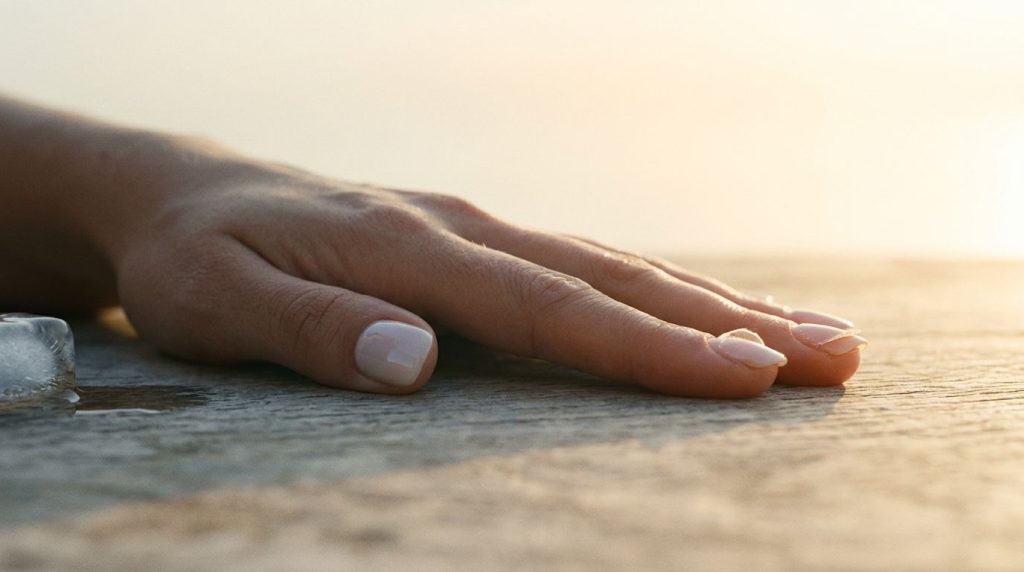
Here is something that surprises most people. Your nail plate actually expands and contracts with temperature, just like most solid materials do. When you move between air-conditioned rooms and hot outdoor air repeatedly throughout the day, your nails flex slightly with each change. Gel is a harder, less flexible material than the natural nail underneath it. So while your nail expands and contracts, the gel layer resists that movement. Over time, that tension works at the seal between the gel and the nail, gradually loosening the bond at the free edge or sidewalls.
Think of it like tiles on a roof. When installers bed them correctly, they hold firm. But repeated heat cycles cause expansion and contraction that eventually loosens the bond. Your nails work the same way, just on a much smaller scale.
Sweat and Moisture Underneath the Gel
Sweaty hands are a summer reality. Moisture is one of the most damaging things for gel adhesion, especially when it gets underneath the enhancement. Water molecules work their way into any micro-gap between the gel and the nail, weakening the bond and creating the ideal environment for lifting to take hold.
Prolonged contact with water makes this worse. Swimming, long showers, washing up without gloves, even just carrying a cold drink in a hot environment where condensation builds up on your hands. All of these introduce moisture that chips away at the adhesion over time. If you notice your gel nails always seem to lift after a beach day or a pool session, moisture infiltration is almost certainly a factor.
It is also worth noting that some people naturally have more porous nail plates than others. For those people, summer conditions are even more likely to trigger lifting, because their nails absorb and release moisture more readily. If you have noticed unexpected changes in how your nails respond to gel services, the season and your nail’s natural moisture levels are worth considering alongside product choices.
Research published by the American Academy of Dermatology confirms that nails are highly permeable to water, absorbing and releasing moisture far more readily than skin does. That permeability is a key reason why summer conditions put gel adhesion under so much pressure.

Gel Nails Lifting in Hot Weather and Nail Growth
Nails grow faster in warm weather. This is a well-documented biological fact. Increased circulation in the warmer months speeds up cell turnover in the nail matrix, which means the nail plate pushes forward more quickly than in winter. That growth creates a natural mechanical force at the base of the gel. As the new nail plate emerges, it lifts the product from underneath, starting at the cuticle area.
So even a technically perfect application will face more pressure in summer simply because of accelerated growth. This is one reason why some people find they need to book infills more frequently between June and August.
Nail Shape and Length Play a Role Too
Longer nails have more surface area exposed to the environment, which means more opportunity for heat, moisture, and expansion to work on the seal. Shapes with sharper corners, like stiletto or square with hard edges, can also catch on surfaces more easily in everyday activity, creating micro-lifts that heat and moisture then widen.
Shorter, rounder shapes tend to fare better in summer for this reason. They have fewer vulnerable edges and less leverage for the product to separate from.
What Actually Happens at the Bond Level
Gel polish works by forming a chemical bond with the nail surface during curing. That bond is strong, but it is not invincible. Heat softens gel slightly, and repeated softening and re-hardening as temperatures fluctuate can shift the molecular structure of the gel over time. This is particularly relevant for gel that has been on the nail for several weeks, since older gel has already experienced more thermal cycles.
Gel applied in uneven layers is also more prone to lifting in heat because internal stress within the product is greater. Thicker gel expands more, creating more tension at the edges.
Humidity Adds Another Layer of Complexity
High humidity affects nail prep and gel behaviour in ways that low-humidity conditions do not. In very humid environments, moisture in the air can settle on the nail surface during application and interfere with bonding before the gel even goes on. This is a subtler factor than sweating or swimming, but it matters.
Salons in coastal or tropical climates often adapt their prep routines specifically because of ambient humidity levels. For home nail enthusiasts, this is useful context. A humid bathroom is not the ideal environment for gel application in summer, even if it works perfectly in winter.
That is a lot going on at once. Heat, sweat, oil, growth and humidity all pulling at the same bond simultaneously.
Understanding why gel nails lift in hot weather is genuinely fascinating, but there is a lot more to explore about why some applications hold better than others through the summer months.
On MyNailEra, you can access award-winning artist tutorials that cover exactly how application choices affect longevity. Era, your personal nail coach, can also review photos of your nails and give you specific feedback on what might be causing lifting in your own gel work.