There is a quiet hero in every manicure, and most people barely think about it. The top coat. That final, glossy layer gets treated like an afterthought, a simple shine-booster slicked on at the end. But the science happening inside that tiny bottle is genuinely fascinating, and once you understand it, you will never skip this step again.
Right now, nail top coats are having a serious moment of cultural re-examination. Beauty communities on TikTok and Instagram are obsessing over why some manicures chip after two days while others look freshly painted for two weeks. The answer, almost every time, comes back to the top coat.
This is not just about gloss. This is about chemistry, protection, and the kind of long-lasting manicure that actually survives your life. Understanding what is in that bottle changes everything about how you choose and use it.
💡 Key Takeaway
A nail top coat is not just a shiny finish. It is a sophisticated shield built from film-forming polymers, UV filters, and carefully engineered solvents that protect your colour, resist chips, and dramatically extend the life of your manicure. Understanding what is inside the bottle changes everything about how you choose and use it.


What Is Actually Happening When You Apply a Top Coat?
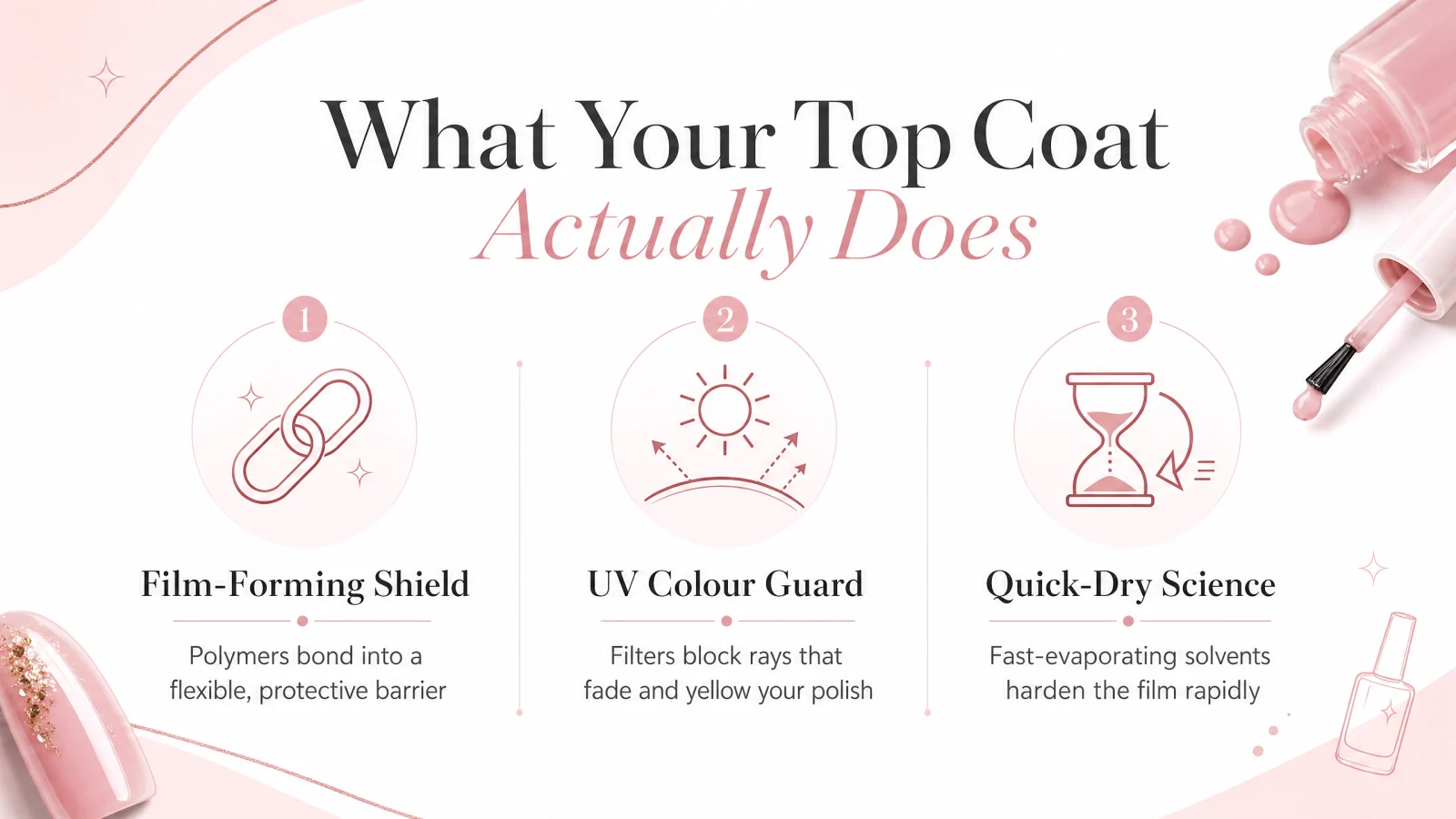
Here is where it gets genuinely interesting. A nail top coat is not simply a layer of clear varnish. It is a carefully engineered formula built around film-forming polymers, most commonly nitrocellulose, that spread across the nail and then bond together as the solvents evaporate.
What is left behind is a transparent, flexible film.
That film does several things at once. It seals the colour underneath, locks in the pigment, and creates a physical barrier between your polish and the outside world. Every time your nails tap a keyboard, open a tin, or scrub a surface, it is the top coat absorbing the impact, not your colour.
The flexibility matters enormously here. A top coat that dries too rigid will crack under the natural flex of your nail. The best formulas are engineered to move with your nail rather than against it, which is exactly why chip resistance varies so dramatically between products.
The UV Filter Ingredient Nobody Talks About
Many premium nail top coats now include UV filters, and this is one of the most underappreciated features in the entire nail-care world.
Sunlight is ruthless on nail colour.
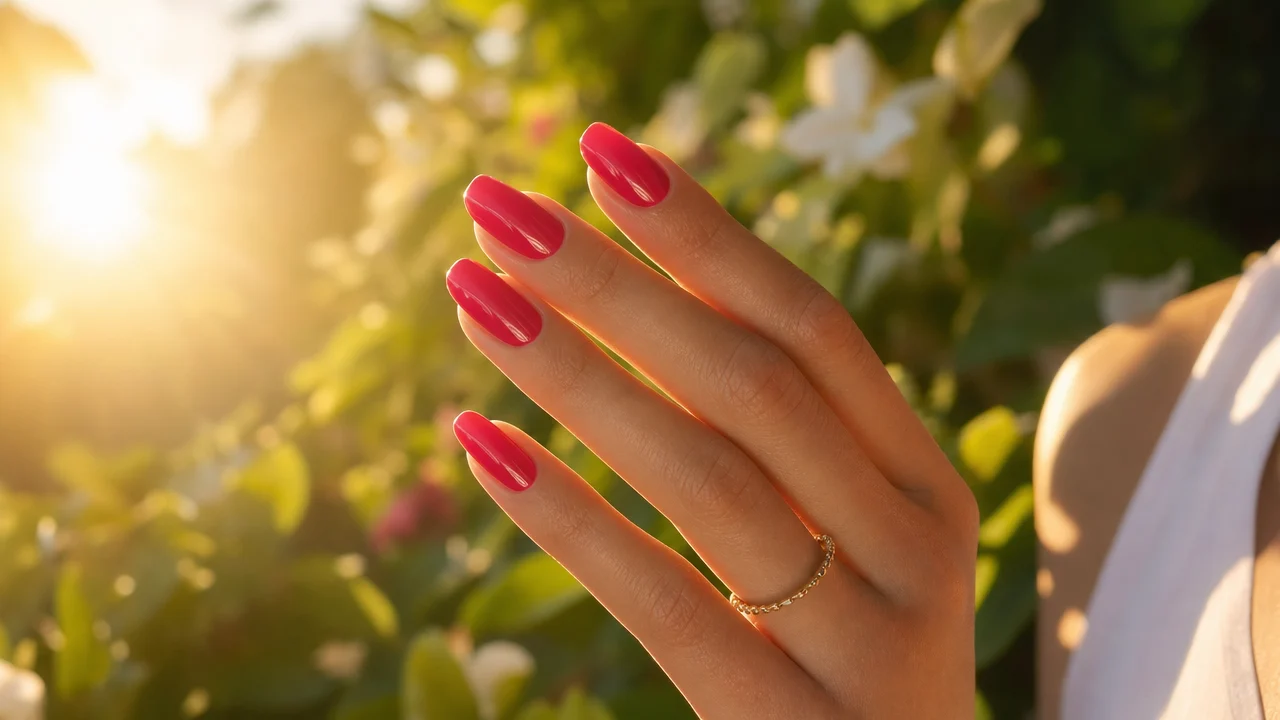
Ultraviolet rays break down the dye molecules in nail polish over time, causing colours to fade, shift, or yellow. A top coat with UV-absorbing ingredients acts as a kind of sunscreen for your manicure, slowing that degradation and keeping your colour true for longer. If you have ever noticed a vibrant red turning slightly orange after a week in summer sunshine, you have seen UV damage in action. The team at NailKnowledge points to this as one of the biggest reasons why two people using the same polish can end up with completely different results after ten days, even with identical application.
And while we are talking about manicure longevity, it is worth knowing that top coat chemistry does not exist in isolation. The health of the nail underneath plays a huge role too. How you treat the skin around your nails affects how well any product adheres and performs long-term.
Why Quick-Dry Formulas Feel Like Magic (Because They Kind of Are)
The quick-dry top coat is one of those beauty innovations that feels almost too good to be true. You paint your nails, apply the top coat, and within minutes you can actually use your hands. How?
It comes down to solvent engineering.
Standard nail formulas evaporate their solvents at a fairly predictable rate. Quick-dry formulas use a different blend of solvents, ones that evaporate faster, pulling the film-forming polymers into their final structure in a fraction of the time. Some also include ingredients that actively accelerate the cross-linking of the polymer chains, essentially speeding up the hardening process at a molecular level.
The trade-off, historically, was that faster-drying formulas sometimes sacrificed flexibility or durability. But modern nail top coat formulations have largely closed that gap, which is part of why the beauty community has become so engaged with understanding what is actually in the bottle.
The Gel World Has Its Own Top Coat Science
If you have ever explored BIAB gel manicures or any gel system, you will know that the top coat situation there is a whole different conversation. Gel top coats cure under UV or LED light, triggering a photochemical reaction that transforms liquid monomers into a solid, cross-linked polymer network.
The result is a finish that is significantly harder and more durable than anything achievable with a traditional air-dry formula.
But there is nuance here too. Gel top coat adhesion depends heavily on what it is layered over, how the surface has been prepared, and the compatibility between the base, colour, and top coat systems. Mixing brands can sometimes disrupt that chemistry entirely, which is one reason why so many nail enthusiasts end up researching the science rather than simply following the instructions on the label.
Matte Versus Gloss and the Trend Toward Multitasking Formulas
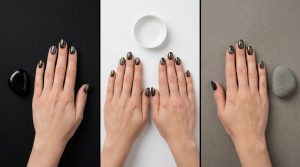
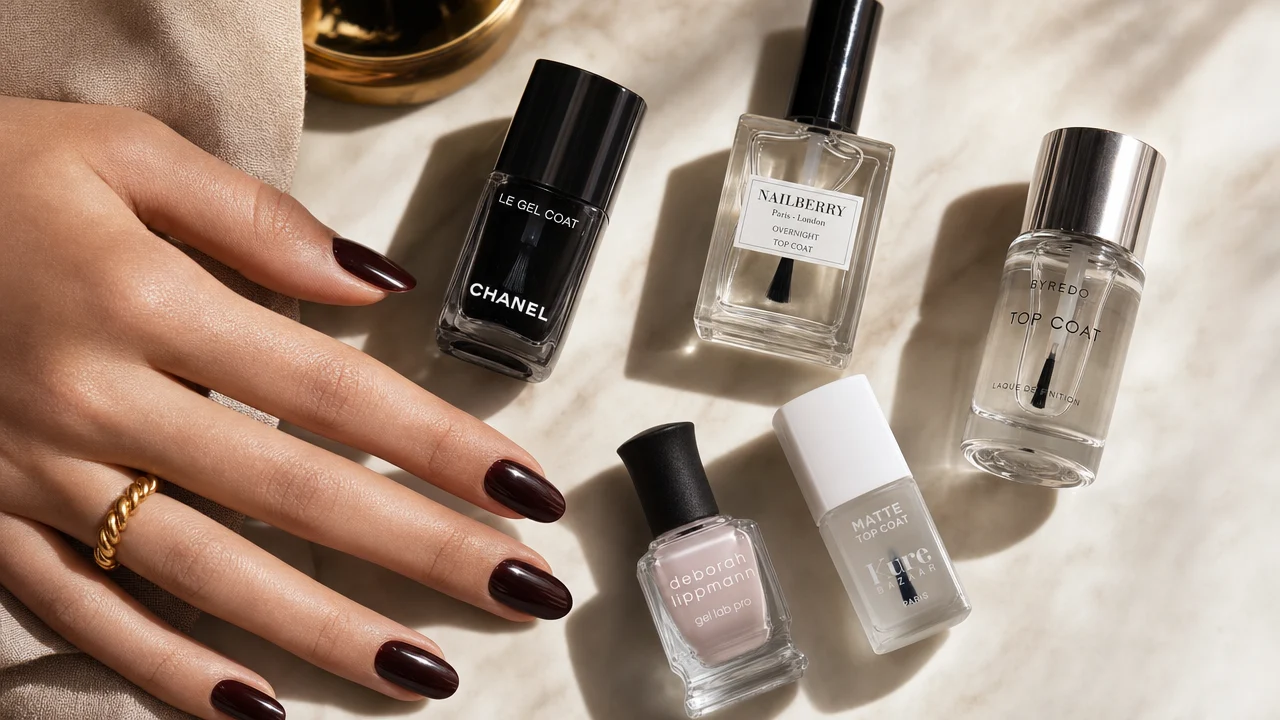
The choice between a matte top coat and a glossy one is not purely visual. Matte formulas contain tiny particles, often silica-based, that scatter light rather than reflect it, creating that signature flat finish. Those particles also subtly change the texture and feel of the surface.
Interestingly, matte top coats can sometimes feel less durable than gloss versions because the light-scattering particles interrupt the smooth polymer film.
It is a small trade-off, but one worth knowing about. And the visual difference is striking enough that many nail enthusiasts keep both finishes in rotation, switching between them depending on the look they are chasing that week.
The newest wave of top coat innovation is all about doing more with one product. Strengthening agents, hydrating ingredients, and even colour-shifting pigments are being built directly into top coat formulas. The line between a top coat and a treatment is blurring fast. This fits perfectly with the broader shift toward nail trends that prioritise health as much as aesthetics, and it is pushing the category in directions nobody predicted even a few years ago.
What This Means For You
- Not all top coats are equal. The polymer quality, solvent blend, and added ingredients vary enormously between budget and premium formulas, and that difference shows up directly in how long your manicure lasts.
- UV protection in a top coat is worth looking for, especially in summer or if you spend a lot of time outdoors. Colour fading is largely preventable.
- Quick-dry does not mean lower quality anymore. Modern formulas have evolved significantly, and fast evaporation no longer automatically means a brittle finish.
- Gel and traditional top coats are chemically different systems entirely. Mixing them casually can affect adhesion and durability in ways that are not always obvious until days later.
- The condition of your natural nail underneath affects how any top coat performs, so nail health and nail-care habits are always part of the manicure equation.
Ready to Make Every Manicure Last Longer?
Find out what your nails are truly capable of with the right knowledge and guidance.


The Finishing Touch That Changes Everything
Top coats have spent years being the most overlooked product in the nail routine. But the science inside that bottle is doing extraordinary work, sealing colour, blocking UV rays, resisting chips, and flexing with every movement your nail makes.
The beauty world is catching up. Conversations about nail-care science are growing louder across every platform, and the top coat is finally getting the recognition it deserves. It is not just a shiny finish. It is a shield, a preservation system, and a genuinely clever piece of cosmetic engineering that your manicure has quietly relied on all along.
If this has sparked your curiosity about nail science and nail-care technique, Era, your personal nail coach inside the MyNailEra app, is ready to take you further. Era offers personalised feedback shaped around your nails and your goals, and you will find guided tutorials from award-winning nail artists who make the science feel approachable and the results genuinely achievable. Download MyNailEra and let Era show you what your manicure is truly capable of.