The professional nail industry has evolved in leaps and bounds!! 10-12 years ago the industry was invigorated with the launch of UV gel polish! All of a sudden there was a solution for those that wanted perfect nails that were ‘dry’ instantly and would last 2 weeks+.
Of course, there have always been the ‘enhancement’ clients but far more of the natural nail clients! Here was the miracle solution.
Then it got a bit complicated. ‘UV gel polish’. ‘Hybrid UV gel polish’. ‘Power polish’. ‘UV gel polish that is 7 free’. What IS the difference??
Here are the facts.
Pure UV gel polish
This is a formulation that is totally UV cured material.
UV cured coatings have been around for more than 35 years+. They were in a pot and had various viscosities but mostly ‘runny’. Some brands produced a higher viscosity but these often needed clever manipulation to create a perfect shape. Many included colour versions but these were not picked up on as much as today.
For me, personally, I didn’t like the total covering of the nail plate with opaque coatings for many weeks when any problems were hidden. In my salon we didn’t take it on. We could provide a better equivalent with no potential problems.
Then came UV gel polish. The title made all the difference plus the fact that it needed to be removed every 2-3 weeks. Game changer!
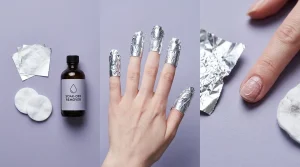
This innovation made UV cured coatings thinner and more like a traditional polish and put it in a bottle with a brush. There was a vast array of colours and it could be removed every 2-3 weeks in around 20 mins by soaking in acetone.
It does have a specific appearance that is thicker than traditional polish and can be very glossy for longer. Not everyone liked the ‘look’ but many loved the strength. Now, there is even nail polish with a ‘gel like’ finish for those that like the ‘look’ but prefer the easy removal of polish
Hybrids and ‘power polish’
What on earth was this???
This used the lower viscosities of UV cured coatings with colour but mixed it with solvents. So a ‘hybrid’ of UV gel and traditional nail polish (which dries using evaporation) All in a bottle with a brush.
So what was the purpose of this innovation?
Pure UV gel cures into a solid coating. It may take a while to soak off and usually requires buffing the top coat as this was formulated to be solvent resistant and harder wearing. For the right nail it is very supporting i.e., good for slightly weaker natural nails.


The purpose of the solvents (hybrids) is that they make a far more ‘delicate’ coating. The evaporation of the solvents during curing creates a polymer network that allows much quicker penetration of the acetone to remove the coating. This means less time with contact with acetone which is, by its nature, drying. Typically, 10 mins or less.
If you have removed both, you will see that the ‘hybrids’ soak off in flakes. The ‘pure gel’ will soak off in sheets.
This innovation provided a traditional nail polish for reasonably strong nails but one that would be ‘dry’ immediately and would last far longer than polish. It also had the ‘look’ of a traditional nail polish that is sleeker.
They both have massive benefits – for the right nails.
Now, the pro industry has moved on. Many are realising that a UV cured colour is beneficial to enhancement clients as it is immediately ‘dry’! That is the ONLY benefit! Traditional nail polish will not chip off an enhancement but there is no waiting time with a UV cured colour coat.
Where does ‘7 Free’ come in??
Well, nowhere really!
The usual ‘7 free’, ’10 free’ etc. are ingredients that are relevant to traditional nail polish. They are not at all relevant to UV cured material. It is yet another marketing spin to make some brands more acceptable for some.
ALL UV cured coatings include known allergens. This needs to be totally understood.
‘Not tested on animals’ is irrelevant. No finished cosmetic product is tested on animals anywhere!
‘Vegan’ almost ALL cosmetic products fall into this category. There are just a couple of colour pigments the are ‘animal derivatives’ but this is SO rare.
Some ingredients in some ‘care’ products use keratin but this is sourced from sheep’s wool just like ‘wool’. Some use wax from bees but this is no different from honey.
They all have a place, and it is, and always has been, true that ‘one size does not fit all’. Understanding the differences and your clients nail condition and expectations is the key. Even for the ‘hybrid’ UV gel polishes there are now many solutions that provide better longevity and even more strength by using a thicker base.
However, the popularity of ‘builder’ gels does need a bit more understanding for those only qualified in natural nail services. Structure, form and shape come into play that is not taught in manicure courses. This education comes into good enhancement education.
Now, with the knowledge and understanding of the system, the chemistry and the condition of the individuals nail condition, lifestyle and expectations virtually ANY brand can provide the solution for all.