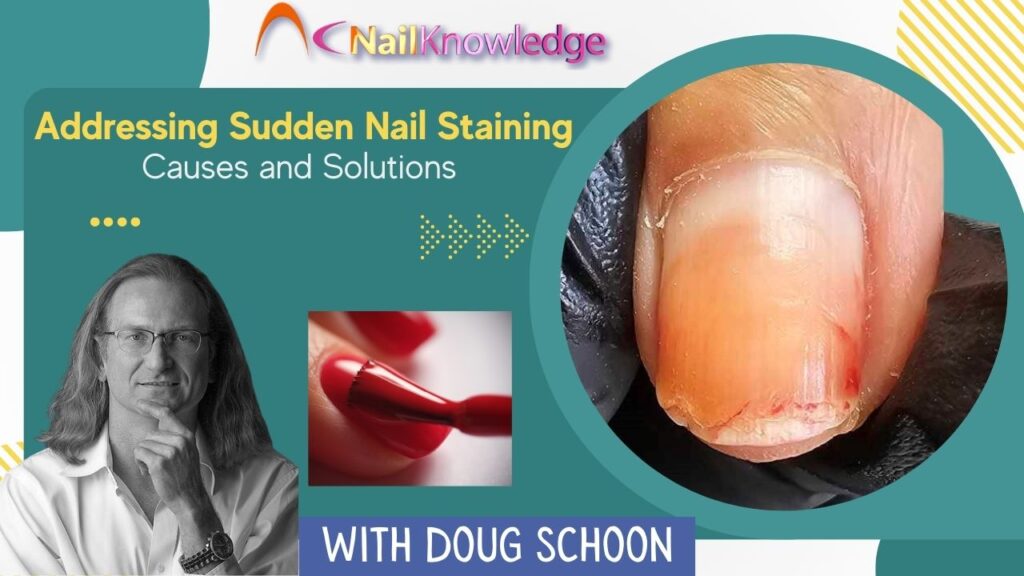
Exploring the realm of nail care unveils unexpected intricacies, particularly when it comes to dealing with nail staining, as shared by one of our valued clients.
Despite conscientious efforts in application and curing techniques, they found their nail plates marred by stubborn stains, particularly after adorning them with a rich, dark red hue.
In our pursuit of unraveling this perplexing issue, we look into the critical role of the base coat, shedding light on how its thickness can influence staining susceptibility. Join us as we explore the unique challenges posed by red-colored nail coatings and unveil strategies to mitigate staining while restoring the beauty and resilience of your client’s nails.


Managing Nail Staining: Importance of Base Coat Thickness
One of the first things to consider is the base coat, since applying it too thinly can increase staining.
Understanding the Challenge of Red Nail Coatings and Nail Staining
Red colored nail coatings are one of the greatest challenges for the nail plate. It is difficult to create a deep red color that doesn’t stain the nail plate. Because some red colorant molecules can penetrate the nail plate’s surface. When that occurs, the molecules collect and pool just underneath the surface to create a visible stain.
Tackling Nail Staining: The Role of Incomplete Curing
The surface of the nail coating may seem hard, but if the color coat isn’t completely cured all the way through, it will remain tacky in the area where it meets the base coat. This is called a “tacky interface”, in technical terms. This tacky interface allows colorants to move around more easily, into and through the base coat, so nail plate surface staining becomes easier.
This is especially true for areas of nail surface damage. Nail plates that are over filed, peeling, pitted or otherwise damaged are more readily stained. This is hard to avoid when nail surfaces are damaged. The greater the damage, the more likely it is that staining will occur.
Application Techniques for Success
Also, it is very important to note that staining is more likely to occur when the color coating is applied too thickly. So, besides finding a solution to the surface peeling problems, perhaps what this nail professional needs is more base coat and less color coat.