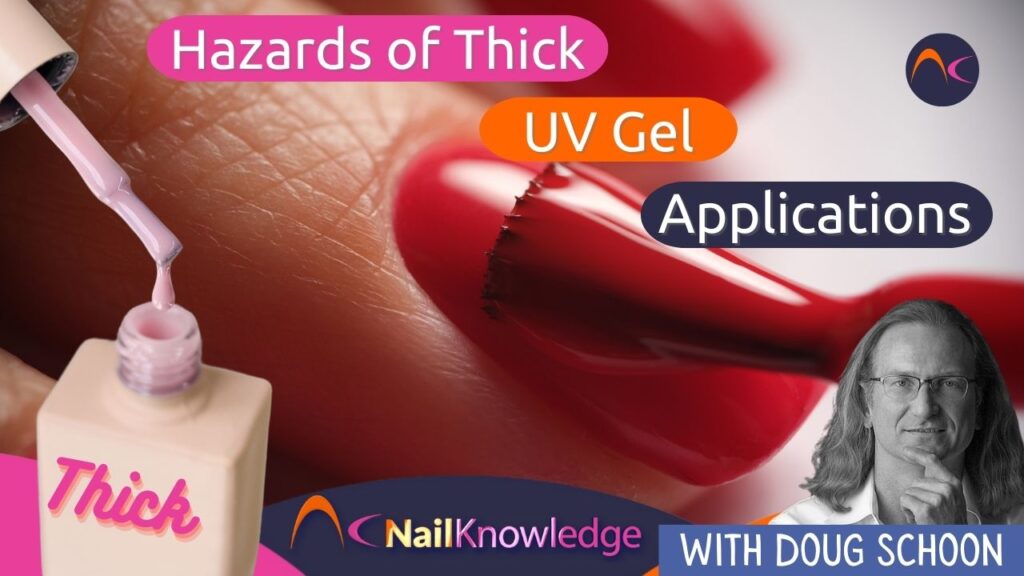
Let’s explore a crucial fact that every nail professional, student or enthusiast must be made aware of. As we explore the world of UV gel application, it’s essential to understand the impact of thicker gels on the curing process.


The Crucial Fact About UV Gel Thickness You Can’t Afford to Overlook
Thicker Gels: Thicker layers of UV gel absorb more UV light at the top surface, resulting in lower penetration to the bottom layers of the gel. This can lead to incomplete curing and under-curing in the deeper layers.
The Phenomenon of UV Gel Absorption in Thicker Gel Layers
In thicker layers of UV gel, most of the UV light is absorbed by the upper layers of the gel, resulting in lower penetration of UV light into the lower layers. This phenomenon occurs due to the nature of UV light and the properties of the UV gel material.
When UV light passes through a material like UV gel, it is absorbed or scattered by the molecules within the UV gel. As the light travels deeper into the gel, even more of it is absorbed or scattered, leading to a reduction in the intensity of UV light reaching the lower layers. As a result, thicker layers of UV gel provide more material for the UV light to interact with, further reducing the amount of UV light that can penetrate to the bottom layers.
As a result, the top layers of the gel receive the highest intensity of UV light, leading to more efficient curing of the upper layers. However, as the light travels deeper into the gel, its intensity decreases, and the lower layers receive less UV light, which can result in incomplete curing and under-curing in those regions.
This phenomenon highlights the importance of proper curing techniques, including using thinner layers of UV gel to ensure adequate UV light penetration and uniform curing throughout the entire thickness of the gel layer. It also underscores the need for understanding the curing properties of UV gel and adjusting application techniques accordingly to achieve optimal results.