• Skip to primary navigation
  • Skip to main content
  • Skip to footer
NailKnowledge

NailKnowledge

  • Courses
  • MyNailEra
  • Free eBooks
  • Knowledge Base
    • Knowledge Base
    • Ask the Experts
    • Glossary
  • News
  • Blog
  • Login
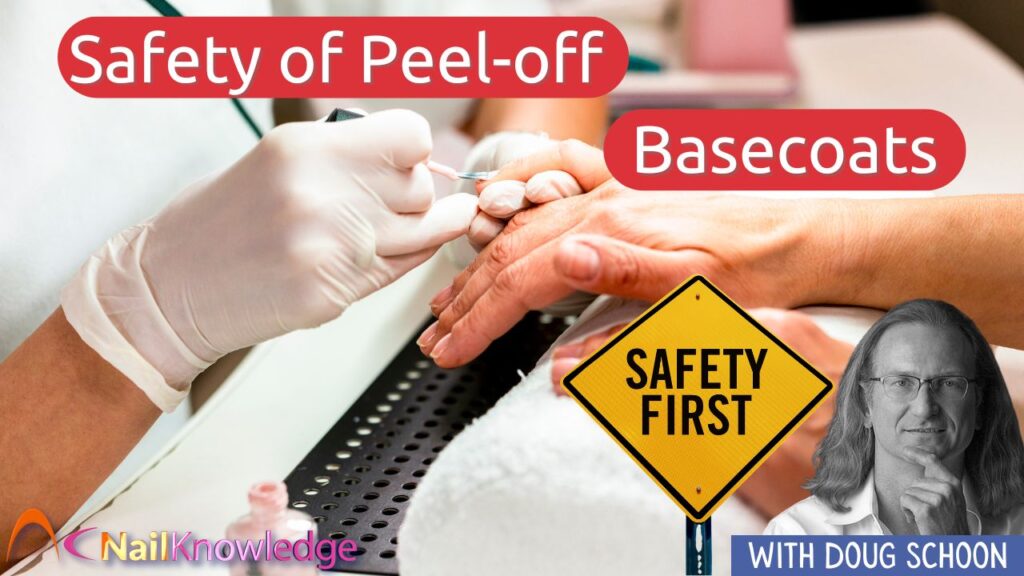
Safety of peel-off basecoats on nails

The Impact of Peel-Off Basecoats on Nail Health

June 19, 2024 by Doug Schoon

1.1k Views

Was this article helpful?
Error submitting rating

Peel-off basecoats offer a convenient solution for those who frequently change their nail color, but what is the real cost of this convenience to your nail health?

This article delves into the common misconceptions and potential risks associated with peel-off basecoats.

Peeling Back the Truth about Peel-Off Basecoats

We are receiving a lot of questions from nail professionals regarding the safety of peel-off basecoats. A common inquiry concerns the correct method of removal: “Are peel-off basecoats safe as long as they are peeled from the base of the nail plate toward the tips, supposedly going with the grain of the keratin cells?”

If they did as you described, then they would be going “against the grain”, since any so-called grain in the nail would run across the width of the nail plate. Keratin fibers inside the nail cells lays across the width of the nail plate, which is why the nail plate typically splits across the width of the plate and not down the length. Therefore, the grain doesn’t seem to make a difference, at least when it comes to nail surface damage. People with healthy nail plates may not see damage when these base coats are used according to directions.  Even so, if the nail plate is already damaged, these peelable nail coatings can worsen existing damage. If the nail plates become dry-appearing or small white spots develop on the surface of the plate, then I would recommend that the wearer should discontinue use and/or reevaluate how they are using and removing these products. 

How Improper Use of Peel-Off Basecoats Can Affect Nail Health

These types of peel-off basecoats are more likely to worsen existing nail surface damage, but it is very common that people ignore directions and do it “their way” and then blame the product when it doesn’t work.  Users will likely notice decreased wear time. In other words, they won’t get the same wear.  These basecoats are likely to shorten wear time by as much as 50%.  Often those who use these types of products are people who want to change their nail color often and doing so can also increase nail damage.

Was this article helpful?
Error submitting rating

Categorised: General Information, Lotions, Potions and Polishes, Nail Services

Related Articles

The Truth About Acetone Use in Nails

The Truth About Acetone Use in Nails

When it comes to nail care, few topics stir as much confusion as acetone use in nails. Is it drying?…

Read More
Curing Tension in Gel Nails

Excessive Curing Tension in Gel Nails

Let’s talk about curing tension in gel nails, something most gel nail lovers have experienced but might not fully understand.…

Read More
Why is my nail polish bubbling

Why is my nail polish bubbling?

Why It Happens and How to Prevent It for a Perfect Finish You’ve just painted your nails. The colour looked…

Read More
How gel polish cures

Gel Polish Curing Explained: Behaviour, Lamps and Common Problems

Gel polish curing is a chemical process, not simply a matter of time spent under a lamp. Many common problems…

Read More
Does nail polish expire

Does Nail Polish Expire

Does Nail Polish Expire and Can Old or Expired Nail Products Cause Reactions. A very common question from both consumers…

Read More
Understanding the Real Difference Between Rubber Base, Builder in a Bottle, and Hard Gel

The Truth Behind Rubber Base and BIAB: Marketing vs Chemistry

Understanding the Real Difference Between Rubber Base, Builder in a Bottle, and Hard Gel Why This Matters Students and new…

Read More

Level Up Your Nail Insights

Join our Newsletter!
SUBSCRIBE...

Copyright © NailKnowledge

NailKnowledge

  • MyNailEra
  • eBooks
  • About us
  • Courses
  • News
  • Blog
  • Newsletter
  • Glossary

Policies

  • Privacy Page
  • Terms & Conditions
  • Cookie Policy

Support

  • Contact Us
  • Meet the Experts
  • Ask the Experts
  • System Support
  • FAQs
English
English
Portuguese Spanish Vietnamese