• Skip to primary navigation
  • Skip to main content
  • Skip to footer
NailKnowledge

NailKnowledge

  • Courses
  • MyNailEra
  • Free eBooks
  • Knowledge Base
    • Knowledge Base
    • Ask the Experts
    • Glossary
  • News
  • Blog
  • Login

Archives for September 26, 2022

Nail Health Check

The most popular nail services these days use opaque nail coatings (e.g. UV gel polish and opaque builders). This means that you cannot see the nail plate without removing the coating. But a nail health check is imperative!

If you have had experience or been following the stories of client allergies, you’ll know that a reaction can appear within days, not weeks. 

Now, if an allergic reaction does take hold, you need to remove the coating immediately:

  • To allow the nails to start healing
  • To remove the allergen asap

An allergic reaction can start slowly, with minimal symptoms, but it can also be extreme with symptoms, such as severe onycholysis on all nails, hyperkeratosis, and splinter hemorrhages. removing coatings from this type of effect is quite shocking and horrifying for both client and nail pro.

Now, as a side ‘story’ that is very relevant to understand, for every coating you put on a natural nail, there will be a compromise you need to make. This is one of the many reasons oil is a non-negotiable daily.

Everyone knows and accepts that, if you bleach your hair, it will need extra care after, forever. You can use a washing-up liquid as shampoo and fabric softener as a conditioner. It will do the job but not as effectively as the real products. Why does just about everyone think that you can do what you like with nails, and they do not understand about the compromises?

If clients want the benefits of nail coatings, they need to play their part in taking care of them. And so do nail pros!!!!

If you are concerned about the use of acetone for soaking so regularly:

  1. Acetone is not an allergen but it may be an irritant. Its drying effect is temporary as the skin is producing natural oils all the time so will be replaced in minutes. OR, coat the skin with oil before the soak if clients don’t like the drying effect.
  2. Buff off. Whether it is hand buffing or an e-file removal, the action does disturb the physical attachment of the nail plate onto the nail bed. ‘Gentle’ is the key word. Apart from thinning the nail plate, harsh buffing can cause the physical bond to ‘pop’.

Checking nail health is really essential. So, is there a solution to removal every 2-3 weeks? Yes, of course there is!

Apply a clear layer first. Then apply any of the opaque options. This means that only the opaque coating needs to be removed without going near the nail plate. (A situation where an e-file would be invaluable)

Do not compromise on your nail health check but understand that other compromises need to be made for clever and intelligent nail services.

Filed Under: Nail Services

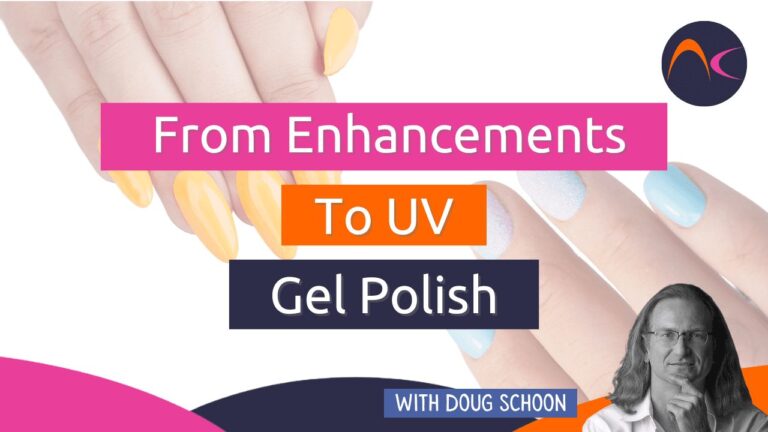
From Enhancements to UV Gel Polish

Sometimes a client wants to switch from enhancements to UV gel polish manicures. But some nail professionals feel like their clients’ nails look weak and fragile after an enhancement removal that they fear removal altogether! So they grow out enhancements by gradually thinning the existing product and applying the UV manicure service. But then they get chipping and flaking! What should they do?

There is no need to remove an enhancement that’s in good shape. Generally, it is successful in filling in the areas of new growth with the new nail coating product. Of course, if the enhancement is experiencing any substantial amounts of service breakdown, I’d recommend removing it and starting fresh with a new coating. UV gel manicure nail coatings are very different. They are often designed for complete removal on a regular basis, e.g. twice per month.  For this reason, to go from enhancements to UV gel polish, I believe removing the nail enhancement coating is best before applying a UV gel manicure product.  However, the more important question is: Why are your client’s nails weak and fragile after removal? 

This should not occur unless the client’s nails were over-filed during the application, or the nail enhancement is removed improperly. Simply wearing a nail coating doesn’t damage the nail.  That is a big myth. Nail damage is most often a result of improper application and/or improper removal: not simply from wearing enhancements. Remember, artificial nail coatings are “enhancements” not replacements for the nail plate. Always perform your services in a manner that protects the condition and health of the nail plate. In other words, respect the nail plate. No type of nail coating should ever compromise the nail plate’s strength, condition, and health. When properly applied and removed, any damage should be minimal to non-existent.  

If the nail plate shows thinning after removal, that thinning is a result of the nail file, not the enhancement or UV gel manicure product. Some are fooled because, while wearing an artificial nail coating, the water content of the natural nail plate can increase from 15% to 25%. When they remove the nail enhancements, this extra 10% of water will dramatically increase the flexibility of the nail plate. By the next day, the moisture content will return to normal and so will the nail’s flexibility. Some nail professionals and clients will misinterpret this extra flexibility as a “weakness”. The nail isn’t any weaker, just temporarily more flexible. Even so, if you determine that the client’s nails are too weak or fragile for nail services, you should discontinue any nail service that may further thin or weaken the nail plate.

Filed Under: Liquid and Powder, UV Gel

Rust and metal nail implements

Most nail professionals have experienced rust on their metal nail implements at some point in their careers.

Rust is a common concern since many people grew up hearing stories about how a rusty nail or other pieces of rusty metals can cause infections such as tetanus. That is a myth… rust does NOT cause tetanus or any other type of infection. Tetanus is caused by a bacterial infection. If these bacteria get deep into the skin, this can lead to a severe infection. But this can just as easily happen with a rust-free nail! Some people are infected with these bacteria by puncture wounds from thorns on plants such as rose bushes. Even so, rust is NOT a pathogen and rust is NOT toxic.

What is rust? The word itself comes from the German word for “red”.  About 1200 BC iron began to replace bronze for the making of tools and weapons. The Roman historian and philosopher Pliny the Elder hypothesized that the Gods had created rust to limit the destructive power of iron weapons… which we know now is a rather silly notion. That’s not surprising since the ancients had made lots of silly notions and didn’t have much understanding of the world around them.

Rust is caused by water and oxygen working together to oxidize iron into iron oxide. Rust is a type of iron oxide. Water is the main culprit that causes this oxidation process. Other metals can also oxidize. Copper and bronze, for instance, will form colored patinas on their surface because of oxidation. When iron rusts, the rust takes up more space or volume which causes expansion. As this expansion continues, the metal separates into layers and flakes away from the surface.

This creates pitting and more flaking which leads to more rust formation of freshly exposed metal surfaces in contact with water and oxygen. This leads to the corrosion that is typically seen when metal rusts. Since steel is made mostly of iron, it is no surprise that steel nail implements are corroded by rust when exposed to water and oxygen, unless proper care is taken. That’s why it is important to completely dry all metal implements and keep them in a dry location. This will also prevent the growth of pathogens since they require water to live and reproduce. Therefore, keeping metal implements clean and dry has many benefits.

Filed Under: General Information

Level Up Your Nail Insights

Join our Newsletter!
SUBSCRIBE...

Copyright © NailKnowledge

NailKnowledge

  • MyNailEra
  • eBooks
  • About us
  • Courses
  • News
  • Blog
  • Newsletter
  • Glossary

Policies

  • Privacy Page
  • Terms & Conditions
  • Cookie Policy

Support

  • Contact Us
  • Meet the Experts
  • Ask the Experts
  • System Support
  • FAQs
English
English
Portuguese Spanish Vietnamese