

• Skip to primary navigation
  • Skip to main content
  • Skip to footer
NailKnowledge

NailKnowledge

  • Courses
  • MyNailEra
  • Free eBooks
  • Knowledge Base
    • Knowledge Base
    • Ask the Experts
    • Glossary
  • Blog
  • Newsletter
  • Login
Overfiling

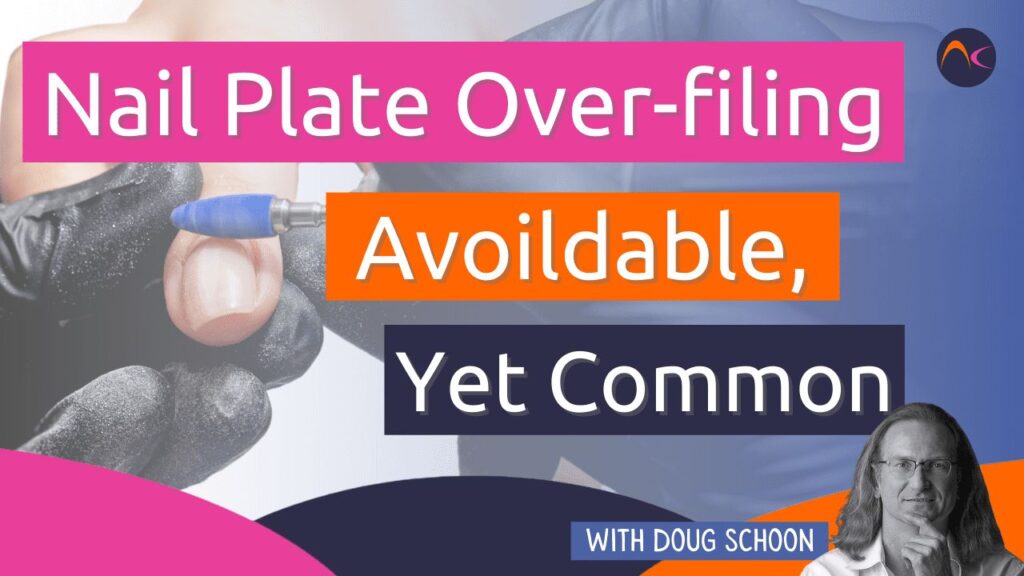
Nail plate overfiling is an avoidable, yet common problem.

November 13, 2020 by Doug Schoon

2.8k Views

Overfiling is one common cause of nail damage. When people say, “artificial nails ruined my natural nails”  they’re often referring to damage from overfiling. A heavy-hand use of a coarse abrasive (120 or 180 grit) or an electric file can quickly remove half of these layers, leaving the nail plate overly thin and weak. Even a wooden pusher can scrape and damage the nail plate if excessive downward pressure is used. Avoid a heavy hand and the client’s nails will thank you.

Safe Grit Levels for Natural Nail Care

Don’t use below a 180 grit on the natural nail late, and only with a very light touch. More preferably a 240 grit should be used. In careless hands, a 180-grit hand file (or electric file) may create considerable nail plate thinning damage, so these should be used cautiously.

The Risks of Over Filing and Importance of Nail Plate Integrity

It is unwise to use coarser files or electric files directly on the natural nail. A good rule to remember: the lower the grit the easier it will be to create nail damage. That’s because lower numbers indicate there are fewer, but bigger abrasive particles on the nail file. Bigger particles make deeper and wider scratches into the nail plate. Over filing can make nail plates overly flexible, which will negatively affect adhesion – for both nail polish, UV gel manicures and artificial enhancements. For many reasons, you should always strive to keep the natural nail plate thick and intact.

Adopting Safe Nail Filing Practices for Optimal Nail Plate Health

In my observations, I’ve found that many nail professionals over file the natural nail plate, some filing away as much as 50% of the plate’s thickness. There is a better way – only remove the “surface shine” – not layers. Carefully/thoroughly clean the nail plate, taking time to use proper nail preparation procedures. If the nail is visibly thinned, e.g. a  ledge exists between the filed plate and new growth; then it is safe to say that over filing probably occurred.

Emphasizing Gentle Care for Healthy Nail Plates

A nail professional’s job is to protect and beautify the nail plate, not file or scrape it away. This is achieved by filing lightly on the very topmost layer. When it comes to filing the natural nail, less is best. Keep those nail plates thick!



Categorised: Health and Safety, Nail Services

Related Articles

nail technician first impression consultation

Nail Technician First Impression Tips That Work

First impressions for nail technicians begin long before a client sits down at the desk. From how you respond to…

Read Moreabout Nail Technician First Impression Tips That Work
Gel polish wrinkling, lifting, or full of bubbles? The science of curing compatibility explains everything. Learn why your lamp and formula need to match — and how to get a perfect cure every time.

Gel Polish Curing: Lamp Compatibility and Common Issues

Gel polish curing is more than just light and time. Discover how mismatched lamps and formulations cause wrinkling, micro-bubbles, and…

Read Moreabout Gel Polish Curing: Lamp Compatibility and Common Issues
Best Nail Shape for your hand

Best Nail Shape for Your Lifestyle

Choosing the best nail shape goes beyond trends. Discover how your nail bed width, finger length, and daily lifestyle all…

Read Moreabout Best Nail Shape for Your Lifestyle
Colour Theory for Nails

Colour Wheel for Nails: How Colour Theory Works

Colour theory for nails is grounded in real science: how light reflects, how cone cells perceive wavelength, and how pigments…

Read Moreabout Colour Wheel for Nails: How Colour Theory Works
nail reaction explained

Nail Reactions Explained: What Your Nails Are Telling You

Redness, soreness, lifting, itching after a nail appointment — these responses have a name and a cause. Getting nail reactions…

Read Moreabout Nail Reactions Explained: What Your Nails Are Telling You
Looking After Your Nails During Cancer Treatment

Nail Care During Cancer Treatment

Cancer treatment places significant demands on the body, and while the main focus is understandably on medical care, the condition…

Read Moreabout Nail Care During Cancer Treatment

Level Up Your Nail Insights

Join our Newsletter!
SUBSCRIBE...

Copyright © NailKnowledge

NailKnowledge

  • MyNailEra
  • Free eBooks
  • About us
  • Courses
  • News
  • Blog
  • Newsletter
  • Glossary

Policies

  • Privacy Page
  • Terms & Conditions
  • Cookie Policy

Support

  • Contact Us
  • Meet the Experts
  • Ask the Experts
  • System Support
  • FAQs
English
English
Spanish