• Skip to primary navigation
  • Skip to main content
  • Skip to footer
NailKnowledge

NailKnowledge

  • Courses
  • MyNailEra
  • Free eBooks
  • Knowledge Base
    • Knowledge Base
    • Ask the Experts
    • Glossary
  • Blog
  • Newsletter
  • Login
nail bed epithelium

The Bed Epithelium Tissue

October 20, 2021 by Tracy Anne Shelverton

260 Views

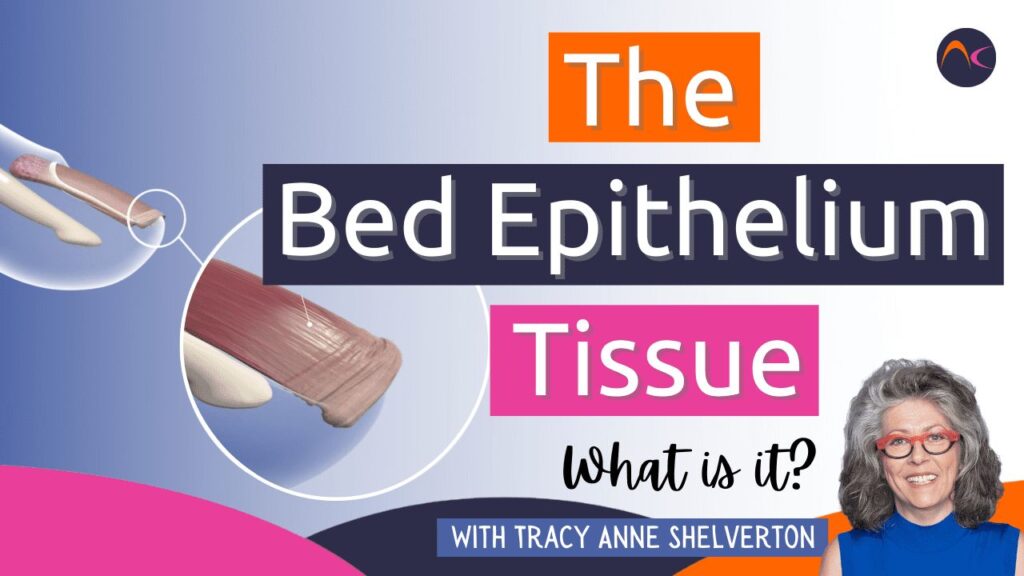
Between the nail plate and the nail bed is some elastic tissue called the bed epithelium – it’s kind of the same non-living tissue as the cuticle, only the cuticle is produced by the eponychium and the bed epithelium by the nail matrix. It’s as if the nail plate is sandwiched between cuticle and bed epithelium if you like.

When that bed epithelium remains elastic the nail plate can always transport along the nail bed. If for whatever reason the bed epithelium dries out, psoriasis, lichen planus, eczema, minor trauma, fungus, whatever – then the nail plate cannot travel along the nail bed and it really just won’t do it.

A good way to think about it is the nail plate is like a glacier – it moves in perpetual motion (nail plate cells are made 24/7 by the nail matrix) This motion only continues so long as there is no opposing friction underneath it – when friction happens it crumbles and breaks down. The bed epithelium makes sure there is no friction.


Doing anything else other than using a good quality oil and lotion, will only create more problems and solve nothing. Recover the natural nail plate first and afterwards you can use any product to enhance it and you will have a client for life!

It makes no difference if the dryness is a new problem or 10 years in the making, as long as the nail matrix still produces nail plate cells and bed epithelium you will recover the nail plate – it may not be perfect, but it will be there – oil and lotion is the key.


Categorised: Nail Conditions, Nail Services

Related Articles

nail technician first impression consultation

Nail Technician First Impression Tips That Work

First impressions for nail technicians begin long before a client sits down at the desk. From how you respond to…

Read Moreabout Nail Technician First Impression Tips That Work
Gel polish wrinkling, lifting, or full of bubbles? The science of curing compatibility explains everything. Learn why your lamp and formula need to match — and how to get a perfect cure every time.

Gel Polish Curing: Lamp Compatibility and Common Issues

Gel polish curing is more than just light and time. Discover how mismatched lamps and formulations cause wrinkling, micro-bubbles, and…

Read Moreabout Gel Polish Curing: Lamp Compatibility and Common Issues
Best Nail Shape for your hand

Best Nail Shape for Your Lifestyle

Choosing the best nail shape goes beyond trends. Discover how your nail bed width, finger length, and daily lifestyle all…

Read Moreabout Best Nail Shape for Your Lifestyle
What Are Hangnail Infections and Why Do They Happen?

Hangnail Infections: How to Treat and Prevent Them

Hangnail infections are painful, common, and largely preventable. Learn what causes them, how to spot the symptoms early, and which…

Read Moreabout Hangnail Infections: How to Treat and Prevent Them
Colour Theory for Nails

Colour Wheel for Nails: How Colour Theory Works

Colour theory for nails is grounded in real science: how light reflects, how cone cells perceive wavelength, and how pigments…

Read Moreabout Colour Wheel for Nails: How Colour Theory Works
nail reaction explained

Nail Reactions Explained: What Your Nails Are Telling You

Redness, soreness, lifting, itching after a nail appointment — these responses have a name and a cause. Getting nail reactions…

Read Moreabout Nail Reactions Explained: What Your Nails Are Telling You

Level Up Your Nail Insights

Join our Newsletter!
SUBSCRIBE...

Copyright © NailKnowledge

NailKnowledge

  • MyNailEra
  • Free eBooks
  • About us
  • Courses
  • News
  • Blog
  • Newsletter
  • Glossary

Policies

  • Privacy Page
  • Terms & Conditions
  • Cookie Policy

Support

  • Contact Us
  • Meet the Experts
  • Ask the Experts
  • System Support
  • FAQs
English
English
Spanish