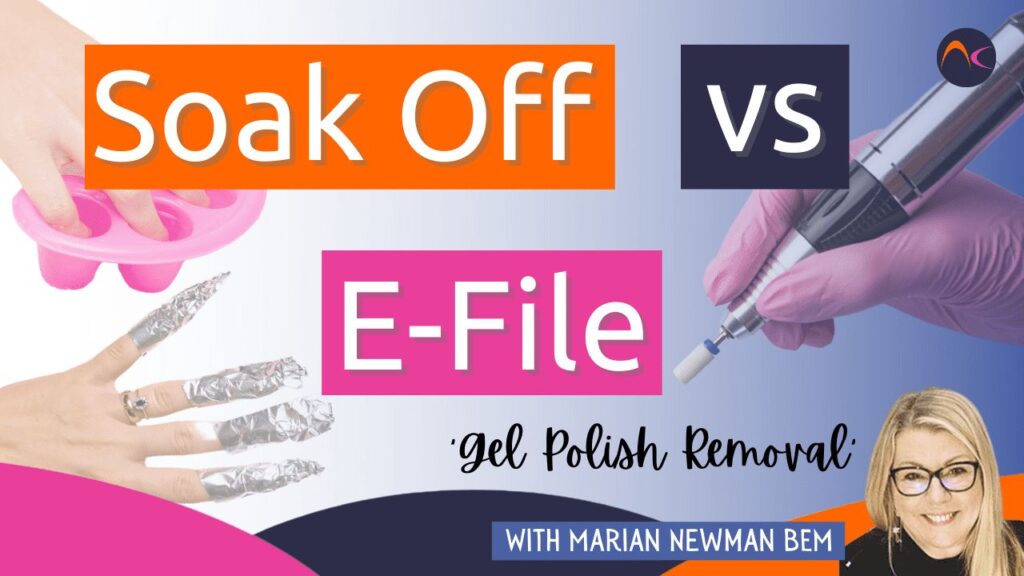
We were asked recently for information on the topic of the removal of UV gel polish using the soaking method or e-file method. Let us address this question with fact-based information gained from experts in the topic.
Firstly, the newly revised National Occupational Standards advise against using an e-file on the nail plate. It also states that the surrounding skin must not be damaged. There may be an ‘advanced e-file NOS’ coming later in the year that will address when and how e-files can be used on or close to the nail plate.
Some of the information provided here gives cost comparisons between the two methods. Having researched this (with help) I can provide an accurate cost comparison. However, the fact remains that the nationally agreed (UK) industry standards strongly advise against the use of the e-file on the nail plate and no risk of damaging the skin.
This chart is based on real costs.
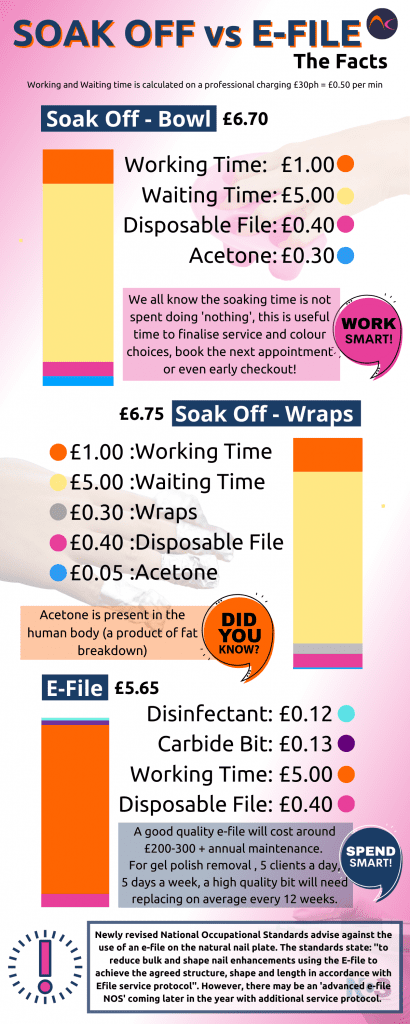
- It DOES take into account the cost per use of buying an e-file bit
- It DOES take into account products used for suitable and high-level hygiene protocols (bits need cleaning and high level disinfection)
- education for soak off removal is included in the UV gel polish qualification
- the time taken is based on a nail professional earning £30 per hour (that can be mitigated if efficient use of time is in place)
- It DOES NOT take into account
- The use of branded products
- the cost of the e-file. A good quality e-file is £200-300
- the cost of specific education: £200-300
- the time needed for suitable practice
- the time taken for hygiene protocols
- annual maintenance of the e-file
There is a LOT of misinformation about the use of the e-file. It usually comes from those that are selling e-files and/or education.
There is information here from scientifically qualified individuals about the use of e-files that are independent of both of these.


The whole issue of using an e-file for this type of work usually generates a massive amount of divided opinion. In Russia, this is not necessarily popular but, for those that use this technique spend a huge amount of time learning. They also take, up to, 2 hours for a UV gel polish manicure. It is more popular in Eastern Europe. This is where much of the education comes from. Many are very respectful of the ‘nail unit’. Many are not and do not understand (or believe in) the anatomy and the long-term effects. See the article here.
Here in the UK (and further afield) the focus is on speed or a ‘look’ that is extreme and not natural. I believe I can liken this to the ‘trout pout’ (i.e. heavily filled lips)! It is an extreme ‘look’ that is not necessarily safe, definitely not natural, but some prefer the look.
As nail professionals, we need to be most concerned with safety! Professional ethics must also play a big part! DO NOT be taken in by those selling products or education. Your understanding, learning, professional ethics and the NOS are essential!
I have been helped with this Blog by Hazel Dixon. She is a globally recognised expert on the use of the e-file. She has personally trained with MANY Russian, Eastern European and US experts. Hazel also understands the nail unit anatomy as provided by scientific experts across the globe.
There are MANY safe practices in the use of the e-file. It is an invaluable tool in our armory. Use it wisely!