• Skip to primary navigation
  • Skip to main content
  • Skip to footer
NailKnowledge

NailKnowledge

  • Courses
  • eBooks
  • eBook Basket
  • Knowledge Base
    • Knowledge Base
    • Ask the Experts
    • Glossary
  • News
  • Blog
  • Gallery
    • Nail Art Gallery
    • Nail Artists
    • Join the Elite
  • Login

General Information

Nail Toughness: The Fourth Key Property of Natural and Artificial Nails

In this fourth instalment of our series on the key properties of natural and artificial nails, we’ll focus on nail toughness. We’ve already discussed strength, hardness, and flexibility—each of these properties plays an essential role, but toughness is the combination of both strength and flexibility in balance. This perfect blend creates nails that are durable, resilient, and resistant to damage in everyday situations. Toughness is what we really want for our nails, ensuring they are both strong enough to withstand pressure and flexible enough to bend without breaking.

What Is Nail Toughness and Why Do Nails Need It?


Toughness is defined as the ability of a material to absorb energy and deform without breaking, making it a balanced combination of strength and flexibility. Nails, whether natural or artificial, need to be tough to protect the delicate tips of our fingers and toes. The more balanced the nails are between strength and flexibility, the tougher they will be.

An excellent example of toughness can be found in nylon fishing lines. Although about the same thickness as cotton string, nylon is much more resistant to breakage due to its perfect balance of strength and flexibility. Similarly, the plastic rings used to hold soda cans together are incredibly tough, able to stretch without snapping. The same principle applies to both healthy hair and nail plates—they are tough materials because they balance strength and flexibility.

The Relationship Between Nail Hardness and Toughness


Nail toughness is closely related to hardness, another key property we’ve already explored. While hardness refers to a nail’s resistance to surface damage like scratching, toughness ensures that the nail can bend and absorb impact without cracking or breaking. Nails that are too hard without sufficient flexibility will become brittle, leading to breakage. On the other hand, nails that are too soft and flexible may not have the necessary durability to resist daily wear and tear.

In both natural and artificial nails, the balance of these properties is crucial. When nails are too rigid or too soft, toughness is lost, and the nails become more susceptible to damage. This is why products and treatments need to be tailored to ensure the nails have enough strength and flexibility to remain tough.

Why Toughness Matters for Both Natural and Artificial Nails


Toughness is one of the most important properties for nail plates, as they must endure the stresses of daily activities such as typing, gripping, and exposure to environmental factors. Without toughness, nails can become brittle, prone to splitting or cracking. For artificial nails, ensuring that the coatings provide enough toughness is essential for preventing service breakdowns and flexibility helps to prevent peeling or lifting.

When nails lose toughness, it is often because the balance between strength and flexibility has shifted. Too much strength without enough flexibility can make the nails brittle, while too much flexibility without enough strength can make them weak. The result is a loss of durability and increased susceptibility to damage. This delicate balance is why nail care professionals must be mindful of the treatments and products they use, ensuring that toughness is maintained.

Enhancing Nail Toughness for Optimal Health


The key to enhancing nail toughness is maintaining the right balance between strength and flexibility. For natural nails, this means proper nail care routines that include moisturizing, protecting the nails from excessive water exposure, and avoiding harsh chemicals that can dry out and weaken the nail plate. For artificial nails, it involves choosing the right systems, such as those that balance flexibility and strength, ensuring that the nails can withstand the stress of daily life.

In conclusion, toughness is a vital property of nails, combining both strength and flexibility to create durable and resilient nail plates. By understanding and enhancing toughness, you can help ensure that your nails—whether natural or artificial—are equipped to handle the demands of everyday use.

Explore More Key Properties of Nails in Our 7-Part Series:

  • Nail Strength – Discover how the strength of nails impacts their performance and durability.
  • Nail Hardness – Understand the crucial role of hardness in nail health and how to maintain the perfect balance.
  • Nail Flexibility – Understand the importance of flexibility in preventing nail breakage and maintaining resilience.
  • Nail Toughness – Find out what makes nails tough and how this property differs from strength and hardness.
  • Nail Brittleness – Learn what causes brittleness in nails and how to prevent it.
  • Nail Solvent Resistance – Explore how nails can resist damage from chemicals and solvents.
  • Nail Wear – Understand the factors that affect how well nails withstand regular use and environmental exposure.

By focusing on toughness, and the critical balance between nail hardness and flexibility, you’ll gain deeper insights into maintaining the durability and health of both natural and artificial nails.

Filed Under: General Information, Nail Services

Understand Seven Important Properties of Natural and Artificial Nails – Part 3 Flexibility

Nail Flexibility: The Third Key Property of Natural and Artificial Nails

In this third part of our series on the key properties of natural and artificial nails, we move from strength and hardness to explore flexibility. As we have already discussed, strength is the ability of a material to resist breaking under pressure, while hardness determines how well a material can resist surface scratching or denting. Flexibility, however, is the capacity of a material to bend without breaking. Just as Confucius said, “The green reed which bends in the wind is stronger than the mighty oak which breaks in a storm,” flexibility is essential for nails to absorb impact and avoid damage. This balance between hardness and flexibility is what keeps nails resilient in everyday activities.

What Is Flexibility and Why Is It Important?

Flexibility allows a substance to bend and absorb force without cracking or breaking. This is especially crucial for nails, both natural and artificial, as it prevents them from snapping under stress. Normal, healthy nail plates have a good degree of flexibility, meaning they will bend rather than break when subjected to pressure. Inflexible nails, on the other hand, are more prone to cracking and breaking, which can lead to discomfort and damage to the nail bed.

Several factors influence nail flexibility, including age, diet, overall health, and exposure to harsh chemicals or environmental conditions. For example, long-term or repeated exposure to cleaning agents, water, garden earth and compost and or solvents can make nail plates brittle and reduce their flexibility and make them prone to infections. Nail care professionals need to recognize this balance and select treatments or nail systems that best suit the flexibility of their clients’ nails but also their clients habits, work and hobbies.

Nail Hardness and Flexibility: Finding the Balance

While hardness and flexibility are often confused, they are distinct properties. Nail hardness refers to a nail’s resistance to surface damage like scratching or denting, while flexibility determines how well a nail can bend without breaking. A healthy nail needs both hardness and flexibility. Nails that are too hard may resist (surface) scratching but are at a greater risk of cracking or breaking under pressure. Conversely, overly flexible nails can become weak and prone to breakage.

For artificial nails, striking this balance is equally important. For example, cyanoacrylate-based systems, like fiberglass wraps, are highly flexible. However, they may not reinforce overly flexible natural nails and can lead to lifting, cracking or breakage. In contrast, systems that use monomer liquid and polymer powder, or UV gels, can provide greater strength and protection (depending on the ingredients) for weaker, more flexible nails.

Why Too Much Flexibility Can Be a Problem

While flexibility is necessary, too much of it can also lead to issues. Nails that are excessively flexible can become fragile and prone to damage. A prime example is the use of methyl methacrylate monomer (MMA) in artificial nails, which creates coatings that are too rigid and not flexible enough. This lack of flexibility causes the nail coating to resist bending with the natural nail, leading to a greater risk of severe nail bed damage.

For healthy nails, whether natural or artificial, it’s essential to maintain a degree of flexibility that allows the nail to bend without breaking, while still providing enough strength to withstand daily activities. Products that promote a balance of strength and flexibility matched to the condition of the natural nail are key to ensuring that nails remain healthy, durable, and aesthetically pleasing.

Maintaining Flexibility in Natural and Artificial Nails

To keep nails flexible, it is important to avoid overexposure to harsh chemicals and solvents, which can weaken the nail plate over time. Proper cleansing and the use of nail care products that moisturize and protect the nail can help maintain the flexibility necessary for nail health. When it comes to artificial nails, choosing products that match the natural nails so they can enhance both the appearance and durability of the nails is essential for health of the nails and durability of the enhancement, regardless of the product used.

In conclusion, flexibility is a critical property of both natural and artificial nails. It allows them to give under pressure, preventing cracks and breaks. However, achieving the right balance between nail hardness and flexibility is key to maintaining nail health and nail enhancement durability and performance.

Explore More Key Properties of Nails in Our 7-Part Series:

  • Nail Strength – Discover how the strength of nails impacts their performance and durability.
  • Nail Hardness – Understand the crucial role of hardness in nail health and how to maintain the perfect balance.
  • Nail Flexibility – Understand the importance of flexibility in preventing nail breakage and maintaining resilience.
  • Nail Toughness – Find out what makes nails tough and how this property differs from strength and hardness.
  • Nail Brittleness – Learn what causes brittleness in nails and how to prevent it.
  • Nail Solvent Resistance – Explore how nails can resist damage from chemicals and solvents.
  • Nail Wear – Understand the factors that affect how well nails withstand regular use and environmental exposure.

By learning more about flexibility and its interaction with other properties like nail hardness, you’ll gain valuable insights into how to maintain healthy, strong, and resilient nails.

Filed Under: General Information, Nail Services

Why Nail Professionals Should Focus on the Hyponychium

The Hidden Protector

As a nail professional, you know the importance of keeping nails looking flawless, but how often do we really talk about the hyponychium? It might not be the most glamorous part of the nail, but it’s one of the most crucial. If you’ve been overlooking it, now’s the time to change that. Let’s investigate why the hyponychium deserves your attention and how understanding it can elevate your nail care skills to a whole new level.

What Exactly Is the Hyponychium?

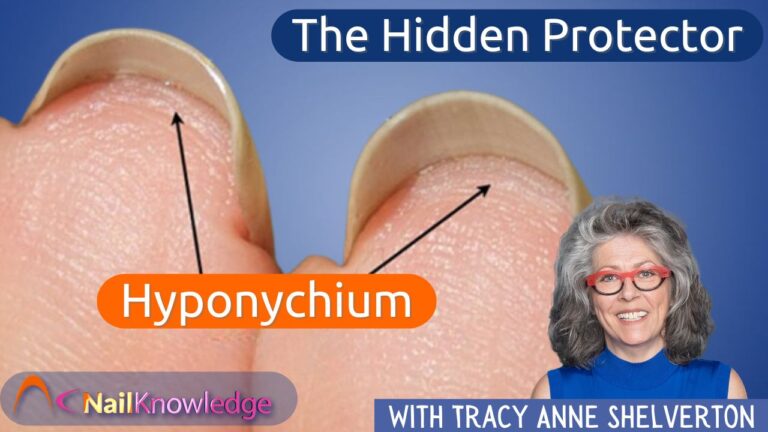
The hyponychium is the area of skin right under the free edge of the nail plate—the part of the nail that extends past the fingertip. Think of it as the gatekeeper of the nail unit, forming a seal that keeps harmful bacteria, pathogens, and allergens out. It might look small and simple, but it plays a big role in keeping the sensitive areas of the nail bed and matrix protected. Neglecting this area could leave your clients vulnerable to infections or other nail issues, which brings us to our next point.

Why Should Nail Techs Care About the Hyponychium?

As nail professionals, your clients rely on you to not only make their nails look great but also to keep them healthy. The hyponychium is packed with nerve endings—sort of like a security system for the nail. If this protective seal is broken, those nerve endings kick into gear, alerting the body with discomfort or pain. This should be your first clue that something isn’t right. A compromised hyponychium can open the door for bacteria, fungal infections, and even onycholysis (when the nail plate starts separating from the nail bed).

In short: a healthy hyponychium means happy, healthy nails. And that means happy clients.

Signs the Hyponychium Needs Attention

As a nail tech, knowing the signs of hyponychium issues can prevent bigger problems down the line. Here are a few things to look out for:

  • Thickening or Discoloration: If the hyponychium starts to thicken or change color, it could be a sign of an infection. If a fungal infection is suspected, test to know for sure and treat accordingly.
  • Pain or Discomfort: Your client mentions sensitivity or pain around the free edge—this could indicate that the seal has been compromised.
  • Onycholysis: If you notice the nail lifting from the nail bed, that’s a major red flag. This condition often stems from a damaged hyponychium and can lead to a more serious infection if not addressed.

The Impact of Hyponychium on Nail Health

If the hyponychium is compromised, it doesn’t just affect the appearance of the nails—it can cause real health concerns for your client. Infections can develop, and untreated issues can even lead to long-term damage to the nail matrix. You don’t want that for your clients, and they don’t want to deal with it either.

So how do you protect this important area? Gentle handling of the nails is key. Over-filing the free edge or using tools too aggressively can damage the hyponychium. Also, make sure to encourage your clients to avoid bad habits like nail-picking, which can break the seal and invite infection.

Good Nail Hygiene is your Best Defense.

Here’s what you can do as a nail professional to maintain a strong and healthy hyponychium for your clients:

  1. Gentle Filing: When shaping nails, avoid over-filing near the free edge to protect the hyponychium.
  2. Clean but Careful: Keep the nail area clean, but avoid poking or pushing too hard on the hyponychium.
  3. Watch for Signs of Infection: Always be on the lookout for discoloration, thickening, or signs of discomfort.
  4. Educate Clients: Teach your clients about the importance of the hyponychium and proper nail care routines to keep this area intact.
  5. Nail Unit Maintenance: When applying oil, do so at the back side of the free edge, this way the oil first soaks around the hyponychium before it makes its way along the lateral nail folds to the PNF.

Final Thoughts: Don’t Overlook the Hyponychium

As a nail professional, your expertise goes beyond just aesthetics—your job is to protect the health of your clients’ nails. The hyponychium may be hidden, but it plays a critical role in nail health. By giving this small but mighty structure the attention it deserves, you’re ensuring your clients not only walk away with beautiful nails but with nails that are strong and healthy from the inside out.

So, next time you’re prepping a client’s nails, take a moment to think about the hyponychium.

It’s not just another part of the nail—it’s the silent protector that makes all the difference.

Filed Under: General Information, Nail Services

Understanding the Eponychium vs. Cuticle

Have you ever been completely puzzled by nail terms thrown around in salons, classrooms, educational materials, or on social media channels?

You’re not alone! Today, we’re cracking the case on two often misunderstood heroes of nail anatomy: the eponychium and the cuticle. Ever mixed these two up? Let’s sort them out once and for all!

What is the Eponychium?

So, what exactly is the eponychium? Imagine it as a thin layer of specialized skin cells hidden underneath the proximal nail fold. It plays a crucial role in nail health, primarily responsible for producing the cuticle. Its main job? To form a protective barrier of non-living skin cells that shields your nail matrix from bacteria and germs—often referred to as opportunistic pathogens. Think of the eponychium as the mastermind behind the club’s security, keeping those unwanted guests out. Without its protection, your nails would be vulnerable to all sorts of intruders!

The Eponychium
Taken from our Animated Course The Essential Nail Diploma

What is the Cuticle?

Moving on to the cuticle—this is the part many people think they know.

The cuticle is actually non-living skin that adheres tightly to your nail plate. If you think of the eponychium as the mastermind behind the club’s security, then the cuticle is the bouncer at the door. Why is this important? The cuticle forms a protective seal that prevents harmful agents from sneaking under your nail or reaching the crucial area of nail plate cell production. When this seal remains intact, your nail matrix is protected, continuously producing nail plate cells. Just as closing the door of a plane before take-off is crucial, maintaining the integrity of this cuticle seal is vital for the health of your nails—without it, there would be no nail plate!

The Nail Cuticle
Taken from our Animated Course The Essential Nail Diploma

Why the Confusion?

Now, you might wonder, why all the mix-up between the two? It’s easy to see why they’re often mistaken for one another—they’re neighbours, after all! Both reside in the same nail neighbourhood and work together to keep your nails looking fabulous and healthy. Plus, let’s be honest, even seasoned nail techs can find nail biology terms confusing, particularly when the focus is more on delivering a flawless mani-pedi than on discussing the finer points of nail anatomy.

The Importance of Distinguishing Between the Eponychium and Cuticle

Understanding the difference between the eponychium and the cuticle isn’t just nail tech jargon, it’s essential for proper nail care. Ever heard someone suggest cutting the cuticle? They might actually mean trimming excess living tissue that has dried out at the proximal nail fold as its almost impossible to trim the cuticle The good news is we can remove the cuticle safely from the nail plate with a quality oil and a curette, no scissors and no pain, just gorgeous nail plates ready for your favourite nail product. Knowing what’s what helps you avoid damaging your nails and ensures you’re actually taking care of them correctly. Would you rather treat your nails like delicate silk or just any old fabric? I thought so!

Further your Expertise on the Eponychium

Interested in enhancing your professional knowledge?  Why not explore our detailed master article on the eponychium. This resource is tailored for nail technicians seeking to deepen their understanding of nail anatomy, ensuring precision and care in every procedure. Equip yourself with expert insights that elevate your practice above the rest. Our Knowledge Base serves as a comprehensive resource for all things related to nails!  

Conclusion

As a nail professional, whether you’re at your station in a salon or setting up for a client visit, keep these insights in mind. Understanding the difference between the eponychium and the cuticle is essential for avoiding common nail care errors that could affect your work and client satisfaction.

Filed Under: BLOG, General Information, Myth Busting, Nail Technology

Understand Seven Important Properties of Natural and Artificial Nails – Part 2 Hardness

Hardness: The Second Key Property of Natural and Artificial Nails

What is Hardness?

Hardness is often confused with strength, yet it’s important to distinguish between these two properties. Hardness specifically refers to a substance’s ability to resist surface scratching or denting. For example, glass is easy to shatter yet has a very hard surface. Diamonds, recognized as the hardest natural substance, can scratch glass and many other materials because of their superior hardness.

When it comes to nails, both natural and artificial, the level of hardness determines how likely they are to withstand surface damage such as scratches, stains, or peeling. The hardness of a nail can be noticeably different when it becomes softer than normal, making it more vulnerable to these issues, particularly during the removal of artificial nail coatings.

Why Hardness Matters for Nail Plates

Nail plates require a balanced level of hardness. If too hard, nails can become brittle, leading to issues like cracking and splitting. Conversely, overly soft nails are susceptible to peeling and damage from routine activities. Therefore, understanding and maintaining the correct hardness is crucial for the health and aesthetics of nail plates.

The comparison between nail plates and other materials can be quite illustrative. For instance, although a diamond is extremely hard, it isn’t necessarily the ideal hardness for a nail plate. Imagine nails as hard as diamonds; they would resist scratching but could become excessively brittle and impractical for everyday use.

The Impact of Nail Hardeners

Nail hardeners are products designed to increase the hardness of the nail plates. However, they should be used judiciously. Excessive or prolonged use of hardeners can lead nails to become too hard and brittle. Ideally, nail hardeners should only be used to achieve a desirable level of rigidity, and their use should be discontinued once this is achieved.

This concept aligns with the balance sought in other areas of life and nature. As Confucius famously said, “The green reed which bends in the wind is stronger than the mighty oak which breaks in a storm.” This analogy highlights the importance of flexibility within hardness; nails should have enough hardness to resist superficial damage but maintain enough flexibility to avoid breakage under stress.

Considerations for Artificial Nail Coatings

Artificial nails also need to consider the balance between hardness and flexibility. Overly brittle artificial nails can lead to service breakdown, such as cracking and peeling. On the other hand, if artificial nails are too flexible, they may not provide the desired look or durability. Adjusting the hardness to achieve the right mix of rigidity and flexibility can significantly enhance the performance and longevity of artificial nails.

Balancing Hardness for Optimal Nail Health

Understanding and controlling the hardness of both natural and artificial nails is crucial for ensuring optimal performance and maintaining nail health. It allows nail care professionals to tailor treatments and products to the specific needs of their clients, ensuring both beauty and functionality are achieved.

Explore More Key Properties of Nails in Our 7-Part Series:

  • Nail Strength – Discover how the strength of nails impacts their performance and durability.
  • Nail Hardness – Understand the crucial role of hardness in nail health and how to maintain the perfect balance.
  • Nail Flexibility – Understand the importance of flexibility in preventing nail breakage and maintaining resilience.
  • Nail Toughness – Find out what makes nails tough and how this property differs from strength and hardness.
  • Nail Brittleness – Learn what causes brittleness in nails and how to prevent it.
  • Nail Solvent Resistance – Explore how nails can resist damage from chemicals and solvents.
  • Nail Wear – Understand the factors that affect how well nails withstand regular use and environmental exposure.

Filed Under: General Information, Nail Technology

Understand Seven Important Properties of Natural and Artificial Nails – Part 1 Strength

There are seven important properties of natural and artificial nails that are often responsible for how your nails will behave in real-world situations.

These seven key properties, strength, hardness, flexibility, toughness, brittleness, solvent resistance, and wear are crucial for understanding how both natural and artificial nails perform and behave.

Interestingly, these same properties apply to both natural and artificial nail coatings. For instance, if a client snags their natural or artificial nail on something, how will that nail respond? Will it tear or crack or will it resist being damaged?

This often depends on one or more of these important properties. Let’s review them, so you can have a deeper understanding of how these properties can affect all types of nails.

Properly understanding these properties will help everyone, from nail enthusiasts to professionals, make better choices for nail care and maintenance.

Understanding Nail Strength: The First Key Property of Natural and Artificial Nails

  1. Strength – What is Strength?

We use the word all the time in many ways; everything from the strength of a person’s character to muscle strength training; but nails don’t have muscles.

Of course, they certainly can have lots of character as any fan of nail art knows and they can certainly be strong, in fact they can be too strong, even dangerously strong!

Strength is defined as the ability of a material to “resist breaking under the stress of a heavy load or impact”. Bridges are good examples. They must be strong enough to hold all the crossing cars. In this case, the cars are the heavy load.

Drop a wine glass on a ceramic tile floor and it will not have the strength to resist the impact. For the same reason, a hard-ceramic tile will break if a heavy frying pan were dropped. The strength of a tree branch allows it to resist the extra load created during heavy wind.  Our muscles must be strong enough to resist tearing apart when moving heavy loads. The strength of hair allows it to resist breakage while being brushed.

Why Nail Plates Need Strength—But Not Too Much

Why do nail plates need to be strong?  That is because we use them like tools. All the bending, picking, prying, poking, scratching and clawing we do with our nails is proof of their strength. 

Strength isn’t the only property that nail plates must possess. There are several other important properties to consider. Would you want nails like titanium alloy? It is very strong, but we don’t want or need our nail plates to be that strong. Not so strong that the nail plate would rip away from the nail bed and matrix area if caught on something.  It would be better if it broke instead, since the alternative would not be fun or pleasant and could cause serious, possibly irreversible damage to the nail bed and matrix.  Also, if client’s nails were that hard and inflexible, they could poke out someone’s eye, maybe their own!

Of course, we want strong nails, but not quite that strong. Right?

It is important for the nail plate to break under certain conditions, so they must not be too strong. Nail plates are designed to break at some point before more serious, potentially permanent damage can occur.

The Issue with MMA: Why It’s Too Strong for Artificial Nails

This is one of the problems of the use of methyl methacrylate monomer (MMA), which is sometimes used as an ingredient in certain monomer liquid and polymer powder (L&P) formulations. MMA is too strong. Rather than break when impacted, the force will cause the natural nail to crack, rather than the artificial nail coating.

In other words, an MMA nail coating is too strong to function properly as an artificial nail. There are other problems with the properties of MMA that make it an undesirable ingredient for artificial nails which are discuss in this blog post MMA and the Nail Industry.

Explore More Key Properties of Nails in Our 7-Part Series:

  • Nail Strength – Discover how the strength of nails impacts their performance and durability.
  • Nail Hardness – Understand the crucial role of hardness in nail health and how to maintain the perfect balance.
  • Nail Flexibility – Understand the importance of flexibility in preventing nail breakage and maintaining resilience.
  • Nail Toughness – Find out what makes nails tough and how this property differs from strength and hardness.
  • Nail Brittleness – Learn what causes brittleness in nails and how to prevent it.
  • Nail Solvent Resistance – Explore how nails can resist damage from chemicals and solvents.
  • Nail Wear – Understand the factors that affect how well nails withstand regular use and environmental exposure.

Filed Under: General Information, Nail Services

  • « Go to Previous Page
  • Page 1
  • Page 2
  • Page 3
  • Page 4
  • Page 5
  • Interim pages omitted …
  • Page 30
  • Go to Next Page »

Level Up Your Nail Insights

Join our Newsletter!
SUBSCRIBE...

Copyright © NailKnowledge

NailKnowledge

  • eBooks
  • About us
  • Courses
  • News
  • Blog
  • Newsletter
  • Glossary

Policies

  • Privacy Page
  • Terms & Conditions
  • Cookie Policy

Support

  • Contact Us
  • Ask the Experts
  • System Support
  • FAQs
English
English
Portuguese Spanish Vietnamese